
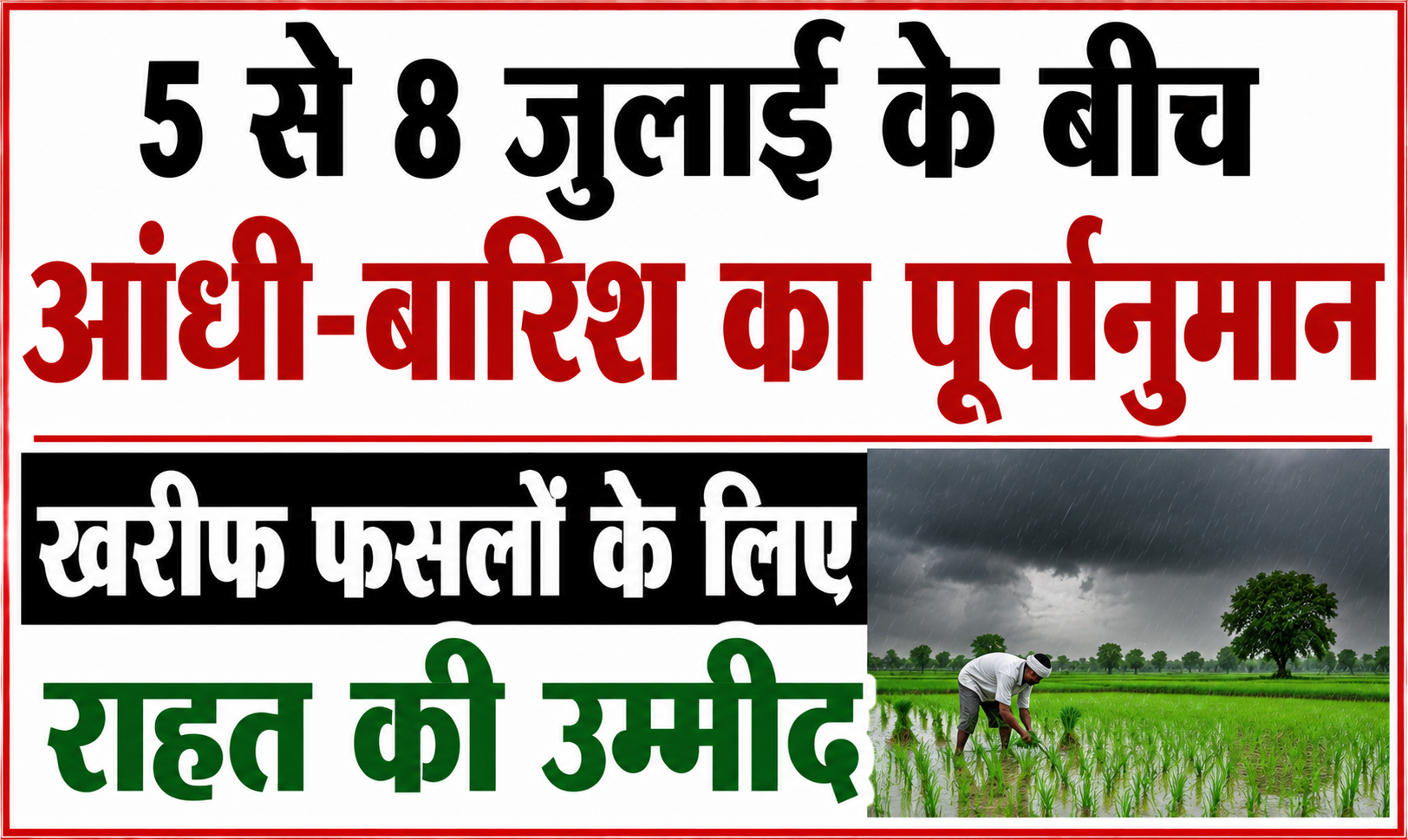
Light Rain and Squalls Predicted Between July 5 and 8; Hope for Kharif Crops
Patna: Relieving news has emerged for the farmers of Bihar. According to the forecast by the Meteorological Department (IMD), there is a possibility of light to moderate rainfall accompanied by squalls in various parts of the state between July 5 and July 8. Signs of the monsoon becoming active again have brought a ray of hope to farmers who have been deeply concerned about Kharif sowing—specifically paddy transplantation—due to extreme heat and deficient rainfall.
Monsoon Picks Up Pace, Relief for Farmers
In the month of June, the state recorded approximately 48% less rainfall than normal, casting a shadow of crisis over Kharif sowing. Now, the Meteorological Department has issued an alert for thunderstorms, lightning, and gusty winds (30–50 km/h) accompanied by rain in districts across North-West and North-Central Bihar. There is also a possibility of heavy rainfall in districts like Darbhanga, East Champaran, Sitamarhi, and West Champaran on July 6 and 7.
Impact on Kharif Crops: What is the Advice from Agricultural Scientists?
After a prolonged dry spell, this spell of rain could act as a lifeline for paddy cultivation. However, agricultural scientists and experts from the Indian Council of Agricultural Research (ICAR) have advised farmers to remain cautious and adopt proper management practices:
Direct Seeded Rice (DSR): In areas where sufficient rain has not yet occurred, farmers can adopt the 'Direct Seeded Rice' technique instead of traditional paddy transplantation, as it requires significantly less water.
Nursery Management: Scientists have emphasized preparing 'Mat-type' or 'Depog' nurseries to ensure better seedlings are ready in a shorter period.
Short-Duration Crops: Given the risk of drought, farmers in regions where the monsoon is weak are advised to pivot toward short-duration crops (such as Moong, Urad, and Sesame).
Water Conservation: Farmers are advised to repair field bunds and increase their height to maximize rainwater harvesting and retain soil moisture for a longer duration.
While the possibility of rain has provided some relief to farmers, experts note that the situation has not fully normalized. Uncertainty remains in the behavior of the monsoon due to the influence of El Niño. If satisfactory rainfall is not received during these four days, the state may face drought-like conditions in the coming weeks.
Administrative Preparedness
The state government's Disaster Management and Agriculture Departments are closely monitoring the situation. Districts have been instructed to keep alternative arrangements for seeds and irrigation ready at the local level.
This period of rainfall is not only crucial for Kharif crops but acts as a lifeline for the state's economy. It remains to be seen how much greenery these raindrops will bring to the farmers' fields over the next few days.


