
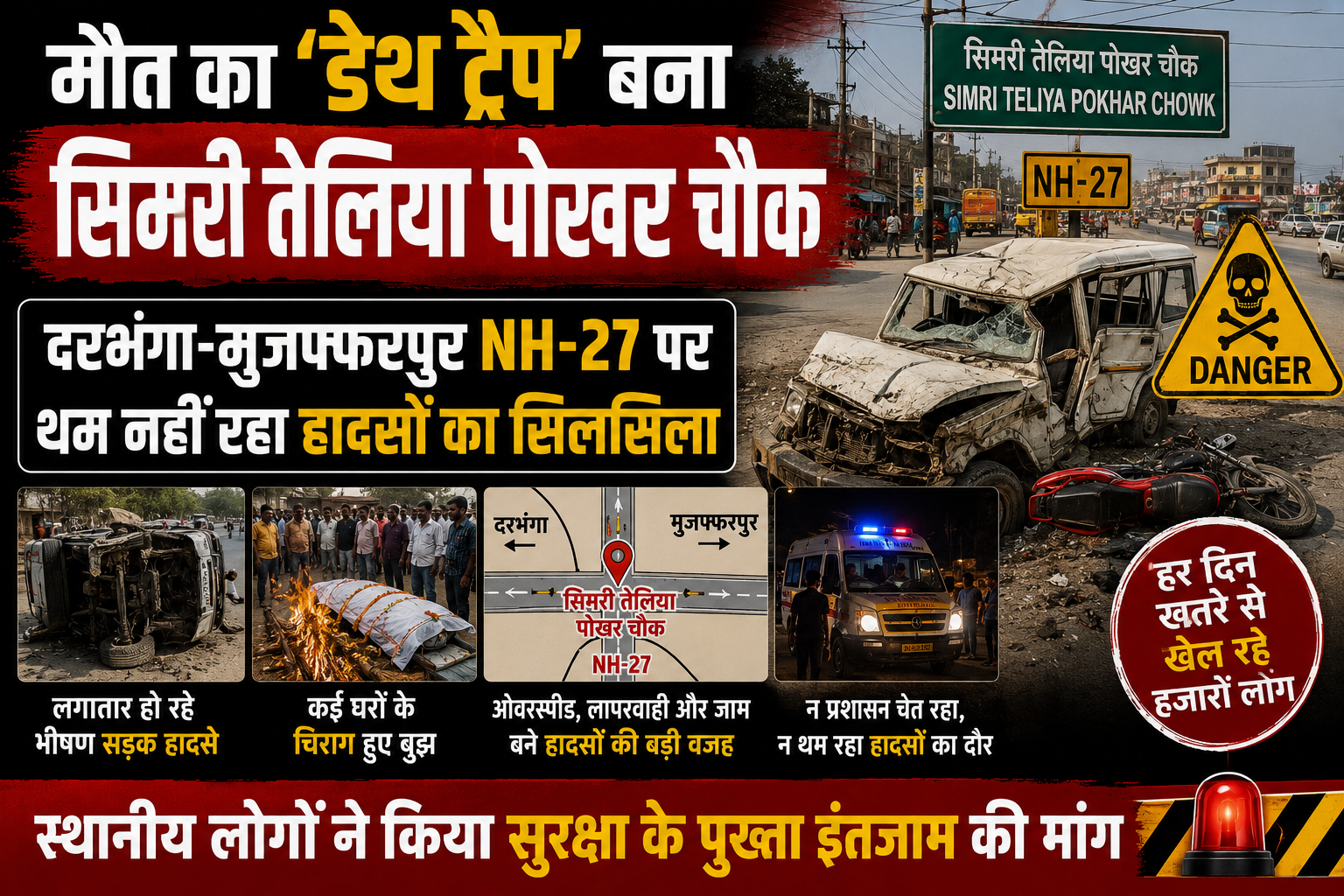
The 'Death Trap' at Simri Telia Pokhar Chowk: Series of Accidents Continues Unabated on NH-27
Darbhanga: Simri Telia Pokhar Chowk, located on National Highway 27 (NH-27)—often called the lifeline connecting Darbhanga and Muzaffarpur—has now become a "death trap" for travelers and local residents. The frequency of road accidents at this intersection has become a matter of grave concern for both the administration and the public. According to data, more than a dozen people have already lost their lives here, and over two dozen individuals have been left seriously injured, many facing permanent disability or lifelong suffering.
The Dark Chapter of Accidents: Why is this Chowk Unsafe?
There are several technical and human factors behind the accidents at Simri Telia Pokhar Chowk that have been consistently overlooked.
Blind Turns and Low Visibility: The design of the intersection is such that vehicles traveling at high speeds on the main highway cannot anticipate vehicles turning suddenly.
Encroachment: Due to illegal shops and roadside encroachment around the chowk, the space available for vehicles to pass safely is severely limited.
Lack of Traffic Signs: There are no speed breakers or adequate warning boards at this location. The lack of street lighting at night makes the intersection even more perilous.
Uncontrolled Speed: As it is a national highway, heavy vehicles pass through at high speeds, forcing the local population and smaller vehicles to risk their lives every time they cross the road.
A Painful History
Local residents state that hardly a month passes without a tragic incident at Simri Telia Pokhar Chowk. Among those who have lost their lives in these accidents are not only youth but also schoolchildren and the elderly. A local villager said with a choked voice, "Last year, three members of the same family lost their lives at this very chowk. Even today, when we cross this intersection, we are gripped by fear."
Questions Over Administrative Apathy
Despite the recurring deaths, the silence from the district administration and the National Highways Authority of India (NHAI) has sparked public outrage.
Local Demands: For months, villagers and panchayat representatives have been demanding the installation of speed breakers, signal lights, and a zebra crossing, but their requests have languished in government offices.
Protests: Villagers have staged multiple road blockades in protest. Every time, officials reach the spot and assure an investigation, but the results remain zero.
What Do Experts Say?
Road safety experts believe that such "Black Spots" need to be identified and improved immediately. Describing Simri Telia Pokhar Chowk as a classic "Black Spot," experts suggest:
Construction of a Roundabout: A roundabout is mandatory at the intersection to regulate traffic flow.
High-Mast Lighting: High-mast lights should be installed to ensure adequate illumination.
Sign Boards: Warning boards should be placed at least 500 meters before the intersection.
The Role and Responsibility of Representatives
In this part of the Singhwara block, the responsibility for safety lies not just with the government but also with local representatives. Residents claim that while every politician makes this an election issue, they forget the intersection once they are elected. Enlightened members of the community have now decided to form a "Road Safety Committee" to pressure the government into action.
The blood spilled at Simri Telia Pokhar Chowk screams that the administration must not wait for more lives to be lost. Violation of road safety norms should not come at the cost of human lives. If the design of this intersection is not modified and safety measures are not implemented in time, this location will prove to be even more lethal.


