


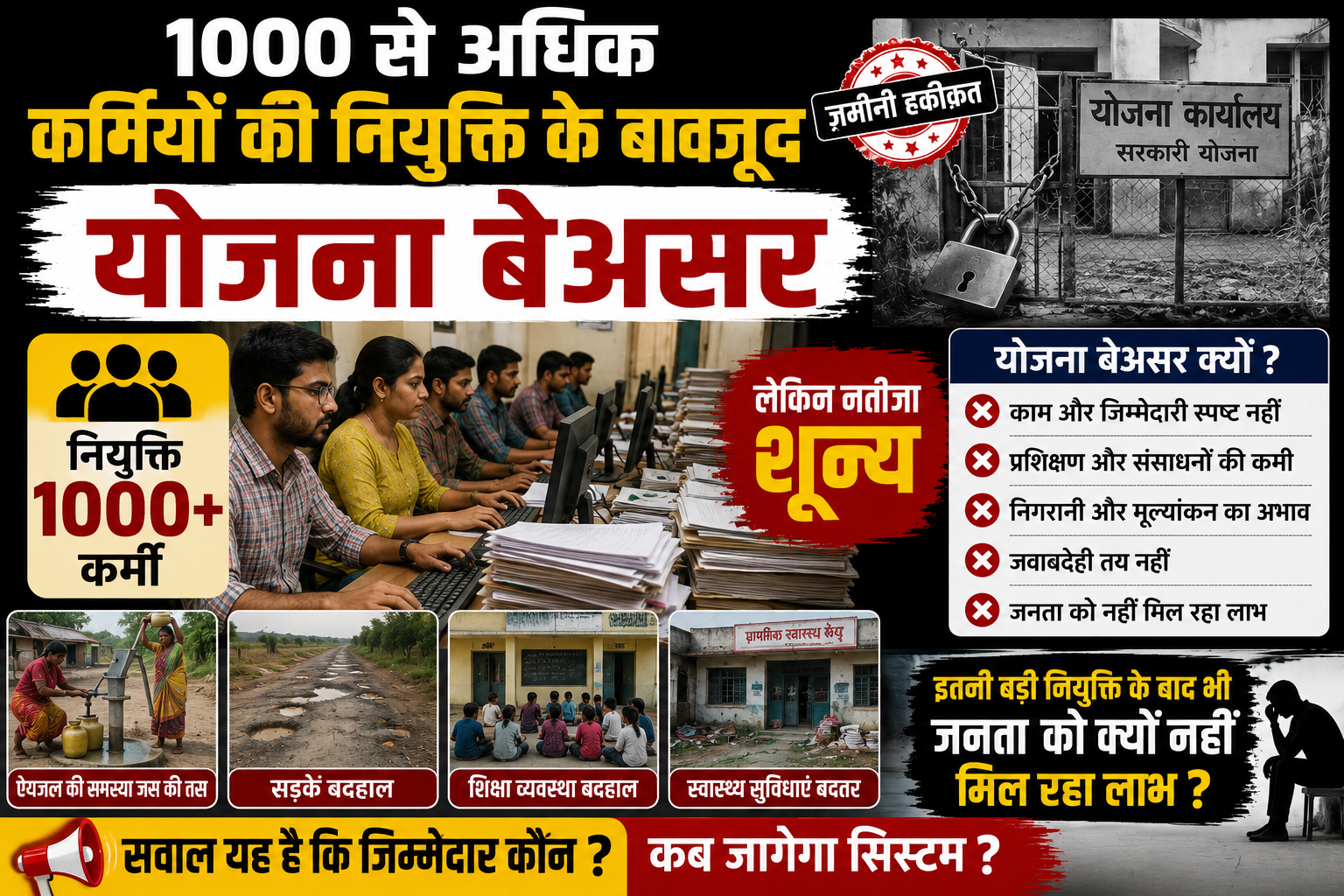
Scheme Proves Ineffective Despite Deployment of Over 1,000 Workers
Munger: The Bihar government is investing crores of rupees under the 'Lohia Swachh Bihar Abhiyan' (LSBA) to make the state clean and beautiful. For the Ganga-coastal Diara region of Munger, a massive force of dozens of supervisors and 1,283 sanitation workers has been deployed. However, the reality on the ground is in stark contrast to these figures on paper. There is no trace of sanitation in the remote areas of Diara, proving the scheme to be entirely ineffective.
1,283 Sanitation Workers on Paper, Silence on the Ground
According to administrative records, a vast team has been constituted to maintain cleanliness in Munger’s Diara region, with a long list of supervisors and 1,283 sanitation workers specifically assigned to the task. Local resident Naveen Kumar Jha points out that for several months, these workers have neither been seen cleaning village lanes nor is there any functional system for waste collection.
Why is this Ambitious Scheme Failing?
Officials are dodging responsibility by citing the geographical challenges of the Diara region. The main reasons for the scheme's failure are as follows:
Lack of Monitoring: Despite the high number of supervisors, surprise inspections are never conducted in the area. 'On-paper' reporting has stifled actual ground-level work.
Shortage of Equipment: The sanitation workers lack both waste-carrying vehicles (e-rickshaws) and the necessary resources for cleaning. They are unable to perform their duties without the required equipment.
Crisis of Accessibility: Since the Diara region is cut off from the main city, no concrete action plan has been formulated for its waste management. There is no designated site for waste dumping, resulting in filth accumulating along the riverbanks.
Lack of Accountability: It is impossible to curb this negligence and potential misappropriation of funds unless the attendance and daily work performed by these 1,283 workers are verified through 'Geo-tagging.'
Waste of Public Funds in the Name of Sanitation
Local residents of Diara allege that a large portion of the budget allocated for sanitation is being spent merely on bureaucratic paperwork. While the honorariums for the workers are being released, the corresponding work is nowhere to be seen.
The Plight of the Villagers: "We are forced to dump our household waste on the riverbanks because no vehicle arrives and no sanitation worker is ever seen, even though our area is recorded as 'clean' in government files."
Administrative Silence and Questions
When attempts were made to contact the relevant district administration officials regarding this matter, instead of a satisfactory response, claims were made that "everything is fine" in the files. The question remains: if 1,283 workers and supervisors are active, why are the lanes of Diara still filled with filth?
Necessary Steps for Improvement
If the government genuinely intends to clean the Diara region, it must undergo a radical change in its methodology:
Social Audit: A social audit of sanitation work should be conducted through the Gram Panchayats.
Performance-Based Payment: Payment to sanitation workers should be ensured based not just on their attendance, but on the actual cleaning work performed.
Distribution of Resources: The dream of doorstep waste collection cannot be realized until e-rickshaws and dustbins reach every lane.
Accountability of Supervisors: There should be a provision for salary deductions for supervisors if filth is found within their designated areas.
Munger’s Diara region remains a victim of neglect. Crores from the government budget are being spent in the name of sanitation, but the results are zero. The existence of 1,283 sanitation workers has remained a mere game of statistics. If this situation does not improve, it will not only be a waste of public funds but also an insult to the campaign envisioned by the Prime Minister and the Chief Minister for a 'Swachh Bharat.'