
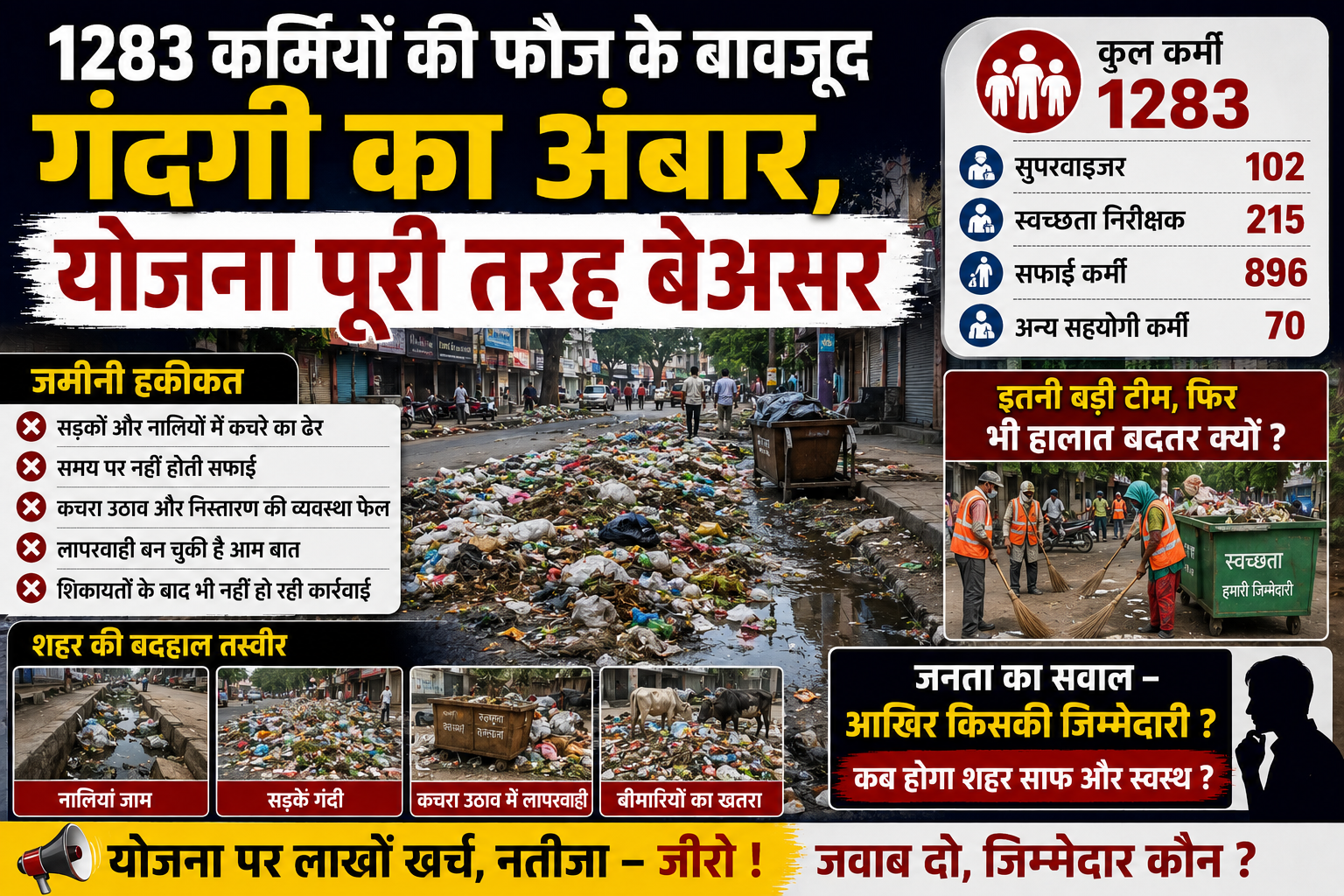
Mountain of Filth Despite a Force of 1,283 Workers; Scheme Proves Completely Ineffective
Munger: The vision of the 'Lohia Swachh Bihar Abhiyan' (LSBA), launched by the Bihar government to make the state clean and beautiful, has completely faded in the Ganga-coastal Diara region of Munger. If government statistics are to be believed, a massive force has been deployed to keep the sanitation system in order—dozens of supervisors and 1,283 sanitation workers. However, the gap between these massive figures and the ground reality is so profound that the scheme is proving to be entirely ineffective in the region.
A Web of Statistics and Silence on the Ground
In administrative files, the appointment of sanitation workers for Munger’s Diara region is recorded as a major achievement. 1,283 sanitation workers have been assigned specific tasks to ensure garbage collection from every village and to keep the lanes clean. But when correspondent Naveen Kumar Jha visited the area, the scene was entirely different.
Mountains of garbage are piled up in the narrow lanes of the Diara villages. Sewage water is flowing onto the roads, and the filth in public spaces has increased the risk of diseases. Local residents state that they have not seen any sanitation worker sweeping or collecting garbage for months.
Main Reasons for the Failure of the Scheme
The geographical location of Diara and administrative apathy have turned this scheme into a "white elephant." The main reasons are analyzed below:
Lack of Monitoring
While supervisors have been appointed, their presence is negligible. These supervisors, who report sanitation status 'on-paper,' never conduct surprise inspections of the area. The lack of administrative accountability is the root cause of this failure.
Severe Lack of Resources
Merely appointing sanitation workers is not enough. They lack the essential e-rickshaws, dustbins, gloves, and other cleaning tools required for waste collection. When workers do not have resources, how can they perform their duties?
Geographical Challenge vs. Administrative Apathy
The Diara region is cut off from the main city, but the administration uses this as an excuse to sit idle. There is no concrete place for waste dumping, due to which work is being done merely for the sake of fulfilling formalities.
Lack of 'Geo-tagging' and Transparency
In today's digital era, if the attendance and daily tasks of these 1,283 workers were 'Geo-tagged,' the truth would be revealed immediately. However, due to a lack of transparency, this process has not yet been initiated.
What do the local residents say?
The anger of the villagers in Diara is evident. They say that their area might have been declared 'ODF' (Open Defecation Free) or 'Clean' in government records, but the reality is that they are forced to live amidst filth.
The Plight of the Villagers: "We demand cleaning every time, but we only receive assurances. When sanitation workers are deployed in government files, then who is actually doing the work? Or is this just a means to siphon off salaries?"
Corrective Steps: What should be done now?
If the administration truly wants to change the face of Diara, it must move away from the old path and adopt new measures:
Social Audit: A social audit of sanitation work should be conducted in every Panchayat, where villagers themselves check the quality of the cleaning work.
Performance-Based Payment: Salary should be paid not just on attendance, but on the performance of work. If there is no cleanliness, payments should be stopped.
Availability of Resources: First and foremost, a foolproof system for doorstep collection and e-rickshaws for waste transport must be ensured.
Accountability of Supervisors: If filth is found in any ward or village, the concerned supervisor should be held directly responsible and punitive action should be taken against them.
The Diara region of Munger has become a prime example of the 'game' being played in the name of the sanitation campaign. The appointment of 1,283 workers has remained just a number, with no positive impact on public life. The success of the sanitation campaign cannot be achieved until the administrative machinery comes out of its 'file culture' and adopts a 'field culture.'


