
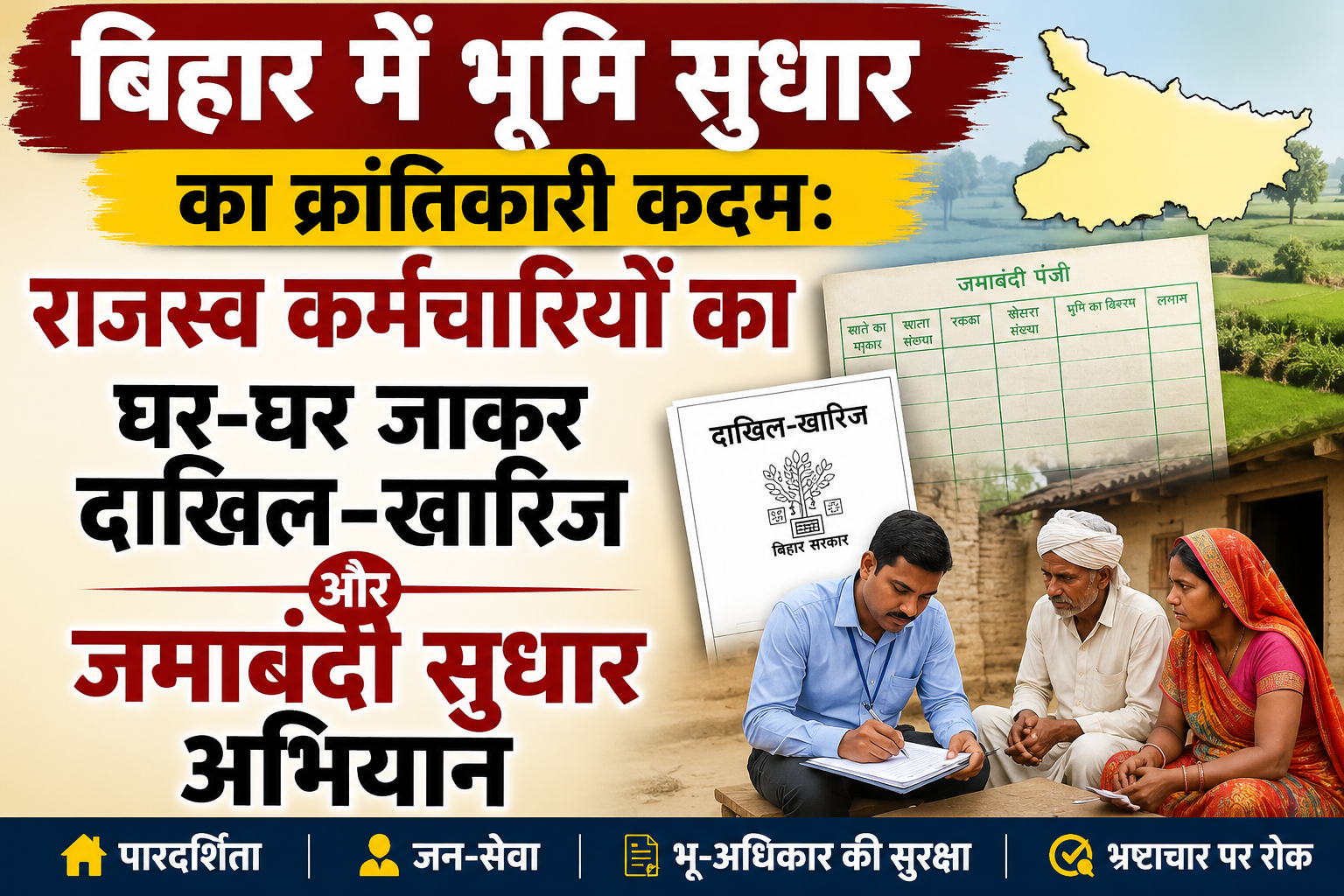
A Revolutionary Step in Land Reform in Bihar: Revenue Employees Conducting Door-to-Door Mutation and Jamabandi Correction Campaign
To make land management and revenue administration transparent, simplified, and citizen-friendly in Bihar, the state government and the Department of Revenue and Land Reform have launched a historic and unprecedented initiative. It has often been observed that old jamabandis (land record accounts) remained pending for years in the names of deceased raiyats (landowners). This caused massive difficulties for families in dealing with mutual disputes, court litigation, and availing the benefits of various government welfare schemes or agricultural aids. The general public had to make endless rounds of circle offices and often fell victim to the exploitation of middlemen and brokers. As a permanent solution to this grave issue, revenue employees themselves are now going door-to-door to advance the process of succession and partition-related mutations.
The Age-Old Problem: The Crisis of Pending Jamabandis in Deceased Raiyats' Names
When the original owner or former raiyat of a piece of land passes away in any family, getting the mutation (namantaran) done in the names of their legal heirs is legally mandatory. However, due to a lack of awareness, complex paperwork, and apathy from circle offices, this process used to remain stalled for years.
Family Discord and Disputes: Due to multiple claimants for the same piece of land or failure to record genealogical succession on time, bloody feuds and household conflicts among siblings and relatives had become common.
The Burden of Litigation: A major portion of civil suits related to land in courts stems from the failure to update the proper division or name change of a deceased person's property in legal records on time.
Obstacles in Government Schemes: To receive agricultural and land-based governmental benefits like PM-Kisan Samman Nidhi, crop assistance schemes, Kisan Credit Card (KCC), or other aids, the concerned individual's name must be listed on the portal as a living and updated raiyat. Farmers were deprived of these benefits due to outdated jamabandis.
The New System: Revenue Mega-Campaign and Employees Reaching Doorsteps
To eliminate this severe administrative bottleneck, the Bihar government expanded the scope of the Revenue Mega-Campaign and initiated ground-level operations. Under this, revenue and halka employees are reaching out directly to the citizens' doorsteps.
Door-to-Door Distribution of Documents and Forms: Revenue personnel are visiting homes to provide forms and pamphlets related to succession mutation and family partition mutation.
Availability of Jamabandi Copies: Online computerized Register-2 and copies of old jamabandis are being handed directly to the raiyats so they can inspect whether there are any errors or omissions in their ancestors' records.
On-Spot Applications and Corrections: If any error is found in a document or jamabandi entry, the employees are taking immediate cognizance on the spot and completing the application process for rectification or correction (parimarjan).
Nature of the Process: Simplification of Succession and Partition
The government has further streamlined the digital system on the 'Biharbhumi' portal. During this door-to-door campaign, the employees are paying special attention to the following stages:
Succession Mutation (Inheritance Mutation): The process of recording names based on the consensus and genealogy of all legal heirs (sons, daughters, wife, etc.) of the deceased raiyat is initiated without any fee or hassle.
Partition Mutation: If family members wish to determine their respective shares of land by mutual consent, the corresponding form is filled out, and separate plots and acreage are recorded in the digital database.
Affidavits and Evidence: Necessary affidavits and death-related paperwork are collected during the campaign itself, sparing the raiyats from making repeated visits to government offices.
Impact on the General Public and the Way Forward
This citizen-centric campaign by the government has brought about unprecedented positive changes in rural areas. Land dispute litigation is expected to decrease significantly because when land records are rectified transparently right from home, the scope for arbitrary manipulation vanishes automatically. The influence of middlemen in circle offices has started to break, and the image of the governance system is emerging as a helpful administration. If this campaign is implemented with absolute dedication, Bihar's land management system can set an exemplary model for the entire country.


