
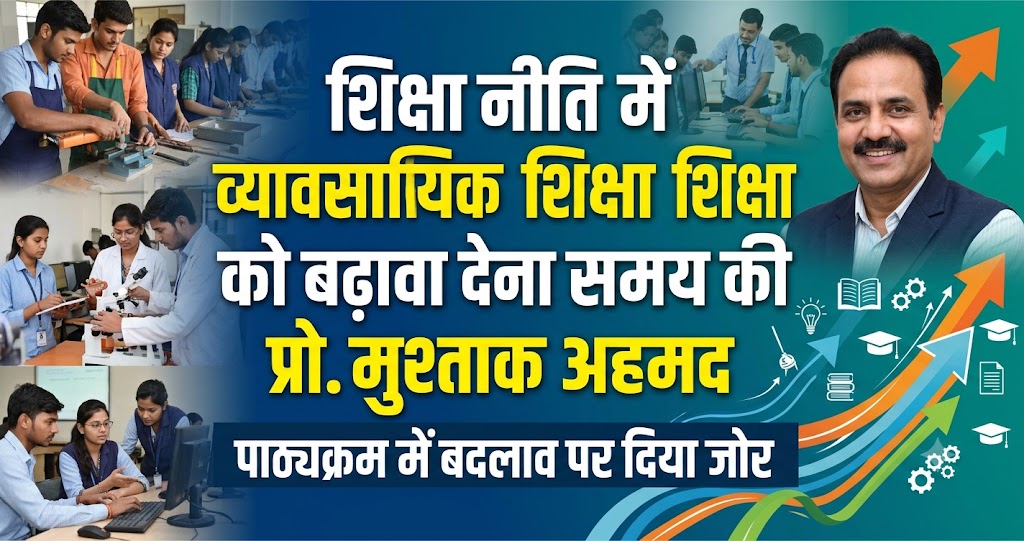
Vocational Education Must Be Prioritized Under the New Education Policy, Says Prof. Mushtaq Ahmad; Institutions Urged to Revise Curricula
Staff Correspondent: India's education system is undergoing significant transformation in response to rapid technological advancements, changing industry requirements, and evolving employment opportunities. One of the most notable developments in recent years has been the growing emphasis on vocational education, which is now regarded as a key component of the country's education policy. Education experts believe that traditional academic learning alone is no longer sufficient, and students must also acquire practical skills to remain competitive in the modern job market.
Speaking at an academic programme on the subject, Prof. Mushtaq Ahmad emphasized that educational institutions must revise their curricula, teaching methods, and training systems in line with the objectives of the National Education Policy (NEP). He stated that institutions that fail to adapt to changing educational and industrial needs may struggle to prepare students for future careers.
The event was also attended by Dr. Javed H... and several academicians, researchers, and educators, who highlighted the importance of making education more practical, skill-oriented, and aligned with industry requirements.
Growing Importance of Vocational Education
In his address, Prof. Mushtaq Ahmad said that earning a degree alone is no longer enough in today's competitive environment. Industries across manufacturing, technology, business, and the service sector increasingly seek graduates with practical knowledge, technical expertise, and problem-solving abilities.
He explained that vocational education not only improves employability but also encourages entrepreneurship and self-employment among young people.
Objectives of the New Education Policy
The speakers noted that one of the primary goals of the National Education Policy is to move beyond examination-centered learning and equip students with skills required for both employment and everyday life.
The policy encourages educational institutions to integrate skill development, internships, entrepreneurship, digital learning, and vocational training into their academic programmes.
Need to Revise Academic Curricula
Prof. Mushtaq Ahmad observed that many educational institutions continue to follow outdated curricula, while the employment landscape is evolving rapidly.
He recommended incorporating subjects such as digital technologies, artificial intelligence (AI), data analytics, communication skills, entrepreneurship, and industry-based practical training into academic programmes.
Stronger Collaboration Between Education and Industry
Experts stressed the need for closer cooperation between educational institutions and industries.
They argued that providing students with internships, industrial exposure, and hands-on training during their studies would significantly improve their employment prospects after graduation.
Greater Focus on Skill Development
The speakers emphasized that future success will depend not only on academic qualifications but also on practical competencies.
They encouraged institutions to develop students' communication skills, leadership qualities, teamwork, critical thinking, digital literacy, innovation, and problem-solving abilities.
Teachers Have a Crucial Role
Prof. Mushtaq Ahmad highlighted the important role teachers play in successfully implementing the National Education Policy.
He urged educators to undergo regular professional training, adopt modern teaching techniques, and promote innovation-driven learning in classrooms.
Dr. Javed H... Shares His Views
During the programme, Dr. Javed H... stated that the purpose of education should extend beyond awarding degrees. Instead, it should empower students to become self-reliant and professionally competent.
He remarked that aligning education with the evolving needs of the job market would create greater opportunities for both employment and entrepreneurship.
Increasing Significance of Digital Learning
The speakers also discussed the growing importance of online education, e-learning platforms, virtual laboratories, and digital educational resources.
They noted that technology-enabled learning provides students with access to global knowledge, advanced learning tools, and flexible educational opportunities.
Promoting Research and Innovation
The National Education Policy also places significant emphasis on research, innovation, and startup culture.
Education experts believe that creating a supportive environment for research and innovation will enable students to develop creative solutions and contribute to the country's economic and technological progress.
New Opportunities for Students
The expansion of vocational education is expected to create better career opportunities in sectors such as information technology, healthcare, agriculture, tourism, manufacturing, banking, design, media, and various service industries.
Skill-based education will also encourage young people to establish their own businesses and pursue entrepreneurial ventures.
Recommendations for Educational Institutions
The experts recommended that educational institutions should:
- Regularly update curricula to meet industry requirements.
- Strengthen vocational and skill-based training programmes.
- Expand internship and apprenticeship opportunities.
- Increase the use of digital technologies in teaching.
- Invite industry experts for regular academic interactions.
- Encourage research, innovation, and entrepreneurial initiatives.
The speakers concluded that prioritizing vocational education has become essential for preparing India's youth for future opportunities. Prof. Mushtaq Ahmad urged educational institutions to modernize their curricula and teaching methods in accordance with the National Education Policy, while Dr. Javed H... emphasized the need to make education more employment-oriented and skill-based.
According to the experts, timely curriculum reforms, stronger collaboration between academia and industry, and greater emphasis on practical learning will equip students with the knowledge and skills needed to compete successfully in the global workforce while contributing to the nation's economic growth.


