

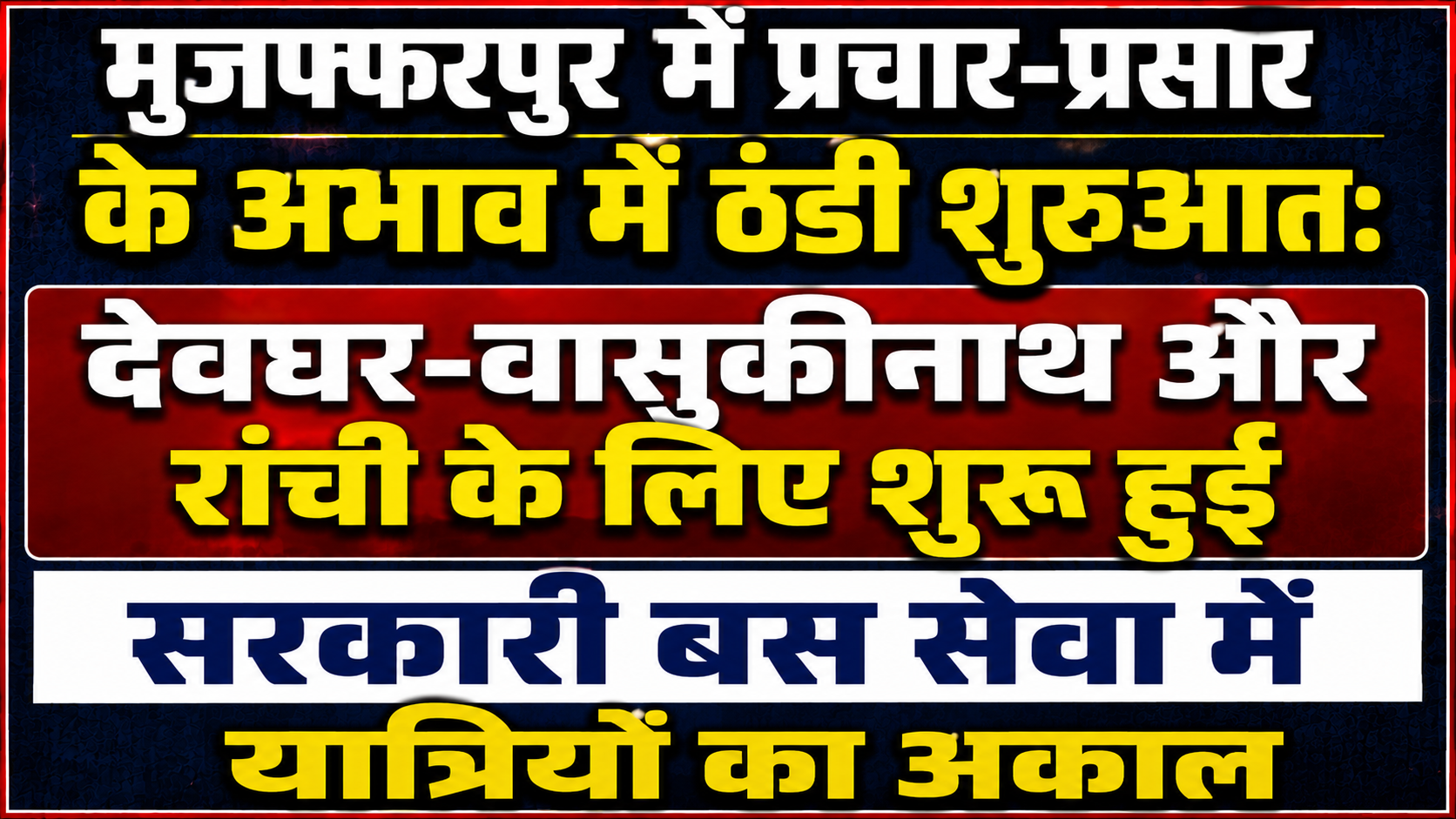
A Chilly Start Due to Lack of Publicity in Muzaffarpur: Famine of Passengers in Government Bus Service Started for Deoghar-Basukinath and Ranchi
Muzaffarpur: A major lapse has come to light regarding the new government bus service launched by the Bihar State Road Transport Corporation (BSRTC) from Bihar's Muzaffarpur district to Jharkhand's major religious and commercial centers—Deoghar, Basukinath, and Ranchi. Initiated amidst the holy month of Sawan and tall administrative claims, this much-awaited bus service was flagged off completely without any publicity, exposing the flaws of the scheme right on its very first day.
Due to the lack of publicity and the failure to timely convey information to the general public, the passenger count on the buses on day one was deeply disappointing. The situation was such that while only a couple of dozen kanwarias boarded the buses heading towards Sultanganj and Deoghar, the luxury government bus departing for Ranchi carried only 19 passengers. Let us read the details of this entire report to see how administrative sluggishness is making a good initiative fall flat.
What is the Overall Plan and Why Was This Bus Service Started?
The Bihar Government and the Transport Department have been continuously striving to provide direct, safe, and economical bus service between various districts of the state and major religious sites and capital cities. Especially considering the massive rush of kanwarias heading to Deoghar and Basukinath during the month of Sawan, a direct bus service from Muzaffarpur had been in demand for a long time.
Convenience for Kanwarias: Every year, millions of Shiva devotees from Muzaffarpur and surrounding districts fetch water from Sultanganj to perform jalabhishek of Baba in Deoghar and Basukinath. This special bus service was initiated with the objective of providing them a hassle-free journey.
Connectivity to Ranchi: There is a constant demand for direct buses from Muzaffarpur to Jharkhand's capital, Ranchi, from both commercial and educational perspectives.
However, despite such an important and utilitarian scheme coming to the ground, the lackadaisical work style of departmental officials dampened its launch.
State of Day One: Two Dozen Kanwarias to Sultanganj, Only 19 Passengers in Ranchi Bus
When the buses for Deoghar-Basukinath and Ranchi started their journey at the scheduled time from the Muzaffarpur bus stand (or designated boarding point), the internal sight was startling.
Deoghar-Basukinath and Sultanganj Route: Despite it being the second and third week of Sawan, when private vehicles and trains were overflowing with heavy crowds of kanwarias, only about two dozen (roughly 24-25) kanwarias boarded the government bus for Sultanganj on the first day. Dozens of seats remained vacant inside the bus.
Ranchi Route Bus: The condition of the government bus departing for Ranchi was even more pathetic. Considered spacious and comfortable, this bus carried far fewer passengers than its capacity—only 19 passengers were traveling on it.
Seeing these buses running with empty seats has drawn lines of worry on the foreheads of transport department officials. The question being raised is why information regarding such government and corporation-run schemes is not reached out to the general public before their launch.
Lack of Publicity: The Biggest Negligence
The biggest reason behind this dismal start is considered to be the complete lack of publicity. Information regarding any new transport service, its fare, time table, and route chart should have been communicated to the general public through newspapers, social media, loudspeakers at the bus stand, or hoardings.
Information Gap: Ordinary citizens, daily commuters, and kanwarias of Muzaffarpur had no inkling that a new government bus service to Deoghar, Basukinath, and Ranchi had commenced from Muzaffarpur.
Confusion at Ticket Counters: By the time passengers arriving at the bus stand learned about this service, the buses were already on the verge of departure. Due to a lack of proper route charts and timing information, people continued to opt for old and private vehicles.
Departmental Apathy: Local officials of the transport corporation flagged off the buses, but paid no attention to their advertising and marketing, paying the price on day one in the form of running empty buses.
Passengers' Reaction and Dissatisfaction
When some passengers and kanwarias present at the Muzaffarpur bus stand were spoken to, they openly expressed their resentment.
One kanwaria shared, "We were looking for a train or private vehicle to go to Sultanganj. Had we known in advance that a direct bus service was being run by the government, we would have taken it. We only found out about it after reaching the bus stand, but by then it was too late."
Another daily commuter stated that government schemes look very grand on paper, but bureaucracy heavily weighs down their implementation and publicity. Had pamphlets been printed on time or timetables provided in local media, the buses would have been full on day first itself.
Response of the Transport Department and Administration
After the matter gained traction and news reports surfaced, the slumber of the transport corporation officials finally broke. Officials claim that this service has just been newly launched, so it is taking a little time for passengers to get acquainted with it in the initial days.
The department has assured that in the coming days:
Publicity Will Be Increased: Large banners and posters will be put up at the bus stand so incoming and outgoing passengers can get complete information about routes and timings.
Promotion of Fares and Facilities: Fares, departure times, and amenities of the buses will be promoted through social media and local news channels.
Continuity Will Be Maintained: Despite low passenger turnout, the operation of the buses will not be stopped for now, so that people gradually get accustomed to it.
This experience of the government bus service started from Muzaffarpur to Deoghar-Basukinath and Ranchi serves as a precise example of administrative negligence. No matter how good schemes are, if they are not publicized in a timely manner and made accessible to the public, their purpose fails. If this service started for kanwarias on the auspicious occasion of Sawan is to be brought on track, the transport department must immediately engage in war-footing marketing, otherwise this scheme is headed towards closure within a few days.