


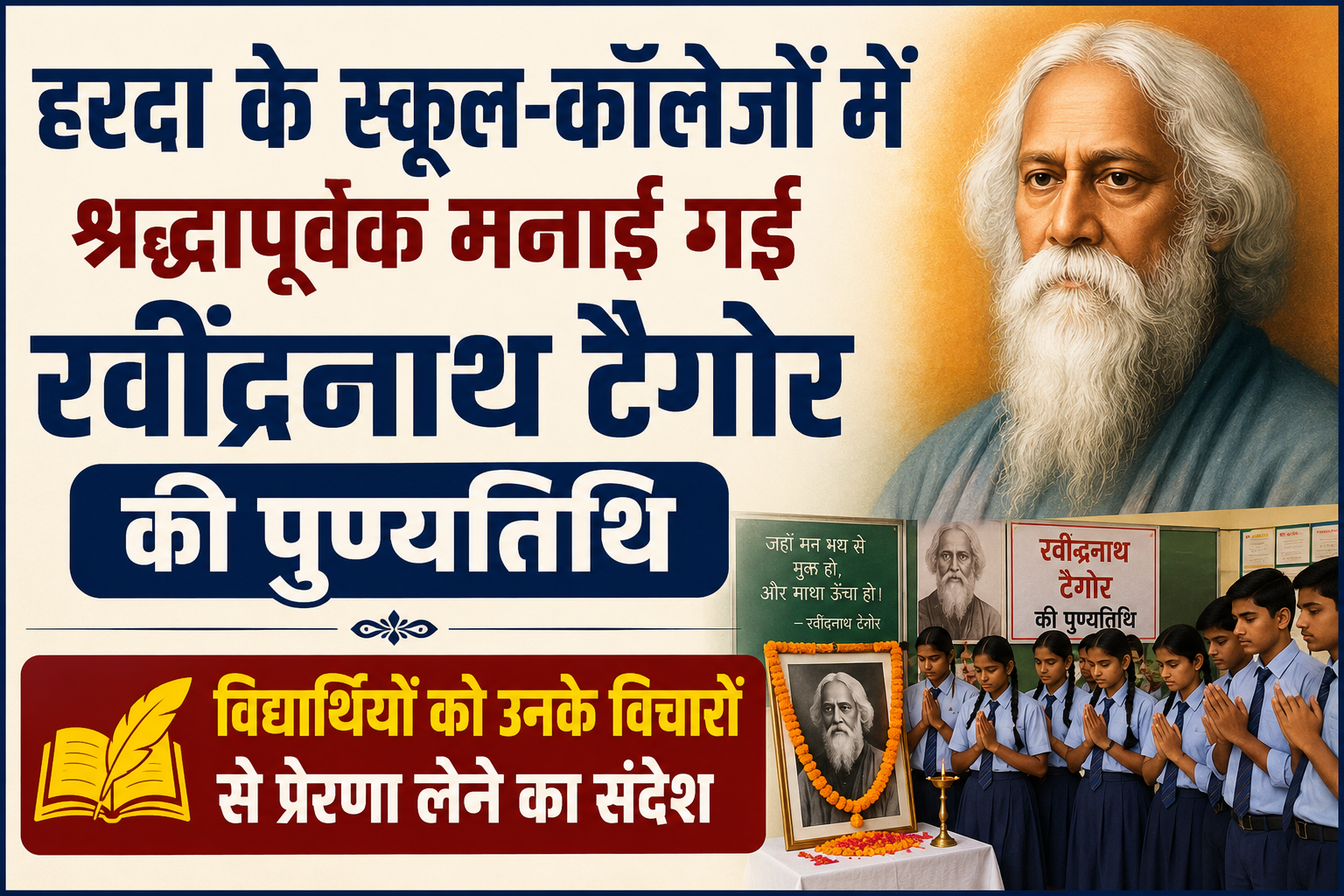
Rabindranath Tagore’s Death Anniversary Observed with Reverence in Schools and Colleges, Students Urged to Draw Inspiration from His Ideas
Harda: The death anniversary of renowned poet, writer, philosopher and Nobel laureate Rabindranath Tagore was observed with reverence at various schools and colleges across the Harda region. Teachers, students and staff members paid floral tributes to Tagore’s portrait and remembered his immense contributions to literature, education and society. During the programmes, speakers highlighted the relevance of Tagore’s literary and educational ideas and urged students to draw inspiration from his life and philosophy.
Speakers said that Rabindranath Tagore was not only a great poet and literary figure but also a strong advocate of education, humanity, nature and independent thinking. His writings and ideas continue to influence Indian society and literature. Students were encouraged to understand his philosophy and incorporate his values into their lives.
Floral Tributes Paid to Tagore
The programmes organised at various schools and colleges began with the garlanding of Rabindranath Tagore’s portrait and the offering of floral tributes. Teachers and students remembered his personality, literary achievements and contribution to Indian culture.
At several institutions, students recited excerpts from Tagore’s poems and literary works. Discussions, speeches and cultural programmes were also organised at some places. Students spoke about Tagore’s life, his literary journey and his contribution to education.
Teachers told students that Tagore’s life represented continuous learning, creativity and a commitment to making society better. They said his ideas remain relevant for students even today.
Immense Contribution to Literature
Rabindranath Tagore made an extensive contribution to Indian literature. He wrote poetry, short stories, novels, plays, songs and essays, among other literary forms. His writings frequently explored themes such as nature, humanity, love, freedom and social consciousness.
Speakers said Tagore played an important role in taking Indian literature to the global stage. His celebrated work Gitanjali earned him international recognition. In 1913, he was awarded the Nobel Prize in Literature, becoming the first Asian recipient of a Nobel Prize.
During the programmes, students were told that Tagore used his writings to present Indian culture and human values to the world in a powerful and meaningful manner.
Significant Contribution to Education
Tagore’s contribution was not limited to literature. He also had a distinctive vision of education. He believed education should not be restricted to textbooks and classrooms and that students should have opportunities to learn from nature, art, culture and society.
At Santiniketan, Tagore attempted to develop an educational environment where students could learn in open surroundings and develop their creativity. The institution later developed into Visva-Bharati University.
Speakers at educational institutions in Harda said Tagore’s educational philosophy remains relevant to the modern education system. They emphasised that education focused only on academic performance is not sufficient for the overall development of students. Creativity, imagination, moral values and independent thinking must also be encouraged.
Encouraging Independent Thinking Among Students
Teachers introduced students to Tagore’s philosophy of independent thought. Speakers said Tagore encouraged students to ask questions, explore new ideas and make use of their creative abilities.
In today’s competitive environment, students often face considerable academic and career pressure. Tagore’s approach to education can help young people develop a balanced and creative outlook, speakers said.
Students were encouraged not to limit education merely to achieving high examination scores. They were also urged to understand their responsibilities towards society, the environment and culture.
Message of Love for Nature
Nature occupies an important place in Tagore’s literature and educational philosophy. Many of his works express the relationship between human beings and nature in a deeply sensitive manner.
Speakers said that at a time when environmental protection has become a major global challenge, the younger generation can draw valuable lessons from Tagore’s love for nature. Students were encouraged to become more environmentally conscious and contribute to the protection of natural resources.
Teachers emphasised that sensitivity towards trees, plants, rivers, water and the natural environment is not merely an environmental issue but is also connected with the future of coming generations.
Emphasis on Humanity and Social Harmony
Humanity and social harmony occupied a prominent place in Tagore’s philosophy. He advocated viewing people beyond the boundaries of caste, religion, language and region.
During the programmes organised at various educational institutions in Harda, speakers urged students to promote social harmony and mutual brotherhood. They said the purpose of education is not merely to achieve individual success but also to prepare responsible citizens who contribute positively to society.
Tagore’s writings reflect the diversity of human life and universal human emotions. This is one of the reasons why his literature continues to appeal to readers across generations.
Students Present Cultural Programmes
Several educational institutions also organised cultural programmes to mark the occasion. Students recited poems and presented performances based on Tagore’s literary works.
Teachers appreciated the students’ performances and said literature and art provide an effective way of introducing the ideas of great personalities to younger generations.
Students also delivered speeches on various aspects of Tagore’s life. They discussed how he established a distinctive identity in literature, music, art and education.
Tagore’s Ideas Remain Relevant for the New Generation
Teachers said that despite changing times, the relevance of Tagore’s ideas has not diminished. His emphasis on independent thinking, creativity, humanity, love for nature and a broad approach to education remains important even today.
Students were encouraged to read Tagore’s works and learn from his life. Speakers said merely remembering great personalities on their death anniversaries or birth anniversaries is not enough. The true tribute is to understand their ideas and incorporate their values into everyday life.
Focus on Promoting Literary Awareness
The programmes also aimed to encourage students’ interest in literature and culture. Teachers said literature plays an important role in the overall development of a student’s personality.
Reading poetry, stories, plays and other literary works helps students improve their language skills while also developing sensitivity and imagination. The works of literary figures such as Tagore allow young people to understand life and society from a broader perspective.