
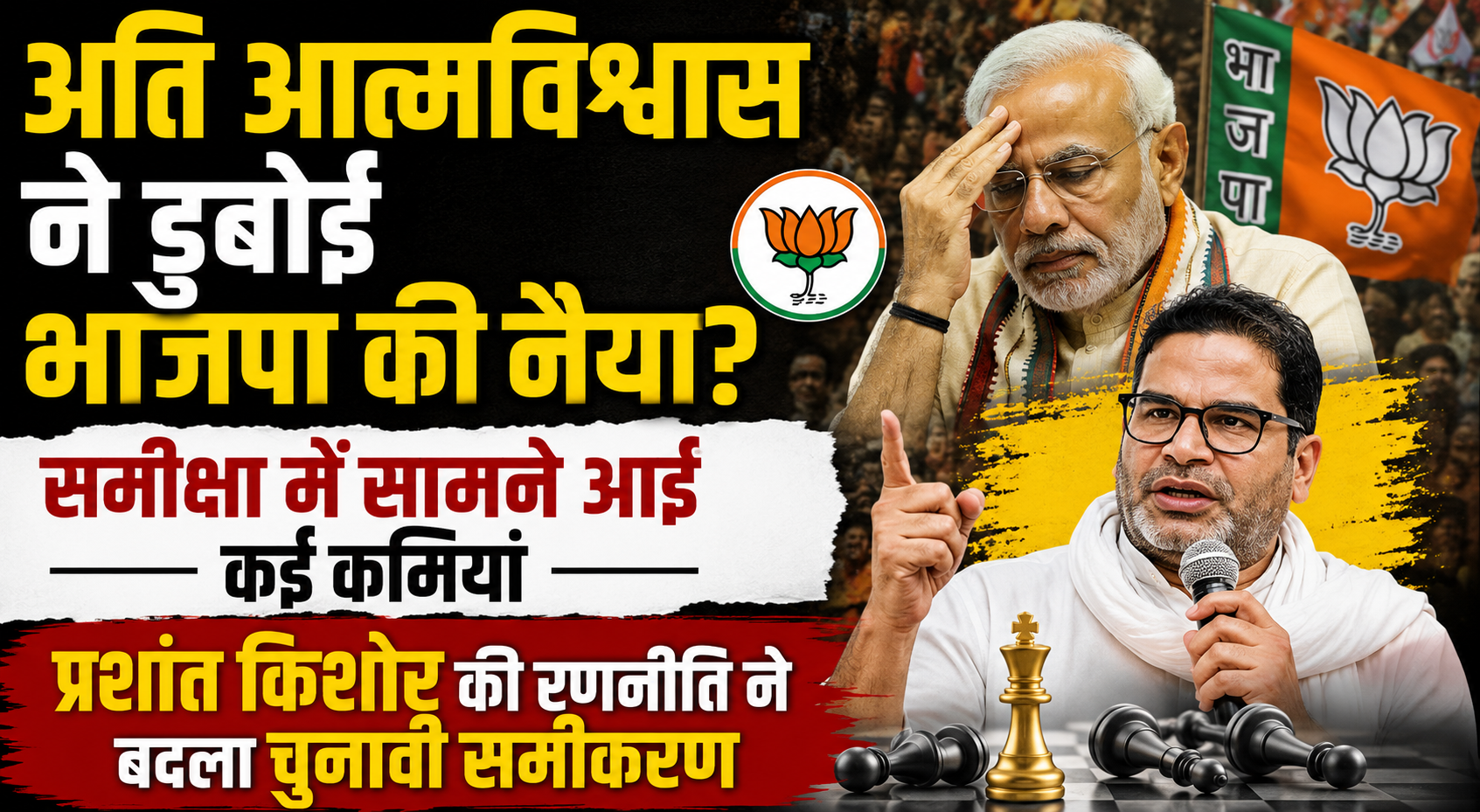
Did Overconfidence Sink the BJP? Review Highlights Several Weaknesses as Prashant Kishor’s Strategy Changed the Electoral Equation
Patna: Following its defeat in the Bankipur Assembly bypoll, the Bharatiya Janata Party (BJP) has intensified its internal deliberations. The party is conducting a multi-level and comprehensive review of the election results. According to the initial assessment, overconfidence is being considered one of the major reasons behind the BJP’s setback. Within the party, there is a view that excessive confidence about victory before the election proved counterproductive.
Bankipur has traditionally been considered a stronghold for the BJP. Therefore, the unexpected result has raised several questions for the party leadership. The review is examining not only voting figures and booth-wise performance but also campaign strategy, efforts to build public sentiment in favour of the candidate, voter outreach and the ability to understand the strategies adopted by political rivals.
According to the preliminary assessment, the BJP suffered a major setback because of the perception that its traditional strength and organisational network would be enough to secure victory. This confidence may have affected preparations at several levels. On the other hand, Prashant Kishor, the political strategist and founder of Jan Suraaj Party, adopted a relatively more aggressive and targeted strategy to reach different sections of voters.
BJP Lagged in Building an Effective Election Narrative
One of the key issues being discussed in the BJP’s internal review is its ability to build an effective election narrative. In an election, organisational strength and a committed support base alone are not always sufficient. It is equally important to establish a clear perception among voters about the key issues and why they should support a particular candidate.
The party’s preliminary assessment reportedly suggests that the BJP could not create the desired impact on this front. In contrast, Prashant Kishor attempted to build his campaign message around local issues, political dissatisfaction and the expectations of different sections of voters.
An important aspect of Kishor’s strategy was his effort to move beyond his traditional supporters and attract voters from different political backgrounds. He attempted to appeal both to sections of BJP supporters and to those strongly opposed to the BJP. This strategy appears to have influenced the electoral equation in Bankipur.
Question of a Dent in BJP’s Traditional Vote Base
Following the BJP’s defeat in Bankipur, one of the biggest questions facing the party is whether its traditional voters remained completely loyal to it. The review is examining whether a section of the BJP’s support base shifted towards another political option.
Political analysts have suggested that Prashant Kishor tried to prevent the election from becoming a conventional BJP-versus-opposition contest. He presented himself as an alternative political option. This potentially helped attract voters who were dissatisfied with the BJP but did not consider traditional opposition parties to be their preferred alternative.
This became a challenge for the BJP. Had anti-BJP votes consolidated behind a single traditional opposition party, the electoral equation might have been different. However, when anti-BJP voters as well as a section of dissatisfied BJP voters moved towards a third option, the political arithmetic changed.
Prashant Kishor’s Calculated Strategy Increased the Challenge
Prashant Kishor has been known for adopting a different style of political strategy in Bihar. During the Bankipur bypoll as well, his campaign focused heavily on extensive voter outreach and attempts to bring together different social and political groups.
His strategy involved repeatedly highlighting his election message while trying to create the perception that the contest was not simply about choosing between established political alternatives. This gave him an opportunity to attract voters who were looking for a different political option.
The BJP’s review is reportedly taking this strategy seriously. One of the key questions before the party is whether it was able to recognise Kishor’s growing political activity as a serious challenge in time. If not, this could be viewed as a significant strategic lapse.
Strong Organisation, But Was Ground-Level Coordination Weak?
The BJP’s organisational network is widely regarded as one of its biggest strengths. The party has a network of workers extending down to the booth level. Despite this organisational strength, the election result has raised questions about whether the organisation functioned as effectively as expected.
The review is examining booth-wise performance, the involvement of local workers, voter outreach and the role of the organisation during the final phase of the campaign. It is also assessing the level of coordination between the candidate and the party organisation.
Even with a strong organisational structure, insufficient direct contact with voters at the local level can hurt a party’s electoral prospects. This aspect is therefore likely to remain an important part of the Bankipur review.
Was Overconfidence the Biggest Factor?
The BJP’s preliminary review is reportedly considering overconfidence as one of the major factors behind the defeat. Treating an electoral seat as virtually guaranteed can be strategically risky. This is particularly true in a by-election, where voter behaviour can differ from that seen in a regular Assembly election.
If leaders and workers develop a strong belief that victory is certain, the intensity of campaigning, voter outreach and booth management may not receive the required attention. This is one of the reasons why the BJP is now examining this aspect closely.
The Bankipur result is particularly significant for the BJP because it has raised questions about the party’s strategy and organisational preparedness among urban voters.
Challenges Before the BJP
After the bypoll defeat, identifying the reasons for the loss will not be enough for the BJP. The party will need to determine what changes are required to prevent a similar situation in future elections.
First, the party will need to assess the status of its traditional voter base. It will then have to identify the social and political groups where its influence weakened. At the same time, responding to emerging political forces and understanding their strategies at an early stage will become increasingly important.
Prashant Kishor’s performance has sent a message to the BJP that organisational strength and a traditional vote base alone may no longer be sufficient to win elections. Changing voter behaviour, social media narratives, local issues and the personal appeal of candidates are also playing increasingly important roles.
Important Signals for Bihar Politics
The Bankipur bypoll result is not being viewed merely as a victory or defeat in one Assembly constituency. It could have broader implications for Bihar politics. If a new political force such as Jan Suraaj succeeds in establishing itself in a constituency considered strong for an established party, traditional political parties could face a new challenge in future elections.
For the BJP, the result also provides an opportunity to review its electoral model. The party will have to decide how to adapt its organisation and campaign strategy to the changing political environment.
For Prashant Kishor, the Bankipur result can also be seen as a test of his political strategy. If he has succeeded in attracting both BJP supporters and voters opposed to the BJP, there could be an attempt to apply this model in other Assembly constituencies across Bihar.


