
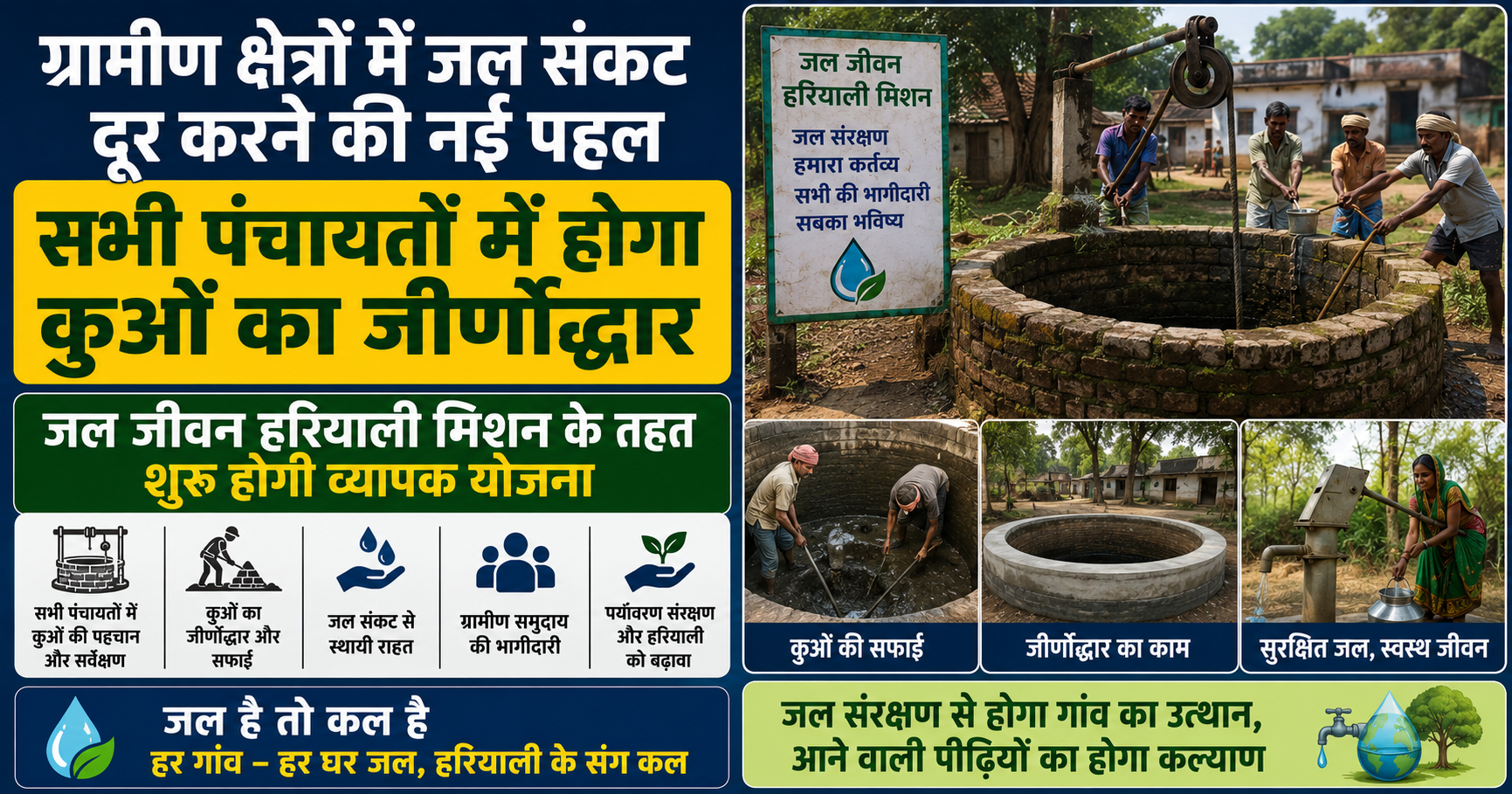
Wells to Be Revived Across Rural Areas to Improve Drinking Water Supply; Restoration Drive Under Jal Jeevan Hariyali Mission
Muzaffarpur | Correspondent
In a major initiative to address drinking water shortages and revive traditional water sources, the Muzaffarpur district administration is preparing to restore old public wells across all rural panchayats under the Jal Jeevan Hariyali Mission. The restoration project will be implemented on the lines of the Amrit Sarovar Scheme, with the objective of ensuring year-round access to clean drinking water while promoting groundwater conservation and environmental sustainability.
District officials believe that many traditional wells have become unusable over the years due to neglect, silt accumulation, and inadequate maintenance. By restoring these wells, the administration aims to provide an additional and reliable source of drinking water for rural communities while also helping improve groundwater recharge and preserving traditional water resources.
Restoration on the Lines of the Amrit Sarovar Scheme
Under the proposed project, public wells throughout the district will undergo comprehensive restoration similar to the development model adopted under the Amrit Sarovar Scheme.
The work will include desilting, cleaning, structural repairs, construction of protective boundary walls, installation of safety measures, and beautification of the surrounding areas.
Officials said the objective is not merely to repair the wells but to transform them into sustainable and long-term sources of water for rural communities.
Integrated with the Jal Jeevan Hariyali Mission
The initiative will be implemented as part of the Jal Jeevan Hariyali Mission, a flagship programme aimed at promoting water conservation, rainwater harvesting, groundwater recharge, and environmental protection.
According to officials, reviving traditional wells will enhance rainwater storage and improve groundwater levels, helping reduce future water shortages in rural areas.
Survey to Be Conducted in Every Panchayat
Before implementation, a detailed survey will be carried out in every panchayat to identify the condition of public wells.
The survey will determine how many wells remain functional, which ones require repairs, and which need complete restoration or reconstruction.
Based on the findings, separate action plans will be prepared for each panchayat.
Improved Access to Clean Drinking Water
Once the restoration work is completed, thousands of rural households are expected to benefit from improved access to clean drinking water.
The initiative is expected to be particularly beneficial during the summer months, when several villages experience acute water shortages.
Restored wells will serve as an important supplementary source of water during periods of increased demand.
Boost to Groundwater Conservation
Water conservation experts believe that restoring traditional water bodies plays a crucial role in maintaining groundwater levels.
Proper maintenance of wells allows rainwater to naturally percolate into the ground, improving groundwater recharge and helping secure long-term water availability.
Panchayats to Play a Key Role
Local panchayats will play an important role in ensuring the success of the project.
The district administration plans to assign responsibility for the maintenance, regular cleaning, and protection of restored wells to local governing bodies so that the assets remain useful for many years.
Possibility of MGNREGA Support
Officials indicated that certain components of the restoration work may also be carried out through the Mahatma Gandhi National Rural Employment Guarantee Act (MGNREGA).
This would not only accelerate restoration work but also generate employment opportunities for rural workers.
Positive Impact on the Environment
The restoration of traditional wells is expected to contribute significantly to environmental conservation.
In addition to improving drinking water availability, the project will help strengthen ecological balance, increase greenery, and reduce the long-term impact of water scarcity in rural areas.
Positive Response from Villagers
Residents have welcomed the proposed initiative, noting that many old public wells still exist in villages but have become unusable due to years of neglect.
They believe that restoring these wells will provide considerable relief, especially during the summer season when access to drinking water becomes increasingly difficult.
The proposed restoration of public wells across all panchayats in Muzaffarpur under the Jal Jeevan Hariyali Mission represents a significant step toward improving rural drinking water infrastructure and conserving traditional water resources. Inspired by the Amrit Sarovar Scheme, the initiative aims to revive neglected wells, strengthen groundwater recharge, support environmental sustainability, and enhance rural development. District authorities are optimistic that with the active participation of panchayats and local communities, the project will become a long-term solution to water scarcity and ensure a more reliable supply of clean drinking water for future generations.


