
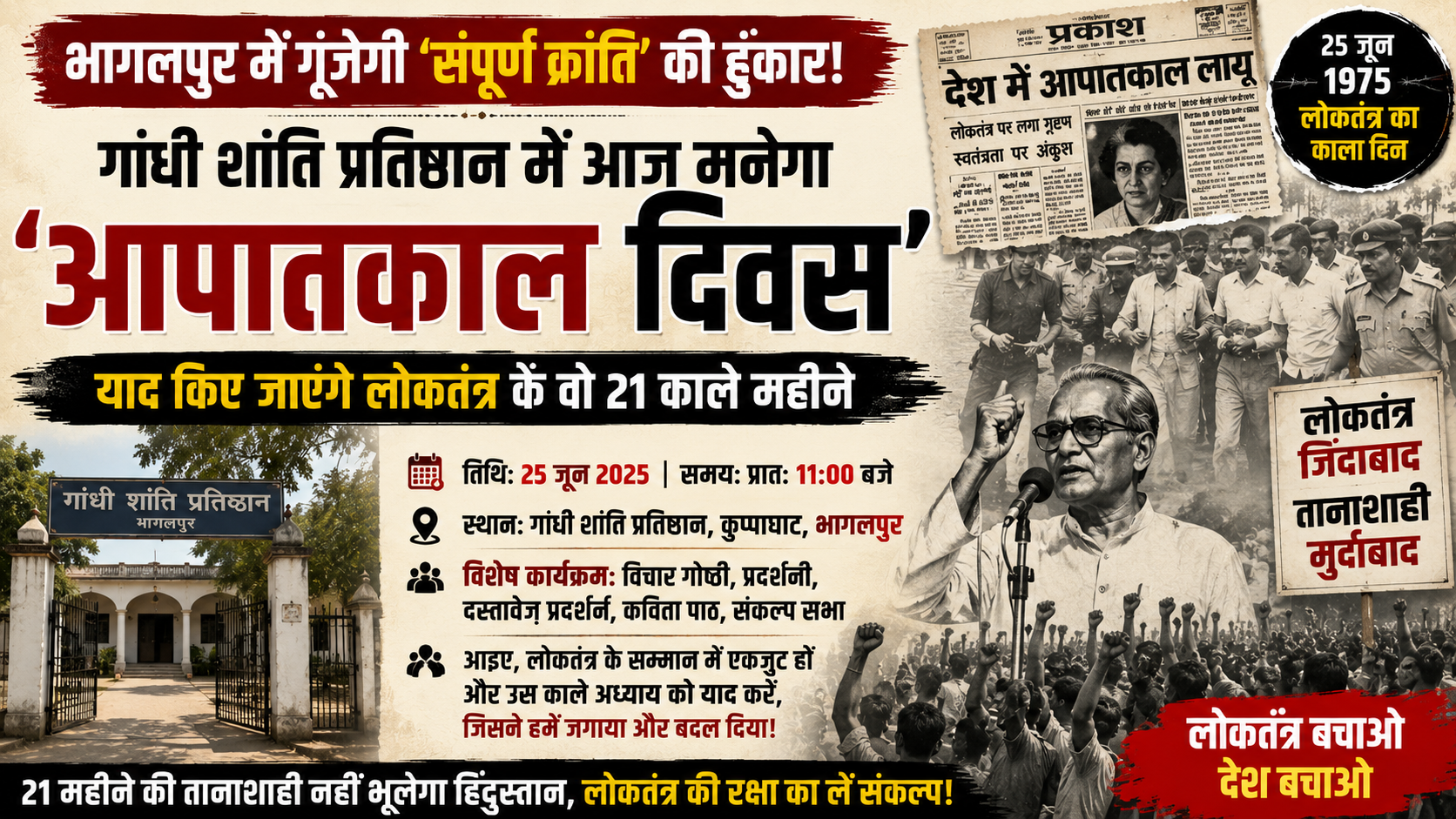
The Roar of 'Total Revolution' Echoes in Bhagalpur! 'Emergency Day' Observed at Gandhi Peace Foundation; Shines Light on the 21 Darkest Months of Indian Democracy
On the solemn anniversary of the darkest and most oppressive chapter in Indian democratic history—the Emergency of 1975—a major commemorative seminar is being organized in the Silk City of Bhagalpur. The Gandhi Peace Foundation Center, situated at the heart of the city, will observe June 25 as 'Emergency Day' (Black Day).
This day holds massive historical gravity, marking the night of June 25, 1975, when the then Prime Minister Indira Gandhi imposed a state of National Emergency across the country, which subsequently ignited the historic 'Total Revolution' (Sampoorna Kranti) movement. Organised under the joint banner of the Sampoorna Kranti Andolankari Manch (Total Revolution Activists' Forum) and the Gandhi Peace Foundation, the event has drawn immense interest from regional intellectuals, veteran JP activists (JP Senanis), and the younger generation.
The complete inside report, mapping the historical weight of the day and the details shared by prominent social activist Sanjay Kumar, is outlined below.
June 25, 1975: The Night That Shook Indian Democracy
Briefing reporters on the extensive preparations for the event, Sanjay Kumar, a senior member of the Sampoorna Kranti Andolankari Manch, noted that the night of June 25 remains one of the longest and darkest nights in the timeline of modern India.
The Declaration of Emergency: In the dead of night, on the pretext of "internal disturbance," a National Emergency was clamped down, stripping citizens of their fundamental rights.
Bhagalpur’s Historic Imprint: When Loknayak Jayaprakash Narayan (JP) gave the clarion call for a 'Total Revolution' against authoritarian rule, the youth, student bodies, and scholars of Bhagalpur and the entire Anga region plunged headfirst into the agitation, completely disregarding the fear of police brutality. During that turbulent period, Bhagalpur’s central prisons were filled to capacity with political prisoners and frontline freedom fighters.
High-Value Agendas at the Gandhi Peace Foundation
According to Sanjay Kumar, this day is observed annually with deep intellectual introspection rather than as a mere token ritual. The day-long event has been structured into three primary core sessions:
Honoring JP Movement Veterans : The conclave will host aging freedom fighters from Bhagalpur and adjoining districts who braved batons and spent months in solitary confinement in 1975 to preserve the Constitution. They will be publicly honored, and their oral histories will be recorded.
Seminar on 'Contemporary Challenges to Democracy': Renowned historians, veteran editors, and political analysts will analyze the current structural health of democratic institutions, extracting key lessons from the strategic mistakes of 1975.
Youth Interface Conclave : Organizers stress that it is absolutely critical to make today's digital and social-media generation realize that the 'Freedom of Speech' they enjoy today was bought through the heavy sacrifices of their elders.
"When the Press Was Gagged and Prisons Replaced Parliaments"—Sanjay Kumar
Addressing the press, forum leaders and Sanjay Kumar highlighted core historical events that the current generation needs to absorb regarding life during the Emergency:
The Era of absolute Censorship : Newspapers were legally barred from printing anything without the explicit preview and seal of government censors. If an independent press dared to criticize executive overreach, its electricity lines were cut, or the printing presses were entirely sealed.
Massive Sweep Arrests: Icons like Jayaprakash Narayan, Atal Bihari Vajpayee, Lal Krishna Advani, George Fernandes, and Lalu Prasad Yadav, along with thousands of grassroots opposition leaders, were thrown into prisons without warrants under administrative detention laws.
Bhagalpur’s Underground Resistance: Local student leaders in Bhagalpur went underground, setting up clandestine printing operations to distribute revolutionary pamphlets among citizens, ensuring the fire of resistance never fizzled out.
A Chronological Snapshot of the 1975 Emergency
| Parameter | Operational Impact | Consequences on the Polity |
|---|---|---|
| Duration | June 25, 1975, to March 21, 1977 (21 Months). | The nation functioned entirely under centralized, authoritarian command. |
| Civil Liberties | Total suspension of fundamental rights, including Article 21 (Right to Life). | Law enforcement received unchecked power to detain anyone without assigning reasons under the notorious MISA Act. |
| The Pushback | The 'Total Revolution' movement coalesced under the leadership of JP. | Paved the way for the historic formation of the first-ever non-Congress coalition government (Janata Party) at the Centre. |
Why This Event Remains Critically Relevant Today
The central objective of observing 'Emergency Day' at the Gandhi Peace Foundation is not merely to reminisce about a bygone era, but to keep the present citizenry vigilant.
Key Message from the Organizers: "True democracy can only thrive in an environment where the voices of dissent are respected. Bhagalpur’s Gandhi Peace Foundation has historically stood as a fortress for ideological freedom. Through this forum, we want to remind society that an active and conscious citizenry is the only true protector of democracy. If the public goes to sleep, authoritarianism can creep back in under any guise."
The observance of 'Emergency Day' at Bhagalpur's Gandhi Peace Foundation is a profound documentation of independent India's greatest civil resistance movement. This combined effort by Sanjay Kumar and the Sampoorna Kranti Andolankari Manch serves as a powerful reminder of historical failures that must never be repeated. The intellectual message emerging from Bhagalpur will undoubtedly empower the youth of Bihar and India to be more protective of their constitutional values. Stay tuned for further updates from the seminar.


