
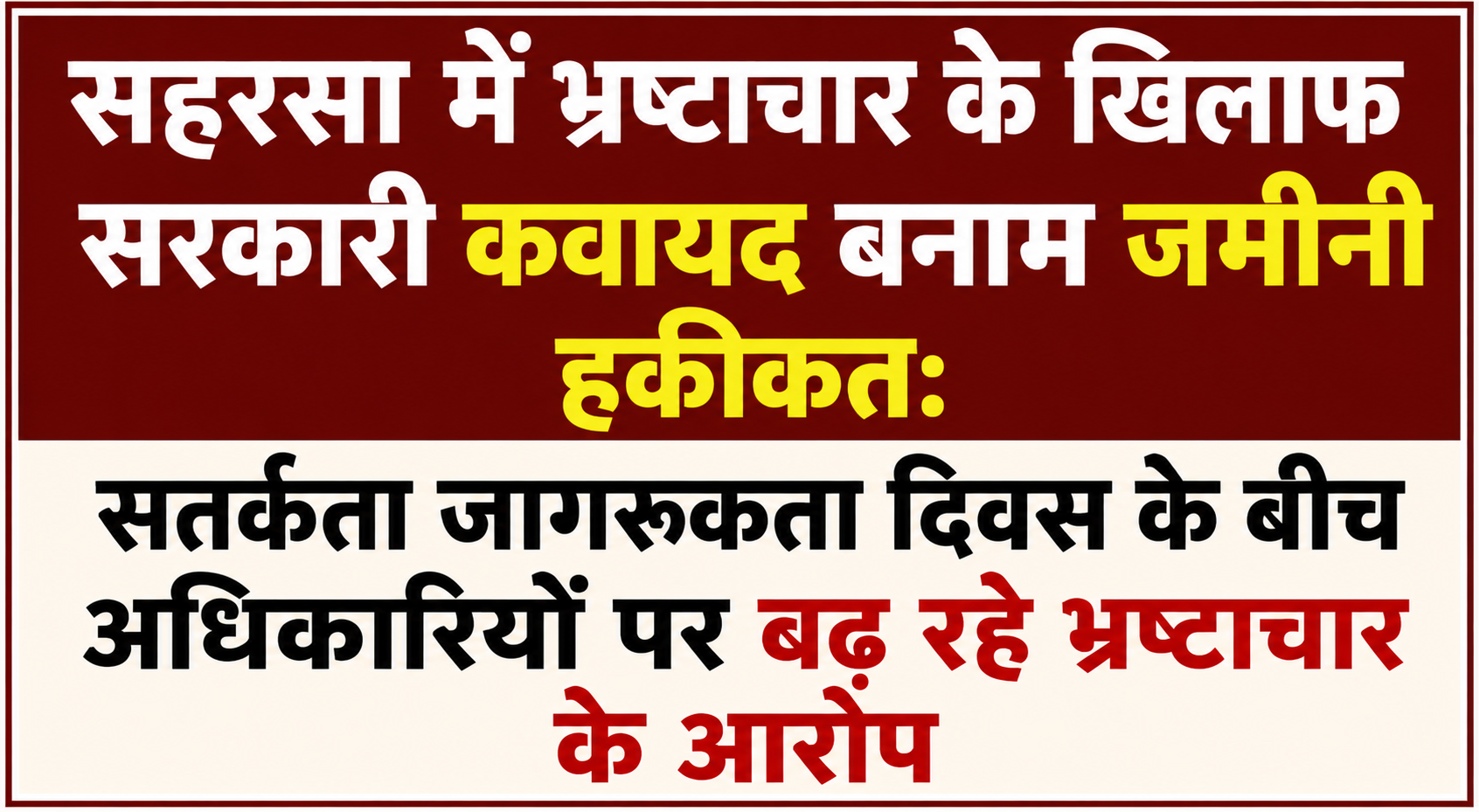
Health Workers' Protest in Saharsa Over Corruption Allegations and Lack of Transparency Amid Awareness Day
Saharsa (Bihar): Despite the annual celebration of Vigilance Awareness Week in Saharsa, cases of corruption involving officials continue to escalate. The accumulation of disproportionate assets against Education Department DPO Ajit Amar and Executive Engineer Pramod Kumar has brought this reality to light.
According to a report received from the 'Hindustan' correspondent, while administrative offices organize grand oaths and seminars promoting honesty during vigilance weeks, the ground reality reflects a stark contrast. The rising number of corruption allegations against high-ranking officials has raised serious questions regarding the effectiveness of these annual awareness campaigns. Let us explore the detailed account of the corruption allegations against these officials, the systemic challenges in Saharsa, and the broader implications for governance.
Vigilance Awareness Week: A Mere Formalism?
Every year, government departments in Saharsa observe Vigilance Awareness Week with seminars, banners, and slogans aimed at establishing a transparent and corruption-free administration.
The Paradox of Data: While officials lecture on integrity, investigative bodies and economic offense units continue to unearth cases where public servants possess assets far exceeding their known sources of income.
Public Perception: Such recurring scandals foster skepticism among common citizens, who increasingly view these awareness programs as routine formalities rather than effective deterrents against graft.
Case 1: Disproportionate Assets Allegations Against DPO Ajit Amar
Ajit Amar, serving as the District Programme Officer (DPO) in the Education Department at Saharsa, has found himself at the center of serious corruption allegations.
Gravity of Charges: He is accused of abusing his official position to accumulate vast wealth illegally. Discrepancies found in his asset declarations indicate holdings many times higher than his legitimate income.
Scope of Inquiry: Investigative agencies have scrutinized properties, real estate investments, and assets linked to him and his family members. This case highlights how corruption has penetrated foundational sectors like education, directly impacting institutional integrity.
Case 2: Shadow of Corruption Over Executive Engineer Pramod Kumar
Similarly, Executive Engineer Pramod Kumar, entrusted with overseeing vital construction projects and public infrastructure development, faces intense scrutiny over corruption charges.
Tender Manipulation and Commissions: Responsible for allocating infrastructure tenders and clearing contractor payments, Kumar is accused of amassing disproportionate wealth through systematic commission-seeking and irregularities in project execution.
Mismatch in Declared Wealth: Raids and document verifications conducted by vigilance authorities revealed properties and financial transactions that starkly contradict his official salary and legal earnings, pointing toward the diversion of public funds into private coffers.
Systemic Challenges and Public Impact
The emergence of high-profile cases involving officials like Ajit Amar and Pramod Kumar exposes deeper systemic vulnerabilities within the district administration.
Drivers of Corruption: Weaknesses in procurement transparency, inadequate internal accountability, and delayed punitive measures allow corrupt practices to persist unchecked.
Consequences for Citizens: When officials engage in graft, public welfare projects suffer. Substandard roads, compromised school facilities, and delayed infrastructural projects ultimately deprive ordinary citizens of essential services.
Necessary Reforms for Meaningful Change
To ensure that vigilance campaigns yield tangible results, structural reforms must be implemented:
Mandatory Public Asset Declarations: Periodic and transparent digital auditing of assets for all public servants should be strictly enforced.
Fast-Track Investigations: Vigilance and anti-corruption probes must be conducted on strict timelines to prevent evidence tampering or undue delays in justice.
Whistleblower Safeguards: Robust legal protections must be provided to individuals and personnel who report corrupt practices without fear of retaliation.
Value-Based Training: Regular ethics workshops should replace ceremonial compliance events to foster a genuine culture of accountability.
The unfolding situation in Saharsa demonstrates that corruption remains a formidable hurdle within local administration. Unless oversight mechanisms are strengthened and zero-tolerance policies translate into swift, uncompromising legal action against offenders, observances like Vigilance Awareness Week will continue to lack credibility. True governance is measured not by slogans of honesty, but by unwavering transparency and accountability on the ground.


