
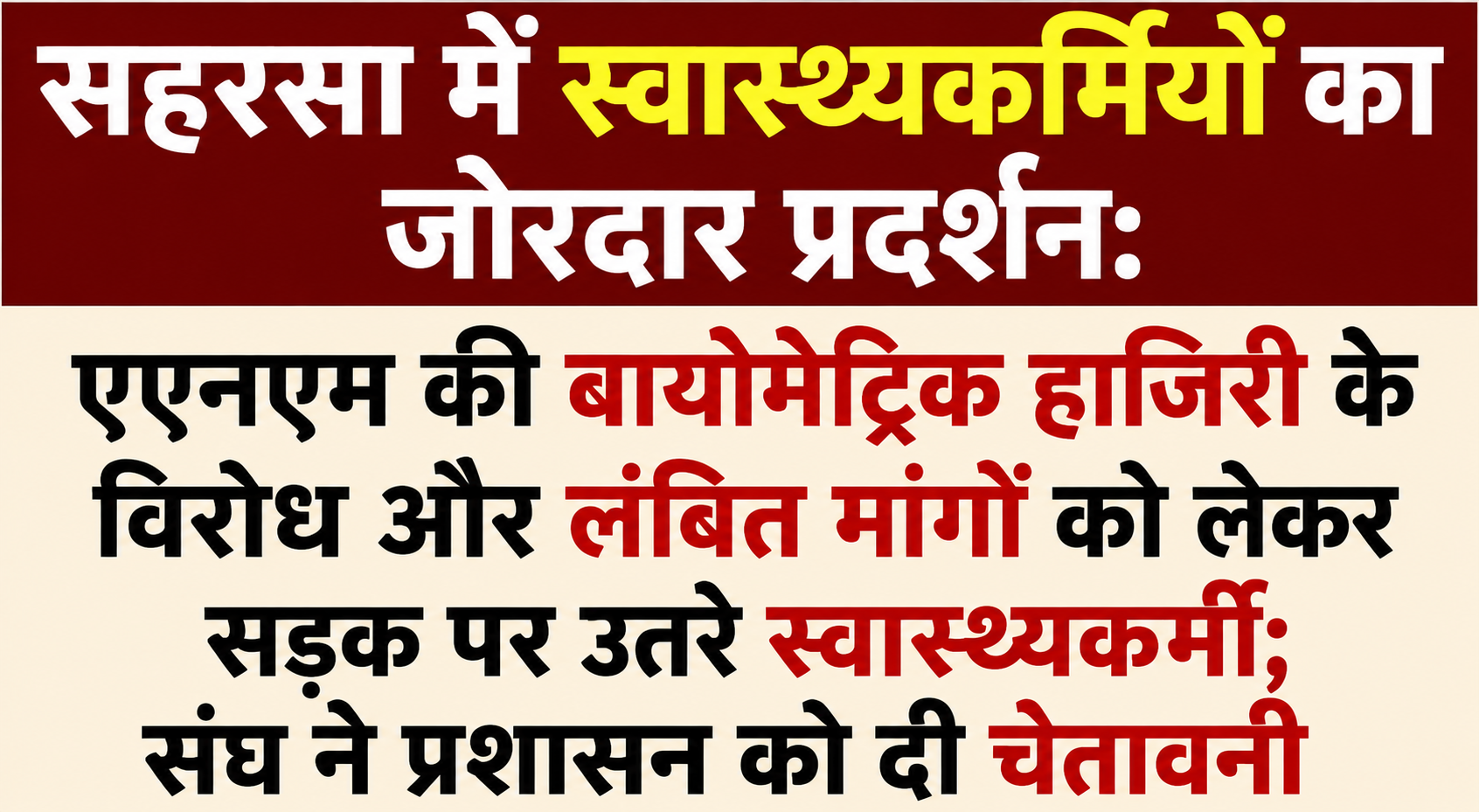
Health Workers Stage Massive Protest in Saharsa: Opposition to ANM Biometric Attendance and Pending Demands; Union Issues Warning to Administration
Saharsa (Bihar): A major development has emerged from Saharsa district in Bihar regarding the ongoing discontent between the health department and healthcare workers. A flutter swept through the district's health machinery when a large number of ANMs (Auxiliary Nurse Midwives) and other health workers became vocal regarding their various demands. Health workers in Saharsa staged a massive protest, strongly opposing the biometric attendance for ANMs and pressing for their other pending demands.
According to a report received from the 'Hindustan' correspondent, representatives of the health union leading this protest warned in unequivocal terms that if their issues are not resolved promptly, the agitation will be intensified further. The union's primary demands include rectifying the impractical system of biometric attendance, granting pending promotions, and posting female health workers at health centers located near their homes or in their home districts. Let us explore a detailed account of the main causes behind this health workers' protest in Saharsa, the union's demands, the administrative response, and the far-reaching impacts of this agitation.
Background of the Agitation: Why Did Health Workers' Anger Flare Up?
Various digital initiatives are being launched by the Bihar government and the health department to bring efficiency and transparency, but deep resentment frequently brews among employees due to the neglect of ground realities.
Why Oppose Biometric Attendance?: Severe difficulties are being encountered at the grassroots level regarding the biometric attendance system made mandatory for ANMs and other personnel. Due to acute network issues in remote rural areas (Health and Wellness Centers or Additional Primary Health Centers), irregular power supply, and lack of internet connectivity, recording attendance on time has become virtually impossible. Furthermore, owing to many ANMs holding charge of multiple areas, they face practical hurdles in marking attendance at different locations.
Problems Faced by Female Health Workers: Female health workers (ANMs) stationed in rural regions face numerous challenges concerning security, transportation, and working hours, prompting their long-standing demand for posting in their home blocks or hospitals near their residences.
Vigorous Protest Led by the Union and Key Demands
During this protest organized at the Saharsa district headquarters, hundreds of ANMs and health workers were seen carrying placards and raising slogans against the government and the department.
The Issue of Pending Promotions: Protestors stated that health workers rendering services for years are not receiving timely promotions, arresting their career progression. Many employees are reaching the verge of retirement without financial benefits.
Demand for Postings Near Home Regions: Keeping the security and familial responsibilities of female health workers in mind, the union has demanded that female personnel be posted at health centers near their native residences or homes so they do not have to travel long distances daily.
Not Pressure Politics, but Justified Demands: Union speakers clarified that they have never stepped back from duty; from the COVID-19 pandemic to every emergency situation, they worked by risking their lives, but impractical rules forced upon them by the administration will not be tolerated.
Administrative Response and Subsequent Situation
In view of this aggressive stance by the health workers, officials from the district health administration and the Civil Surgeon's office have initiated dialogue efforts to manage the situation.
Submitting a Memorandum: At the conclusion of the protest, a delegation of the health union submitted a memorandum addressed to the Civil Surgeon and District Magistrate, discussing all points in detail.
Assurances from Officials: Administrative officials assured that technical difficulties related to biometric attendance and matters regarding the posting of female personnel will be discussed with higher department officials. Furthermore, assurances were given to expedite the processing of pending promotion files.
This protest by health workers in Saharsa over the opposition to ANM biometric attendance and other demands indicates how crucial it is to strike a balance between administrative orders and ground realities. If the government and health department fail to resolve the practical problems (such as network issues and home postings) faced by these female personnel and health workers in time, this agitation could take on a broader scale in the coming days. Sympathetically considering the demands of these personnel, who are regarded as the backbone of healthcare services, is imperative in the public interest.


