
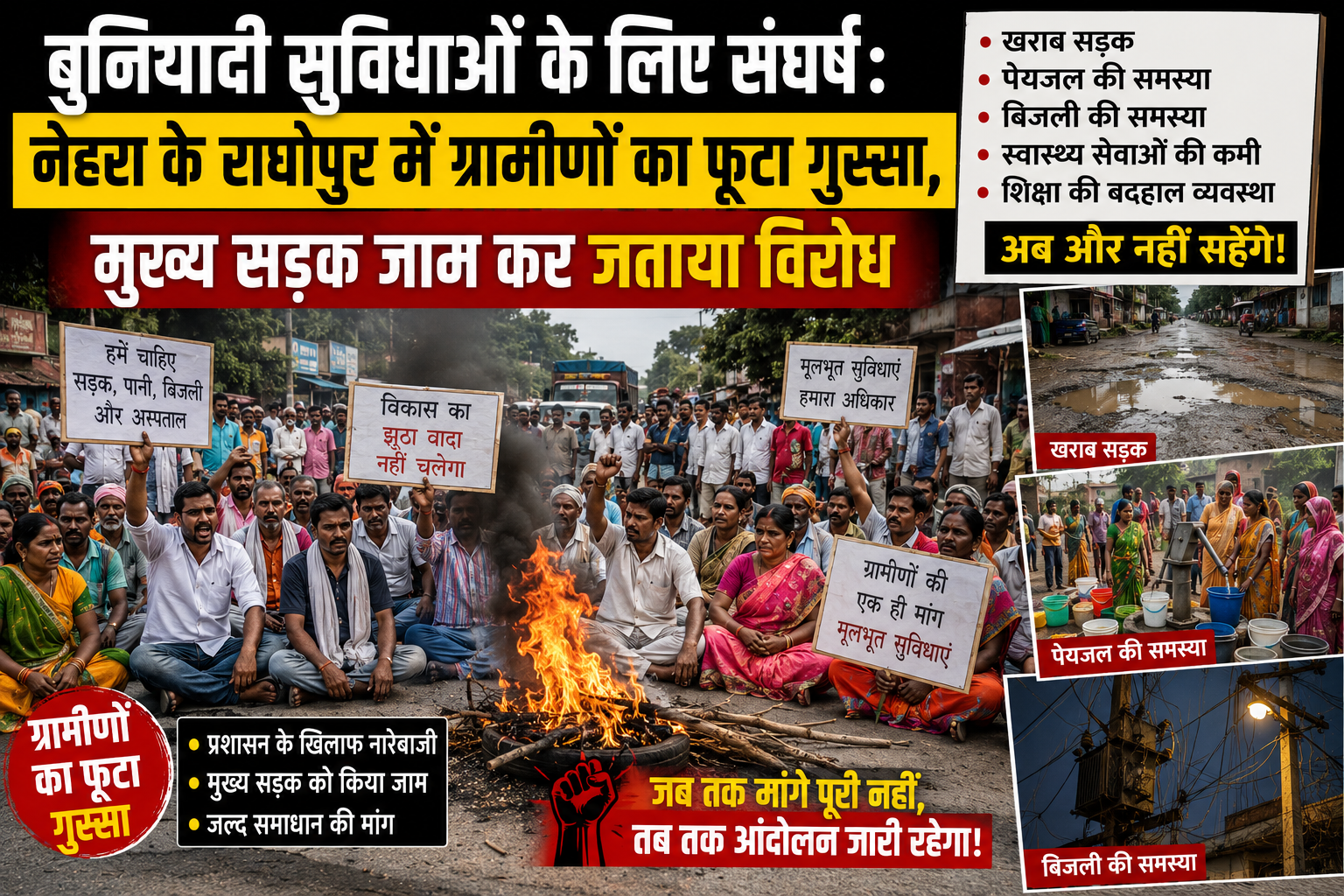
Struggle for Basic Amenities: Villagers in Raghupur, Nehra Express Anger, Block Main Road in Protest
Darbhanga (Bihar): The gap between development claims and ground reality is often starkly visible in rural areas. Tired of administrative apathy and the lack of basic amenities, residents of Raghupur village under the Nehra police station area in Darbhanga finally took to the streets to raise their voices. The villagers blocked the main road, raised slogans against the administration, and demanded immediate solutions to their grievances.
Reason for the Protest: Administrative Apathy and Neglect
The residents of Raghupur stated that they have been running from pillar to post—approaching local administration and public representatives—with their issues for a long time, but have received nothing more than "assurances" in return. According to the villagers, the condition of the village is deteriorating day by day due to gross administrative negligence.
During the protest, the villagers expressed deep anger over the following issues:
Dilapidated State of Roads: The road connecting Raghupur to the main highway has been in a shambles for several years. Having turned into a stretch of potholes, it invites accidents every other day. During the rainy season, the condition becomes so poor that it is nearly impossible to even walk on it, let alone drive.
Waste Management Crisis: There is no trace of sanitation in the village. Heaps of garbage can be seen everywhere, not only causing a foul stench but also creating a breeding ground for diseases. The lack of any concrete system for waste management has made life miserable for the villagers.
Irregular Power Supply: While promises of uninterrupted electricity are frequently made in rural areas, the power situation in Raghupur is pathetic. Voltage fluctuations and long hours of power outages are severely affecting everything from children's studies to daily chores.
Impact of the Roadblock: Traffic Disruption and Administrative Stir
The blockade brought traffic to a complete standstill. School-going children, office-goers, and emergency vehicles were left stranded. Realizing the gravity of the situation, the Nehra police arrived at the scene. They tried to persuade and calm the agitated villagers, but the residents remained firm on their demands.
The villagers declared, "We will not clear the road until a responsible administrative official arrives on the spot, gives a written assurance, and provides a timeline for when the work will begin."
Administrative Response: A Series of Promises
Given the intensity of the protest, local administrative officials arrived at the site. They assured the villagers that a proposal for road repair is in the pipeline and that a special team of sanitation workers would be sent immediately for waste management. Furthermore, the electricity department officials were summoned and instructed to rectify the voltage issues.
Following the written assurance from the administration, the blockade was cleared after much effort. However, the villagers have issued a warning that if the work does not commence within the stipulated timeframe, they will be forced to launch an even more intense agitation.
Lack of Basic Amenities: A Widespread Problem
The incident in Raghupur is not unique to one village; it is a common struggle across many rural areas of Bihar. Roads, electricity, and sanitation are the three main pillars of development for any region. If the administration fails to keep these functional, it directly impacts the local economy and the quality of life of the people.
Expert Viewpoint
Social activists believe that to prevent such situations, there is an urgent need to strengthen the 'Public Grievance Redressal System' at the local level. Often, people are forced to resort to protests even for their most basic needs, which is not ideal for a progressive society.
The act of blocking the road by the residents of Raghupur reflects their helplessness and their declining trust in the administration. Basic amenities like roads, electricity, and sanitation are not favors provided by the government, but the fundamental rights of a citizen.
It is time for the local administration to move beyond "files" and work on the "ground." The patience of the citizens has worn thin, and empty assurances will no longer suffice. If the administration wants citizens to live with dignity rather than having to take to the streets, it must resolve these issues with accountability and transparency.


