
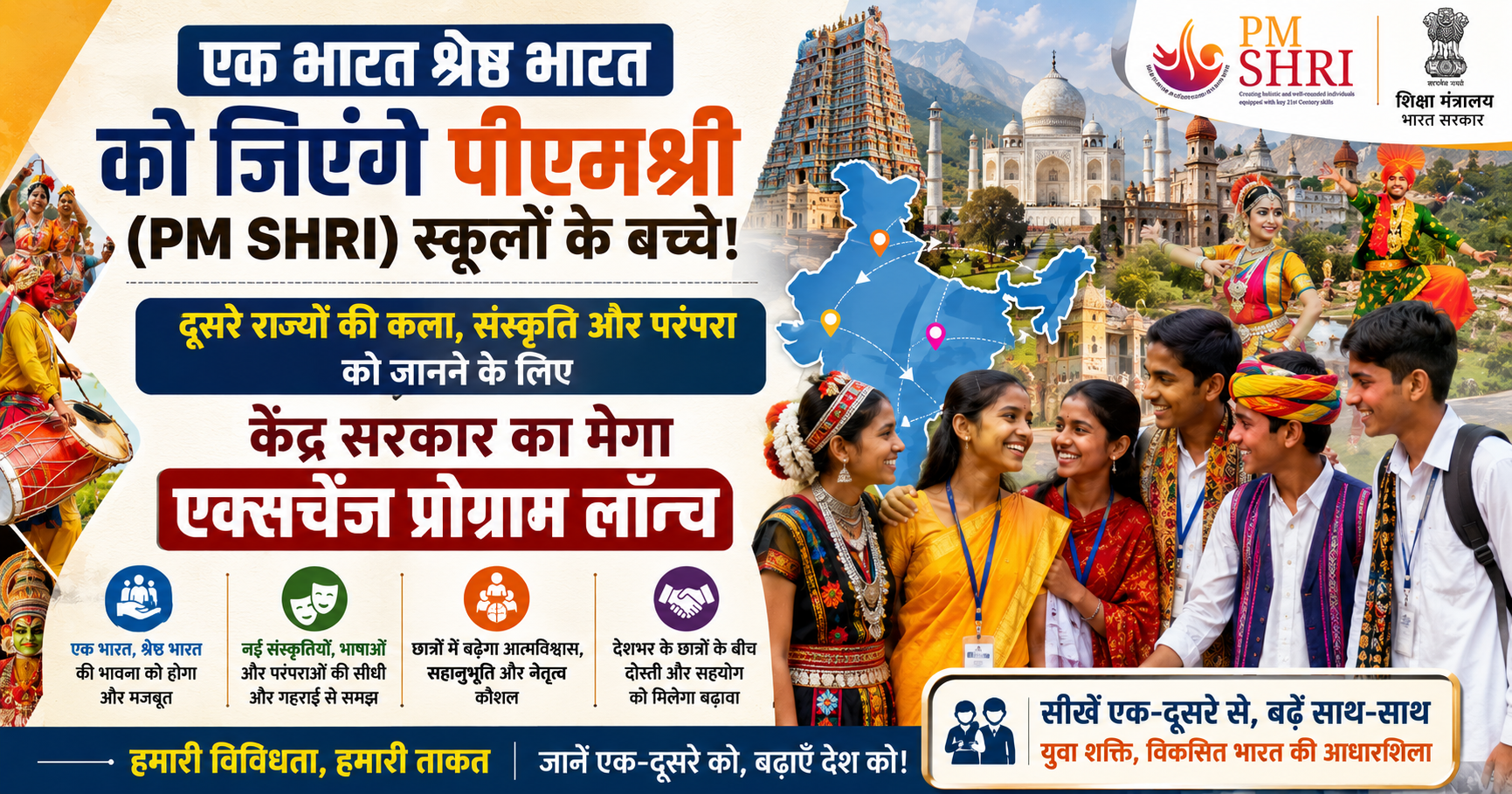
PM SHRI School Students to Experience 'Ek Bharat Shreshtha Bharat' Firsthand! Central Government Launches Mega Inter-State Exchange Program to Introduce Kids to Varied Arts, Cultures, and Traditions
Under the framework of the National Education Policy (NEP 2020), which aims to make Indian heritage, languages, and diversities a core component of the school curriculum, the Central Government has engineered a highly ambitious and unique roadmap. Students studying in the centrally managed and upgraded PM SHRI (PM Schools for Rising India) will no longer just read about other states in their textbooks; they will physically visit those states to experience their unique art, culture, lifestyle, cuisine, and historical traditions firsthand.
The Ministry of Education, Government of India, has officially green-lit this landmark 'Inter-State Cultural Exchange Program'. Under this scheme, groups of students from PM SHRI schools across various states will cross-travel on institutional tours. The primary objective of this move is to ground-implement Prime Minister Narendra Modi's vision of 'Ek Bharat, Shreshtha Bharat' (One India, Great India) right at the school level.
The comprehensive blueprint of this major national decision, its core objectives, and the unique benefits it offers to school students are detailed below.
What is the PM SHRI Scheme and the Basis of This New Policy?
To understand this decision, it is essential to look at the target institution. The Central Government launched the PM SHRI scheme to upgrade and develop thousands of existing government-run schools into model institutions. These schools are equipped with modern tech, smart classrooms, and discovery-oriented pedagogy aligned with the standards of the NEP.
Now, the Central Government intends to significantly broaden the cultural and mental horizons of these young minds. The administration firmly believes that India’s core strength lies in its immense diversity. National integration cannot be built on a rock-solid foundation unless a child from North India closely interacts with the culture of South India, or a student from the North-East understands the deep-seated traditions of West India.How Will This 'Cultural Exchange Program' Function?
According to the operational blueprint structured by the Ministry of Education, this extensive travel-learning exchange will follow a highly organized pattern:
Strategic Pairing of States: Under this master plan, two or more states will be paired or linked together. For instance, a contingent of PM SHRI students from Bihar might be mapped to visit Tamil Nadu or Kerala, while students from those southern states will travel up north to tour historical and spiritual epicenters like Bodhgaya and Nalanda.
Structured Student Exchange Tours: A selected batch of meritorious and socially active students (ensuring equal gender representation of both boys and girls) will be curated from each PM SHRI institution. This contingent, under the strict supervision of trained teachers and certified guides, will embark on a 5-to-7-day educational tour.
Homestay & Family Interactions: The unique highlight of these tours is that students will not merely isolate themselves in commercial hotels or government guest houses. Instead, they will be given opportunities to interact with local families, participate in localized festivals, and sit in regional school classrooms to absorb daily cultural nuances organically.
The 4 Pillars of the Students' 'Learning Vision'
During these exposure visits, the traveling students will be tasked with building a profound understanding across four core domains:
Arts and Crafts : Students will witness and learn the traditional painting styles of host states (such as Madhubani/Mithila painting of Bihar, Warli art of Maharashtra, or Pattachitra of Odisha), as well as local handlooms and heritage weaving techniques.
Language and Literature : Young learners will be introduced to basic spoken words, conversational catchphrases, folk songs, and historic folktales of the host state's native language. This is engineered to foster linguistic harmony and mutual respect.
Attire and Culinary Heritage : This program will serve as an excellent canvas for students to understand the massive diversity of Indian food and traditional clothing, alongside the scientific and geographic reasons behind regional wardrobes and diets.
Historical and Heritage Sites : By touring historic forts, ancient temples, state museums, and ecological reserves, students will come face-to-face with India's glorious and interconnected historical timeline.
Strict Mandate from the Ministry: "Project Reports Compulsory Post-Tour"
The Central Government is categorical that this initiative must not be treated as a mere fun picnic or leisure holiday. Definite 'Learning Outcomes' have been institutionalized.
Official Ministry Guideline: "Upon returning from the tour, every participating student will be required to compile a comprehensive Cultural Project Report or digital presentation. They will present their learnings before their peers. Furthermore, schools will organize 'Cultural Exhibitions' or 'Inter-State Carnivals' to ensure that the students who couldn't travel can also absorb the shared knowledge."
Key Benefits of the National Exchange Program
| S.No. | Core Advantage | Real-World Impact on Student Development |
|---|---|---|
| 1. | Experiential Learning | Shifting from rote-learning to visual, touch-and-feel experiences imprints information permanently onto young minds. |
| 2. | Spirit of National Unity | Breaking past barriers of caste, religion, and regionalism, students naturally absorb the absolute reality of 'Unity in Diversity'. |
| 3. | Personality Development | Adapting to foreign environments and communicating with new communities vastly enhances self-confidence and leadership skills. |
| 4. | Unlocking New Career Pathways | Exposure to diverse regional arts and tourism elements opens up prospective career pipelines in cultural diplomacy, hospitality, archaeology, and historical research. |
The roll-out of this Inter-State Cultural Exchange Program across PM SHRI institutions marks a revolutionary phase in the history of Indian schooling. This step provides students with a global outlook while firmly anchoring them to their authentic Indian roots. When these young students step onto the soil of another state, they will cross boundaries not just as standard tourists, but as young 'Cultural Ambassadors' weaving the social fabric of India together. This initiative is bound to make the upcoming generation mentally, socially, and ideologically far more enriched and truly 'Shreshtha'!