


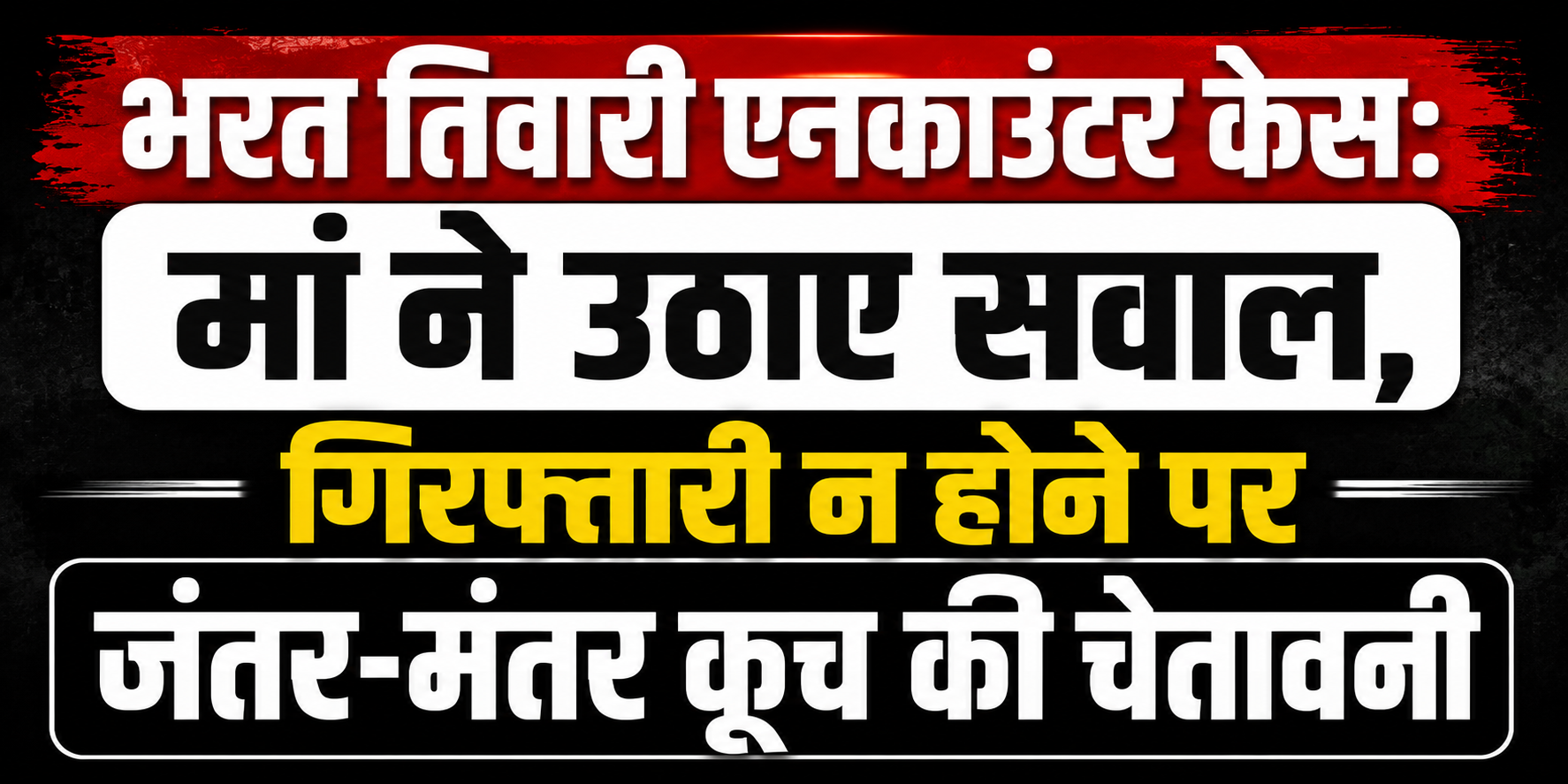
Mother Demands Accountability; Protests Move Towards Jantar Mantar
The Bharat Bhushan Tiwari encounter case in Bhojpur, Bihar, has intensified into a nationwide debate regarding police accountability and the rule of law. With the completion of the terahvin (thirteenth-day mourning rituals) for the deceased, Bharat’s family and supporters have intensified their campaign for justice, openly questioning the lack of arrests among the high-ranking police officers involved.
The Core of the Contention: Justice Denied
Following the terahvin ceremony, Bharat’s mother, Asha Devi, addressed a gathering of supporters, voicing the pain and anger of a grieving family. The primary demand remains the immediate arrest of the police officials who orchestrated the operation. The family argues that the suspension of low-level personnel is merely a "damage control" tactic, while the primary architects of the encounter remain free.
"My son did not die in a fair fight; he was murdered in cold blood. Why are the officers who ordered this still walking free?" — Asha Devi, mother of the deceased.
The Trigger: A Story of Allegations
On June 17, 2026, Bharat Bhushan Tiwari (28) was killed in what the police termed an encounter near Bilauti village in the Shahpur police station area. While the police version claimed they acted in "self-defense" against an armed individual, a viral Facebook Live video surfaced showing Bharat had dropped his weapon and was attempting to surrender before he was gunned down. This footage has served as the backbone of the family's accusations of a "pre-planned murder."
Judicial Status: From Supreme Court to Patna High Court
The legal battle has seen significant developments:
Supreme Court Stance: On June 30, 2026, the Supreme Court of India refused to entertain a writ petition filed by Advocate Vishal Tiwari seeking a CBI investigation and the formation of an independent expert committee. The bench directed the petitioner to approach the Patna High Court, noting that the case could be monitored effectively at the state level.
Judicial Commission: Under immense public pressure, the Bihar government constituted a judicial commission headed by retired High Court Judge, Justice Vinod Kumar Sinha, to investigate the veracity of the police encounter.
The Road to Jantar Mantar: Taking the Protest to the Capital
Disappointed with the pace of the investigation and the lack of arrests of senior officers, the family has decided to escalate their protest.
National Protest: The family has announced that they will soon move their protest to Jantar Mantar, Delhi, to draw national attention to the case.
Unified Support: Local civil society groups, human rights activists, and regional political figures have joined the family in their pledge to keep the protest alive until the officers involved in the decision-making process are behind bars.
Key Demands of the Protesters
The protesters have outlined three non-negotiable demands:
Immediate Arrests: Filing of charges and arrest of the senior officers who commanded the encounter operation.
CBI Inquiry: Transfer of the investigation from the local police and the state-appointed commission to the Central Bureau of Investigation (CBI) to ensure absolute impartiality.
Strict Prosecution: Prosecution under charges of murder for the personnel involved, rather than mere administrative suspension.
Implications for Law and Order in Bihar
The Bharat Tiwari case is increasingly viewed as a litmus test for the accountability of the state police force. The public perception that police officers can operate with impunity has led to widespread unrest in Bhojpur and beyond. As the judicial commission begins its work, the credibility of the entire investigative process depends on whether it can overcome the influence of the police hierarchy
The demand for justice for Bharat Bhushan Tiwari has evolved from a local outcry into a significant movement. As the family prepares to march to Jantar Mantar, the message to the administration is clear: the public will not settle for superficial departmental action. The wait for truth continues, and all eyes are now on the Patna High Court to ensure that the rule of law prevails over administrative power.