


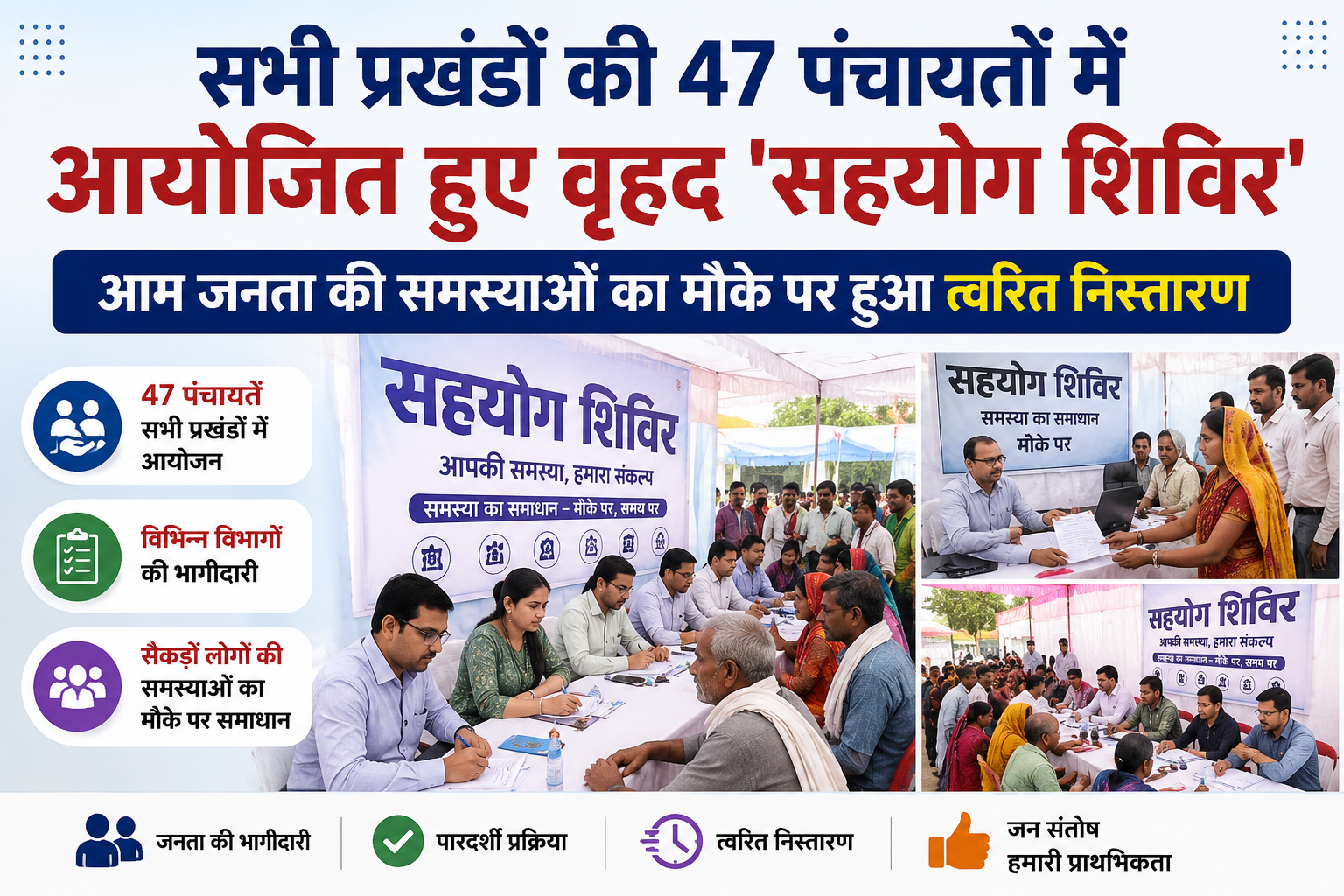
Grand 'Sahyog Shivirs' Organized Across 47 Panchayats in All Blocks; Instant Resolution of Public Grievances On-the-Spot
Muzaffarpur: The true beauty of a democracy lies in how close the administration is to the common people and with what sensitivity and speed their everyday grievances are addressed. When administrative machinery steps out of paper files and the four walls of offices to reach directly onto the doorsteps of villages and panchayats, the trust of ordinary citizens in the government and system multiplies manifold. A deeply inspiring and comprehensive news story regarding good governance and grassroots grievance redressal has emerged from the Muzaffarpur district, which holds a distinct identity in the administrative and social landscape of Bihar. Under a special campaign initiated by the Muzaffarpur district administration, grand-scale 'Sahyog Shivirs' (Cooperation Camps) were organized across designated 47 Panchayats spanning all the blocks of the district.
The primary objective of these camps was to provide a common platform for all needy and distressed residents of rural tracts where they could place their family, land-related, social, pension, ration card, or other government scheme-related complaints directly before the concerned officials. A massive gathering thronged these camps to present their respective problems, and such was the promptness of the administration that instant resolutions were delivered on-the-spot for many minor and severe complaints alike. To evaluate the ground reality of this entire arrangement and maintain strict efficiency, District Magistrate (DM) Kumar Gaurav personally conducted a surprise and intensive inspection of these various camps, issuing necessary directives to the officials. This initiative has infused a renewed wave of positive energy throughout the rural belts of Muzaffarpur.
Conception of Sahyog Shivirs and Selection of Panchayats
The framework for these cooperation camps organized by the Muzaffarpur district administration was meticulously designed to ensure the direct outreach of administrative services down to the most remote and rural corners of the district.
Strategic Selection of 47 Panchayats: Across the various blocks of the district, 47 specific panchayats were targeted where previous reports regarding the non-receipt of developmental benefits or pending public complaints had been relatively high.
All Departments Under One Roof: The greatest hallmark of these camps was the simultaneous presence of key officers and staff from the Anchal (Revenue) office, Child Development Project, Supply Department, Health Department, and Panchayat Raj Department under a single marquee.
Convenience for the Public: Villagers were spared the ordeal of running to block or district headquarters for months over petty grievances, instilling hope for a resolution right within their own panchayat.
Atmosphere of the Camps and Major Grievances Presented
When the doors of the cooperation camps opened across these 47 panchayats from early morning on the designated date, crowds of villagers poured in. People were seen standing in queues carrying their applications and supporting documents.
Land Disputes and Mutation Issues: In rural sectors, the vast majority of cases pertained to land disputes, paternal property partitioning, and pending mutation applications. Several farmers voiced their distress before the Anchal Officer.
Social Security Pensions and Ration Cards: Elderly, widowed, and disabled citizens registered complaints regarding non-disbursement of pensions or names being dropped from beneficiary lists. Furthermore, a massive volume of applications was submitted for procuring new ration cards and adding names to existing ones.
Nal-Jal (Tap Water) Schemes and Power/Roads: Local residents also submitted memorandums concerning basic rural infrastructure, such as non-functional handpumps, incomplete tap-water projects, and repairs needed for broken lanes.
"The duty of the administration is to serve the public. These cooperation camps set up across 47 panchayats in Muzaffarpur district stand as proof that our priority is rural development and on-the-spot redressal of grievances. We have issued explicit instructions to officials ensuring that no citizen returns empty-handed. For issues that could not be resolved instantly due to technical reasons, a fixed timeframe has been established." — DM Kumar Gaurav, interacting with locals during the inspection
Surprise Inspection and Administrative Rigor by DM Kumar Gaurav
To guarantee the success and transparency of these camps, Muzaffarpur District Magistrate Kumar Gaurav took charge personally, conducting field inspections of the camps operating across various panchayats.
Scrutiny of Documents and Registers: Arriving at the camp sites, the DM inspected the help desks deployed by various departments and verified whether incoming applications were being logged properly.
Monitoring Instant Resolutions: Several cases came before him whose execution was possible on the spot, such as immediate sanctioning of stalled old-age pension cases or forwarding ration card applications. The DM ensured prompt action in such cases and distributed approval certificates directly.
Stern Warning to Officials: During the inspection, the DM cautioned all concerned Block Development Officers (BDOs) and Anchal Officers (COs) in unequivocal terms that any laxity or apathy in matters of public welfare would not be tolerated. Officials responsible for keeping applications pending would invite strict disciplinary action.
Positive Outcomes of the Camps in Public Interest
The organization of these cooperation camps not only yielded prompt resolutions for public grievances but also injected transparency into the administrative workflow.
Restoration of Confidence: A renewed belief has taken root among villagers that they no longer require brokers or influential recommendations to secure justice and government benefits, as the government itself has come walking to their doorstep.
Reduction in Pending Cases: Hundreds of cases that had languished inside files for months gathered momentum through these camps, accelerating their disposal rate.
The cooperation camps organized across 47 panchayats in Muzaffarpur district, coupled with the intensive inspections conducted by DM Kumar Gaurav, present an exemplary model of good governance. When grievances are heard by reaching directly among the people and numerous issues are resolved instantly, the trust of the general masses in the administration becomes unshakeable. This initiative not only imparts a fresh dimension to rural development and administrative accountability in Muzaffarpur but also proves that with a clean intent and robust administrative will, resolving problems on the very doorstep of villages is entirely attainable.