
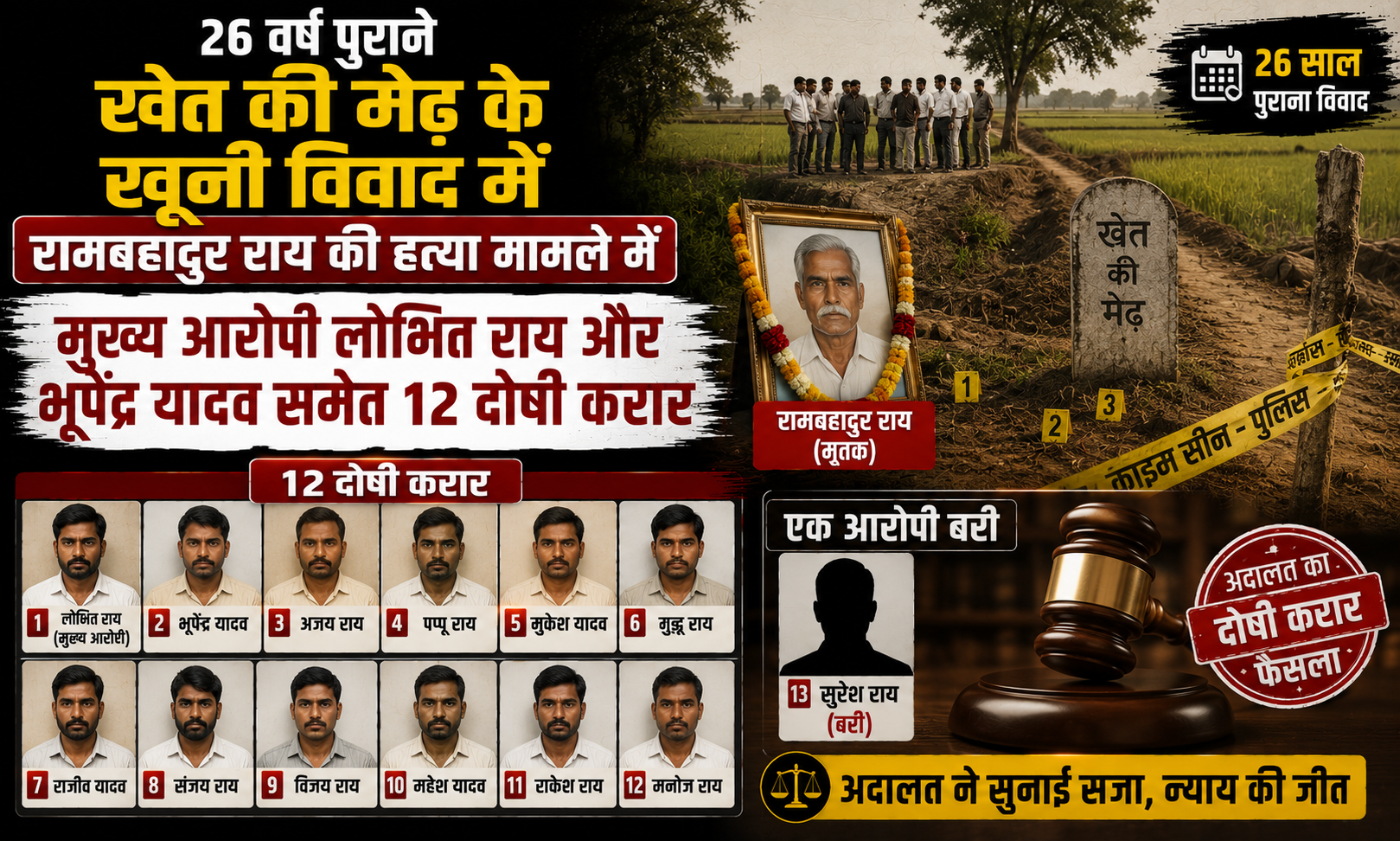
12 Convicted, Including Main Accused Lobhit Rai and Bhupendra Yadav, in the 26-Year-Old Murder Case Over a Boundary Dispute of Agricultural Fields; One Acquitted
Muzaffarpur: The living proof of the endurance, firmness, and validity of long legal processes within the Indian judicial system comprises those historic verdicts that bring forth the sun of truth and justice even in decades-old cases. When a family or social dispute turns so violent that it claims a human life, escaping the eyes of the law remains impossible—even if two and a half decades pass before reaching that justice. A judicial decision destined to serve as a deeply significant milestone in the history of crime investigation and justice in Bihar has emerged from a court in the Muzaffarpur district. Exactly 26 years ago in Muzaffarpur, an ordinary and petty dispute over the boundary of agricultural fields (Khet ki Medh) led to the brutal murder of a man named Rambahadur Rai. In this widely discussed and long-pending murder mystery, the Muzaffarpur Court has adopted a firm and major stance, convicting 12 accused persons.
Among the primary and mastermind accused whom the court held guilty of murder in this sensational case, the names of Lobhit Rai and Bhupendra Yadav feature prominently. Meanwhile, following this prolonged legal battle and rigorous scrutiny of evidence, the court also extended the benefit of the doubt and acquitted one accused. This verdict, arriving after 26 years, has once again kindled hopes for justice in the victim's family, underscoring that while the wheels of justice grind slow, they grind exceedingly fine.
The 26-Year-Old Dark Day: The Tale of Field Boundaries and a Bloody Conflict
This entire episode originates from a rural police station jurisdiction in the Muzaffarpur district, where agriculture served—and continues to serve—as the primary basis of livelihood for the populace. Verbal spats among neighboring farmers over field margins or "medh" commonly occur in villages, but when such disputes transform into ego and stubbornness, they can ruin a thriving family, as this incident tragically demonstrated.
Dispute Arising Over Cutting Boundaries: On the day of the incident, a minor argument erupted between the deceased, Rambahadur Rai, and the accused over the boundary of their adjoining fields. The accused faction was attempting to encroach upon land by cutting the boundary line, which Rambahadur Rai resisted.
Attack by a Violent Mob: This resistance escalated to the point where the main accused, Lobhit Rai, Bhupendra Yadav, and their other associates arrived equipped with lathis, sharp-edged weapons, and other implements in a premeditated assault on Rambahadur Rai.
Instant Death and Turmoil: In this sudden and brutal assault, Rambahadur Rai sustained grievous injuries and succumbed to them before reaching a hospital. Terror gripped the village following this heinous murder, laying the groundwork for a long-standing rivalry between the two factions. The victim's relatives registered a named First Information Report (FIR) at the police station, leading the police to file a chargesheet against the accused.
The 26-Year-Old Extended Court Trial and Examination of Evidence
Running a trial for 26 years in a murder case bears witness to how arduous the path to justice can be amidst turning hostile witnesses, shifting legal arguments, missing documents, and successive court dates.
Basis of Witnesses and Medical Reports: The special prosecution team collated the post-mortem report from that era, statements from eyewitnesses to the crime scene, and the converging links of the police investigation. Although several witnesses turned hostile over this extensive interval, the core evidentiary pillars remained robust.
Proving the Role of Key Accused: Throughout the prolonged legal arguments in court, it was established that Lobhit Rai and Bhupendra Yadav spearheaded the mob in executing this murder. The life of Rambahadur Rai was lost directly due to their instigation and physical blows.
Basis for Conviction: Upon reviewing all case files, material evidence, and witness testimonies, the judge clarified in the verdict that the prosecution successfully proved the murder charges against the 12 accused beyond a reasonable doubt. Accordingly, a total of 12 individuals, including Lobhit Rai and Bhupendra Yadav, were declared guilty, whereas another accused was acquitted due to a lack of sufficient evidence.
Implications of the Verdict for Society and the Legal System
This judgment, arriving after 26 years, holds profound significance not only for the family of Rambahadur Rai but also for rural society at large.
A Lesson in Restraint During Land Disputes: This incident teaches that individuals who resort to bloodshed over field margins or an inch of land ultimately cannot evade the clutches of the law, regardless of how many generations or decades pass before justice is served.
Commitment of the Judiciary: Maintaining a case through such an extended timeframe and ultimately bringing the guilty to the threshold of punishment demonstrates how dedicated our courts remain toward the resolution of criminal trials.
The conviction of 12 accused persons in the Rambahadur Rai murder case arising from a 26-year-old agricultural boundary dispute in Muzaffarpur marks a major victory for justice. The culpability established for prime accused individuals like Lobhit Rai and Bhupendra Yadav proves that the ultimate outcome of violent acts rests behind bars. However, the acquittal of one accused also illustrates that courts deliver justice not based on emotion alone, but strictly in accordance with stringent evidence and legal rules. This verdict brings the 26-year-long wait of the victimized family to a logical and righteous conclusion.


