
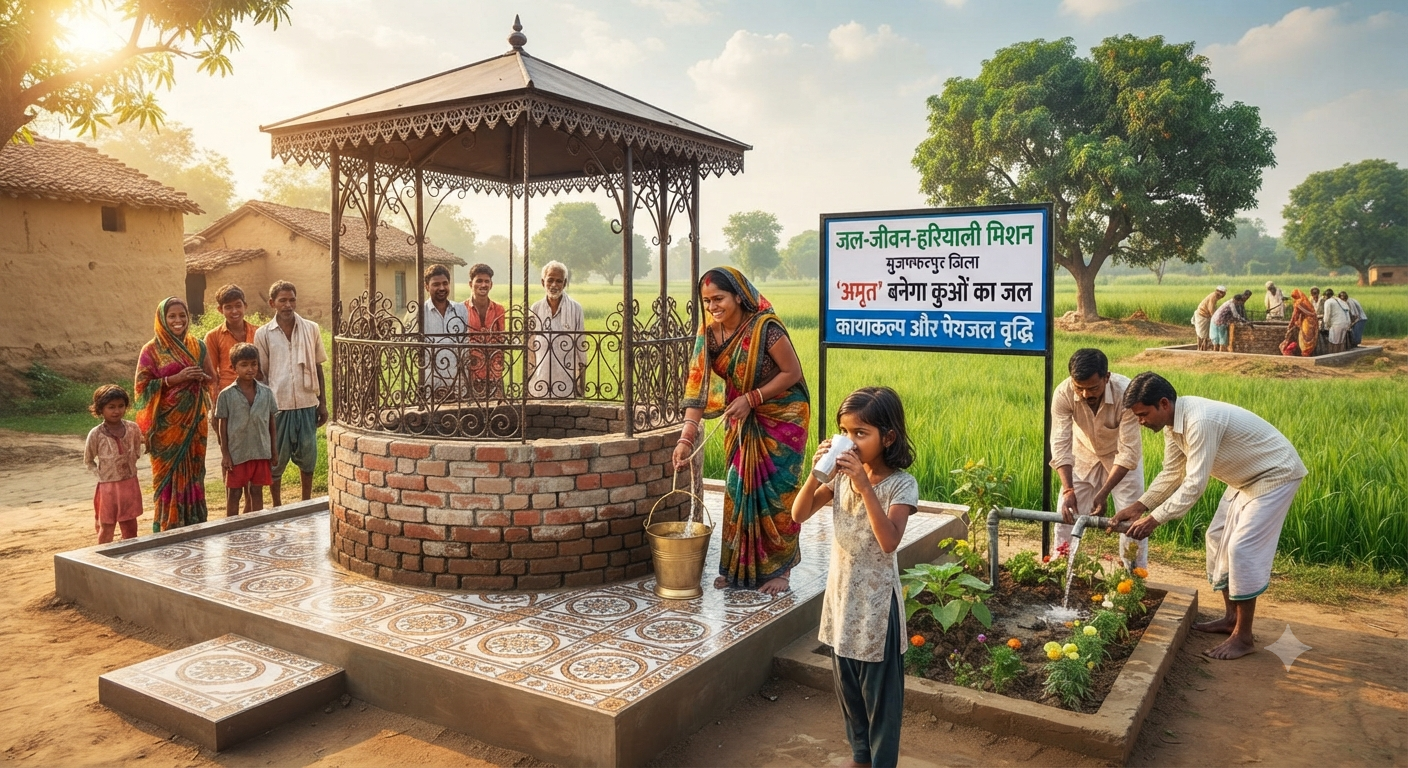
Well Water to Become 'Amrit' (Nectar) in Muzaffarpur: Rejuvenation Under Jal-Jeevan-Hariyali Mission to Increase Drinking Water Availability in Panchayats
Muzaffarpur. In an era of increasing water crises and declining groundwater levels, the Muzaffarpur district administration has taken an extremely commendable and visionary initiative. In the rural areas of the district, old and dilapidated wells will now be rejuvenated to serve as a strong and vital source of water supply. These wells will be renovated along the lines of the 'Amrit Sarovar' scheme, which will not only resolve the shortage of drinking water but also promote water conservation in rural areas.
A New Dimension of the 'Jal-Jeevan-Hariyali' Mission
Under the state government's ambitious 'Jal-Jeevan-Hariyali' mission, this scheme is being implemented in a phased manner across all blocks and panchayats of the district. The district administration believes that wells have traditionally been natural water sources that are environment-friendly. Their rejuvenation will not only help recharge the groundwater level but also prove to be a sustainable alternative for local water supply.
Key Features of the Scheme: Transformation Along the Lines of 'Amrit Sarovar'
Under this scheme, a survey of selected wells in each panchayat is being conducted. The renovation process will include the following tasks:
Cleaning and Desilting: Removing years of accumulated dirt and silt from inside the wells and deepening them.
Concrete Curbing: Construction of concrete walls and high parapets around the wells to ensure safety and hygiene.
Beautification: Planting shady trees around the wells and constructing platforms (chabutras) for sitting, so that they can be developed as a 'community space' in the rural environment.
Water Quality Testing: After the renovation, the water quality of the wells will be tested by the Health Department to ensure it is potable.
Why is this Initiative Necessary?
In the current times, a large number of government and private wells in rural areas have either been filled in due to neglect or have turned into heaps of garbage. Expressing concern over this situation, senior officials of the district administration stated:
"When water crises deepen in rural areas, these wells prove to be life-saving. Preserving these wells will not only ensure the availability of drinking water but is also essential for environmental balance."
Implementation Across All Panchayats
The Block Development Officers (BDOs) of all blocks in Muzaffarpur have been instructed to prepare a list of wells in their respective panchayats that are eligible for renovation. The administration's goal is to ensure that in the coming time, every panchayat in the district has at least two to three fully functional wells.
Environmental Benefits and Groundwater Augmentation
The restoration of wells is not just a means to extract water; wells act as 'water recharging points.' When rainwater percolates into the ground through these wells, it helps raise the groundwater level. Experts believe that this scheme will lead to an improvement in the local water table within the next 3-5 years.
Community Participation: 'My Water, My Responsibility'
The administration is also making efforts to turn this scheme into a 'mass movement.' The responsibility for the upkeep of the wells will be handed over to local ward members and village committees. This is being discussed in Gram Sabhas so that villagers understand that the well in their village is not just a structure, but a village asset that it is their moral duty to protect.
Challenges and the Administration's Resolve
Implementing this scheme on the ground is also a challenge for the administration. In many places, wells have been encroached upon. The administration has made it clear that all encroachments identified under 'Jal-Jeevan-Hariyali' will be cleared. In this regard, the Revenue Department has also been instructed not to be lax in freeing wells situated on public land from encroachment.
The Way Forward
The administration's efforts are timely, given the upcoming summer season. While the government is working on the 'Nal-Jal' (Tap-Water) scheme to address drinking water shortages, the restoration of wells will serve as a strong 'backup' for the project. If for any reason the tap-water scheme is disrupted due to technical faults, the rejuvenated wells will provide clean water to the villagers without any interruption.
This effort by Muzaffarpur is not just an administrative project; it is a gift of water conservation for our future generations. By linking the 'Amrit Sarovar' model with the rejuvenation of wells, the district administration has written a new chapter in the water revolution. It is hoped that this scheme will not only make Muzaffarpur's rural landscape lush and green but will also prove to be a role model for other districts.


