
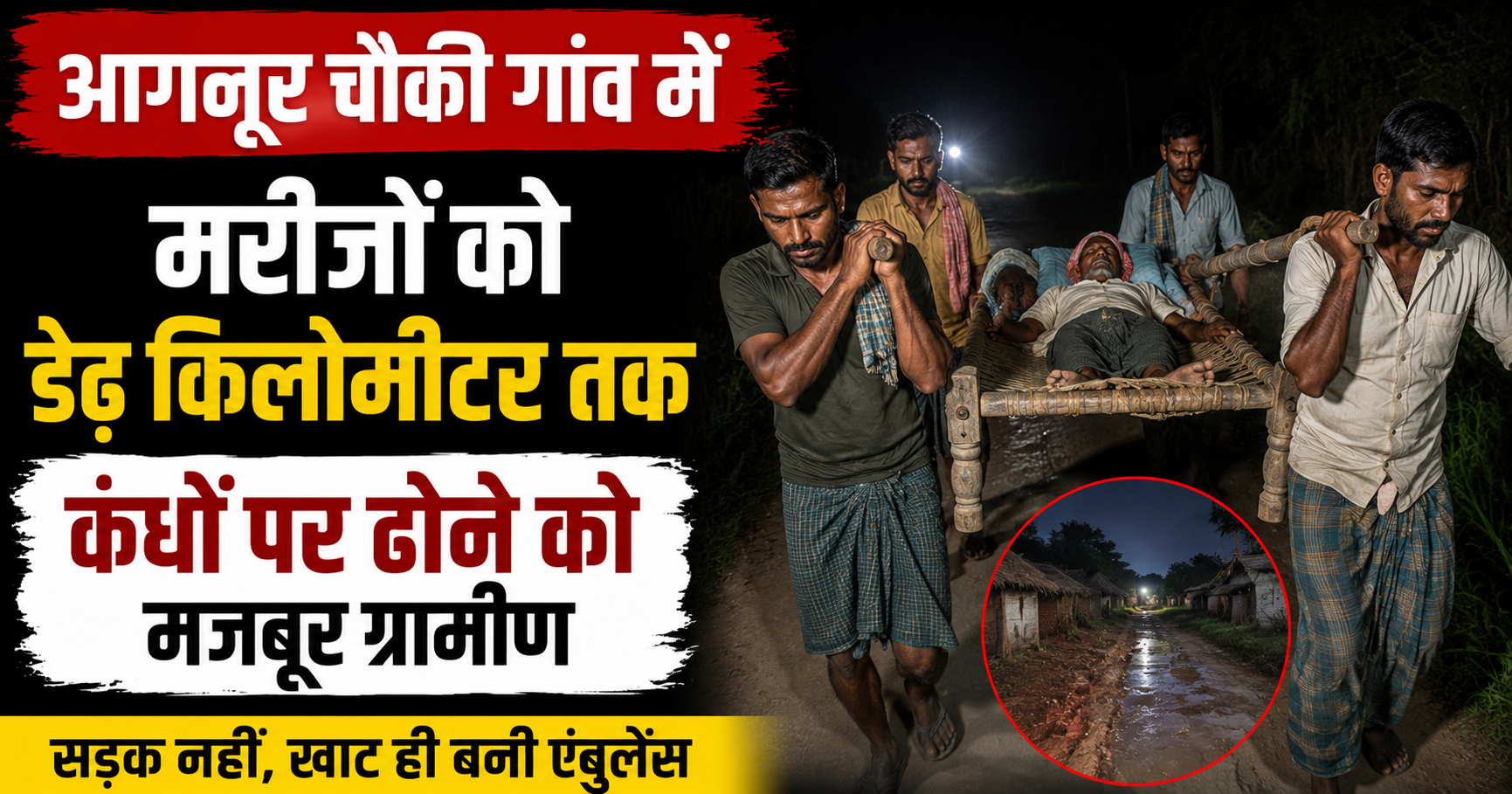
Villagers Forced to Carry Patients 1.5 Kilometres to Reach Medical Help in Aganur Chouki
Aganur Chouki, July 16: The situation in Aganur Chouki village presents a stark reminder of the challenges still faced by many rural communities in India. Whenever someone falls seriously ill during the night or a pregnant woman requires urgent medical attention, the first thing villagers look for is not an ambulance—but a traditional cot (charpoy). Four people lift the cot onto their shoulders and begin a painful journey of nearly 1.5 kilometres to the nearest motorable road, from where the patient can finally be taken to a hospital.
Residents say they have been demanding a proper road for years, but despite repeated appeals, no permanent solution has been provided. During the monsoon season, the situation becomes even more difficult as the muddy pathway becomes almost impassable.
Lack of Road Turns Every Medical Emergency into a Challenge
For the people of Aganur Chouki, accessing healthcare is often a difficult and time-consuming task. While some residents manage to travel on foot or by motorcycle during the day, emergencies at night become a major ordeal.
Ambulances are unable to reach the village because there is no all-weather road connecting it to the main route. As a result, villagers are left with no option but to carry patients on a cot to the nearest accessible road.
Patients Carried on Shoulders for Nearly 1.5 Kilometres
According to villagers, the nearest road where vehicles can reach is about 1.5 kilometres away. The route passes through narrow footpaths, uneven ground, agricultural fields, and unpaved tracks.
Four villagers lift the patient on a cot and carefully walk the entire distance. During the rainy season, the muddy and slippery path makes the journey even more dangerous and physically exhausting.
Pregnant Women and Elderly Residents Face the Greatest Hardship
The lack of road connectivity affects everyone, but pregnant women, elderly residents, and critically ill patients suffer the most.
Villagers say women in labour often have to be carried on cots to reach medical facilities. Similarly, elderly people and accident victims face delays in receiving emergency treatment.
Health experts emphasize that the "golden hour" is critical for many medical emergencies, and delays in reaching a hospital can significantly increase health risks.
Monsoon Makes the Situation Worse
Heavy rainfall during the monsoon further complicates transportation.
The earthen pathway turns into deep mud, making it difficult for villagers to maintain balance while carrying patients. In some places, waterlogging blocks the route entirely, increasing the danger for both patients and those carrying them.
Ambulances Cannot Reach the Village
Although government ambulance services are available, residents are unable to fully benefit from them because ambulances cannot enter the village.
Emergency vehicles can only reach the main road, forcing villagers to first carry patients over the difficult route before an ambulance can take them to a hospital. This delay often proves critical during medical emergencies.
Villagers Have Been Demanding a Road for Years
Residents say they have repeatedly approached public representatives and government officials, requesting the construction of a proper road.
According to villagers, promises are frequently made during elections, but little progress is seen afterward. They believe that a paved road would not only improve healthcare access but also enhance education, employment opportunities, and agricultural development.
Children's Education Also Affected
The absence of proper road connectivity impacts more than healthcare.
Schoolchildren struggle to reach their schools, especially during the rainy season when the muddy path becomes nearly impossible to cross. Many students are forced to miss classes because of the poor condition of the route.
Farmers Face Transportation Problems
Agriculture is the primary source of livelihood for most families in the village.
Without proper road access, farmers find it difficult to transport their produce to nearby markets. During the monsoon, vehicles are often unable to reach the village, causing delays and financial losses.
Residents Appeal to the Administration
Villagers have once again urged the district administration and the concerned departments to construct a proper road at the earliest.
They stress that the issue is not merely about convenience but about saving lives. According to residents, timely road construction could prevent many avoidable tragedies during medical emergencies.
Experts Highlight Importance of Rural Connectivity
Rural development experts say that road infrastructure is one of the most fundamental requirements for the overall development of any village.
Reliable road connectivity improves access to healthcare, education, employment, markets, and emergency services. They argue that villages where patients still have to be carried on cots should receive priority in infrastructure planning.
Administration Expected to Respond
Residents hope that the administration will take their concerns seriously, conduct the necessary surveys, and begin the road construction process without further delay.
They believe that a permanent road would transform daily life and significantly improve access to essential public services.
The situation in Aganur Chouki village reflects the continuing infrastructure challenges faced by many rural communities. While modern ambulance networks and healthcare services are expanding across the country, some villages still depend on a simple cot as an ambulance because of the absence of a motorable road. The villagers are not asking for extraordinary facilities—they are demanding a basic road that would allow patients, pregnant women, elderly residents, and children to reach essential services safely and on time. The focus is now on whether the administration will respond promptly and address this long-standing issue.


