
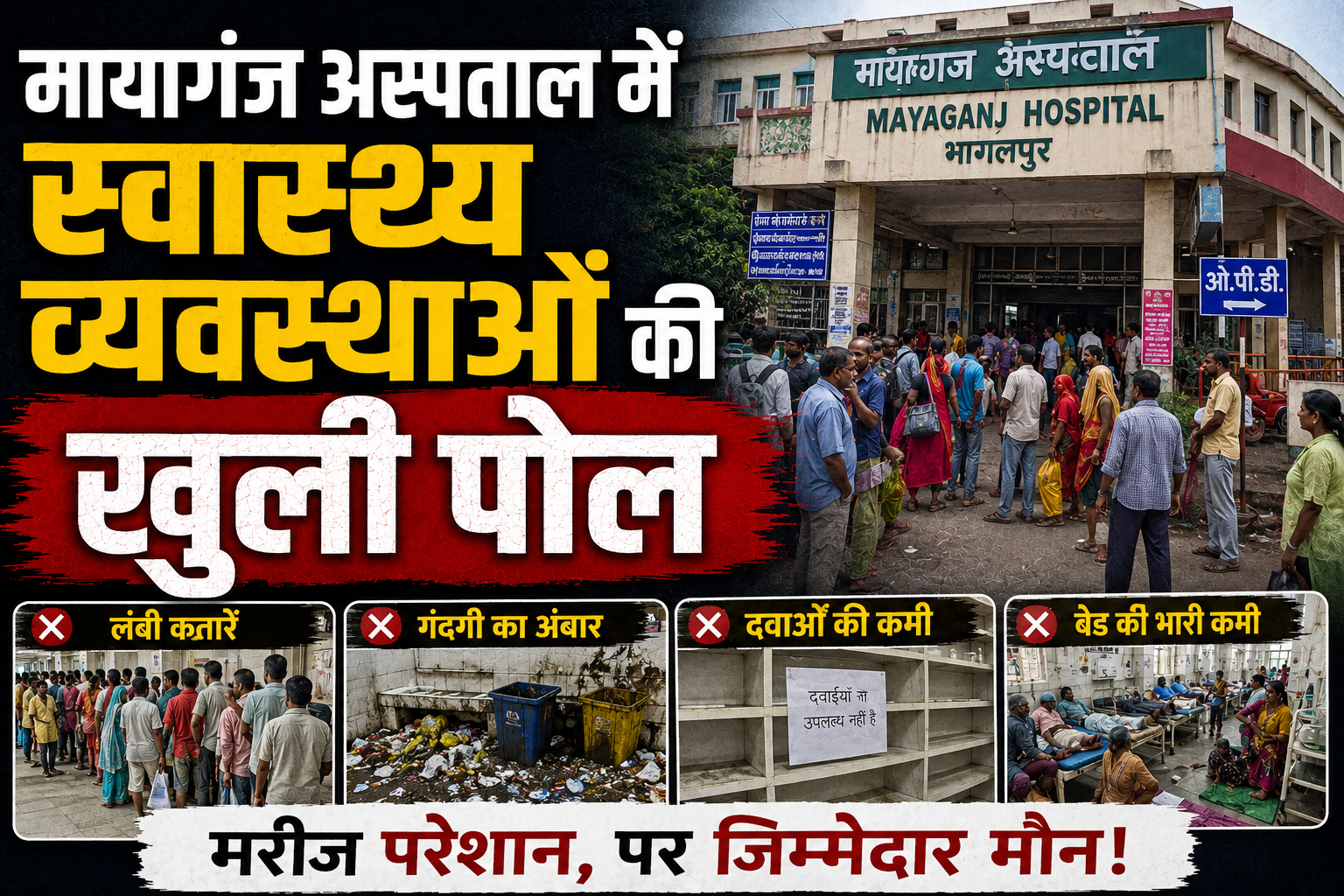
Truth of Healthcare Services Exposed at Mayagunj Hospital; MRI Tests Shut Down for the Past Four Months, JLNMCH Administration Gives Private Testing Agency a Final 10-Day Grace Period
Bhagalpur, Chief Correspondent: Ranked among the largest medical institutions in Bihar, Bhagalpur’s Jawaharlal Nehru Medical College and Hospital (JLNMCH)—locally known as Mayagunj Hospital—has once again come into the spotlight for grave administrative negligence and the abysmal state of its healthcare services. The crucial MRI testing service, operated on a Public-Private Partnership (PPP) mode within the hospital premises, has remained completely crippled for the past four months. Despite this severe crisis, rather than taking concrete action, the hospital administration has once again granted the concerned private testing agency a mere 10-day grace period. Due to this lax approach, the hardships of poor patients are mounting, forcing them to suffer heavy financial losses alongside serious health risks.
MRI Machine Shut Down for Four Months, Excuse of Exhausted Helium Gas Given
The suspension of an essential, modern diagnostic facility like an MRI for four months in a premier institution like Mayagunj Hospital lays bare the sluggish working style of the health department. According to hospital sources, citing technical faults and the exhaustion of 'helium gas' in the machine operated by the private agency, testing services have been stalled for a long time.
Astonishingly, months have elapsed since the machine went out of order, yet no solid steps have been taken by the agency to repair it. Earlier as well, the hospital administration kept issuing mere verbal directives and warnings, which had zero impact on the agency. Consequently, dozens of critical patients arriving daily at Mayagunj Hospital are forced to return empty-handed without getting tested or have to resort to private labs outside at exorbitant rates.
Which Patients Are Facing the Maximum Hardship?
MRI scans are considered the backbone for the neurology, orthopedics, and emergency departments of any hospital. With this service shut down at Mayagunj, patients are grappling with the following major issues:
Road Accident and Head Injury Patients: In accident cases involving severe head injuries, MRIs are critically essential to detect internal bleeding or brain status. The absence of testing creates obstacles in initiating timely treatment.
Bone and Internal Organ Disorders: Patients suffering from complex ailments such as spinal fractures, severe joint issues, and internal inflammation or tumors are unable to receive accurate diagnoses.
Financial Exploitation: With MRI services closed at Mayagunj, patients are compelled to visit private diagnostic centers across the city. Private labs arbitrarily charge two to three times the government rates, breaking the backs of poor and middle-class families. Several patients are even forced to take out loans for their treatment.
Hospital Superintendent's Warning: Strict Action If Services Are Not Restored in 10 Days
Following rising public allegations and media reports, Mayagunj Hospital Superintendent Dr. H.P. Dubey took cognizance of the matter. Issuing another ultimatum to the concerned private testing agency, the hospital administration made it clear that they have been granted a 10-day grace period.
The hospital superintendent stated in no uncertain terms that if MRI testing services are not fully operationalized at Mayagunj Hospital within the stipulated 10 days, strict action will be initiated against the agency under the terms of the contract. An official letter will also be dispatched to the Health Department, Bihar, recommending the cancellation of the contract and initiation of blacklisting procedures.
Grave Questions Raised on Administrative Functioning
Local citizens, social activists, and patients' relatives question why the administration remains silent for four months when a private agency fails to deliver services according to contract rules and conditions. Granting merely a 10-day grace period somewhere points toward collusion or complacency. If the MRI machine is not streamlined in a timely manner, violent protests outside the hospital could also erupt.
The four-month shutdown of MRI tests at JLNMCH (Mayagunj Hospital) in Bhagalpur and the administration's mere granting of a grace period serves as a glaring reflection of the system. Bringing healthcare services back on track requires hard administrative action on the ground rather than just paper ultimatums, ensuring that poor patients arriving from distant places with hopes of treatment receive their constitutional right and accessible medical services.


