
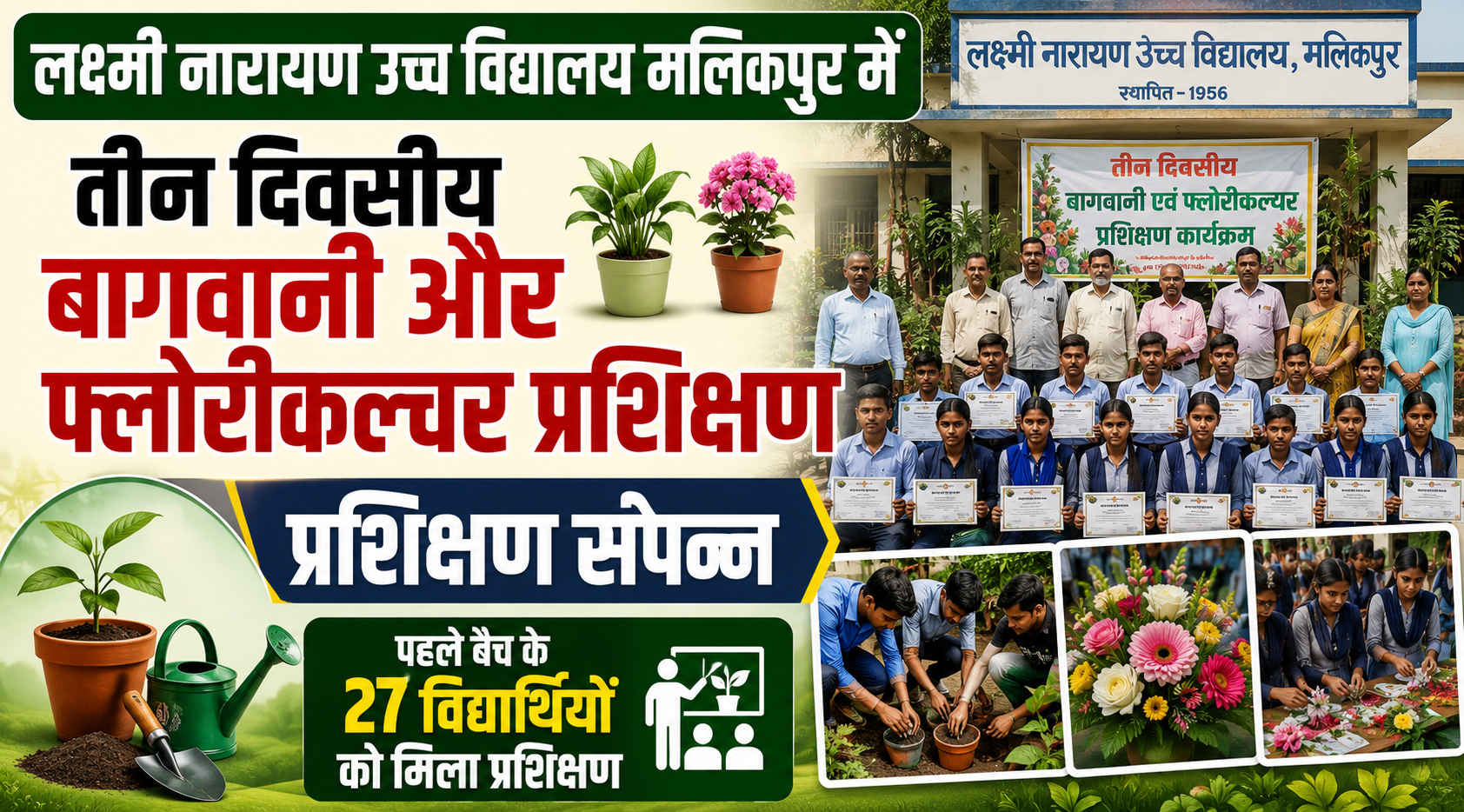
Three-Day Horticulture and Floriculture Training Concludes at Lakshmi Narayan High School Malikpur, 27 Students Trained
Bhagalpur: A three-day training programme on horticulture and floriculture concluded on Saturday at Lakshmi Narayan High School in Malikpur, located in Pirpainti block of Bhagalpur district. The programme was organized with the objective of developing practical skills among students and introducing them to modern techniques related to horticulture and flower cultivation.
The concluding session was attended by the representative of the local MLA, the school principal, teachers, trainers and other guests. The programme formally began with the lighting of a ceremonial lamp.
A total of 27 students participated in the first batch of the training programme. During the three-day session, they received technical and practical information about horticulture, plant care and floriculture.
Concluding Session Begins With Lamp Lighting
The concluding programme began with the traditional lighting of a ceremonial lamp in the presence of the MLA representative, school principal, teachers, trainers and other guests.
During the session, discussions were held about the knowledge and practical experience gained by students during the three-day training.
The trainers explained that horticulture and floriculture are no longer limited to traditional farming. With modern techniques and proper market knowledge, these sectors can also provide employment and self-employment opportunities.
The school administration appreciated the active participation of the students throughout the training.
27 Students Trained in the First Batch
A total of 27 students were trained in the first batch.
During the three-day programme, students were introduced to different aspects of horticulture.
The training covered subjects such as soil preparation, planting, irrigation, use of manure and fertilizers, plant care and methods of protecting plants from diseases.
Students were also introduced to various aspects of floriculture, including the identification of different flower varieties, suitable growing conditions and proper methods of cultivation and maintenance.
Focus on Practical Learning
The primary objective of the training was not limited to theoretical education. Special emphasis was placed on practical learning.
Horticulture is a field in which classroom knowledge alone is not sufficient. Students need to understand soil conditions, irrigation requirements, plant growth and methods of caring for plants through practical experience.
Therefore, students were encouraged to participate in practical activities during the programme.
This helped them understand the actual process of plant cultivation and flower farming.
Employment Opportunities in Floriculture
Floriculture, or flower cultivation, is emerging as a promising agricultural sector.
Flowers are widely used for weddings, religious functions, decorations, hotels and various social events.
There are also opportunities to create small businesses based on bouquets, decorative products and other flower-related items.
During the training, students were introduced to the potential of floriculture as a career and business opportunity.
They were informed that with appropriate cultivation techniques, market knowledge and proper planning, flower farming can be developed into a profitable enterprise.
Scope for Self-Employment Through Horticulture
Horticulture can also provide several opportunities for self-employment.
Nurseries, fruit and vegetable cultivation, flower farming and ornamental plant businesses can be started on a relatively small scale.
Students who acquire technical knowledge can potentially explore opportunities in plant nurseries, floriculture and other horticulture-related activities in the future.
Information about government schemes, agricultural assistance and financial support can further help young people turn their skills into small businesses.
Encouraging Students to Take Interest in Agriculture
Many young people in rural areas are increasingly looking for career options beyond traditional agriculture.
Training programmes in horticulture and floriculture can help students develop a new interest in agriculture by showing them how modern technology and business practices can be integrated into farming.
Such programmes can encourage students to view agriculture not only as a traditional occupation but also as a modern sector offering opportunities for entrepreneurship and employment.
Focus on Skill Development at School Level
The programme is also aligned with the broader emphasis on skill-based and practical education.
Providing students with exposure to horticulture and floriculture at the school level can help them understand agriculture, environmental conservation and entrepreneurship from an early stage.
Such training can also help students explore potential career options before completing their formal education.
Training Also Linked to Environmental Protection
Horticulture is closely connected with environmental protection.
Planting trees, maintaining greenery and caring for plants contribute to improving the local environment.
Training students in plant care can also help create awareness about the importance of green spaces and environmental conservation.
If schools develop gardens and encourage students to participate in their maintenance, it can further strengthen their connection with nature.
Benefits for the Local Rural Area
The Pirpainti region and surrounding rural areas have considerable potential for agriculture and horticulture.
Providing young people with modern technical knowledge and information about markets could help them explore employment and self-employment opportunities within their own communities.
Horticulture and floriculture activities do not always require large areas of land. Small-scale nurseries and flower cultivation can also be developed on limited plots.
This makes the training particularly relevant for students from rural backgrounds.
Importance of Post-Training Support
Although training 27 students is an important beginning, continued support after the completion of the programme will be essential.
Students could benefit from advanced training, guidance from agricultural experts, information about government schemes and opportunities to connect with markets.
Regular workshops at the school could also help students remain updated about new technologies and modern cultivation practices.
Students Share Their Training Experience
During the concluding session, the experiences of the participating students were also discussed.
Students gained new knowledge about plant care, horticulture and flower cultivation during the three-day programme.
The school administration expressed hope that the skills acquired during the training would prove useful to students in their future education and career choices.
Trainers also encouraged students to continue practicing the techniques they had learned and to develop a deeper understanding of plant cultivation and maintenance.
Possibility of More Training Programmes
Following the successful completion of the first batch, similar training programmes could potentially be organized for more students in the future.
Expanding the programme would allow a larger number of students to benefit from technical knowledge related to horticulture and floriculture.
Collaboration between the school, agricultural experts and relevant horticulture institutions could make future training programmes even more effective.
The three-day horticulture and floriculture training programme at Lakshmi Narayan High School, Malikpur, in Pirpainti block of Bhagalpur district concluded on Saturday.
The concluding session was inaugurated with the lighting of a ceremonial lamp by the MLA representative, school principal and other guests.
A total of 27 students were trained in the first batch and received technical and practical knowledge related to horticulture, plant care and flower cultivation.
The initiative provided students with an opportunity to understand modern agriculture and explore potential employment and self-employment opportunities.
If such training programmes are continued and students are provided with further technical guidance, access to government schemes and market linkages, the initiative could make a significant contribution to skill development and employment opportunities for rural youth in the region.


