
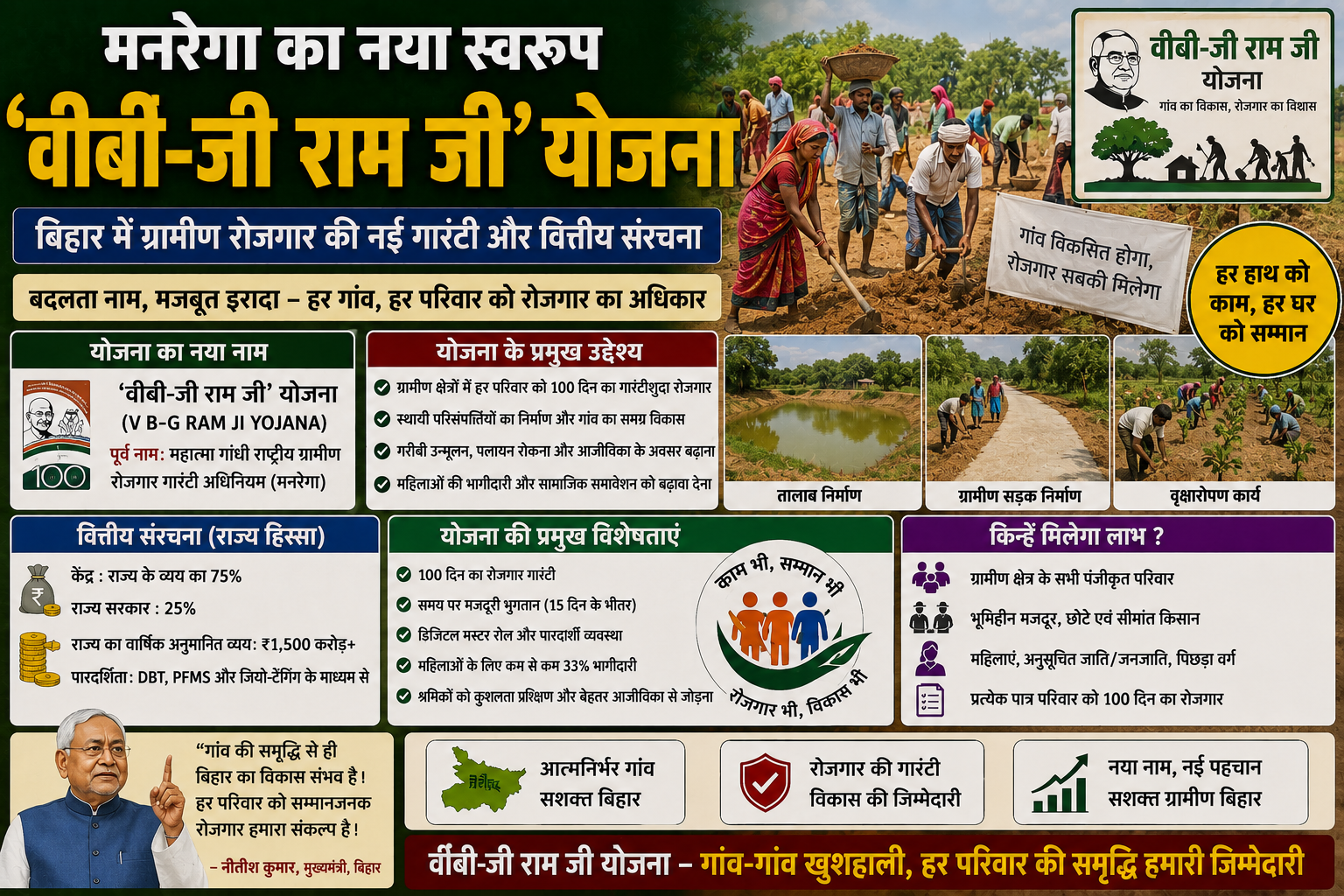
The New Avatar of MGNREGA — 'VB-G RAM G' Scheme — New Employment Guarantees and Financial Structure for Rural Bihar
A new era in rural development began in Bihar on July 1, 2026. Replacing the Mahatma Gandhi National Rural Employment Guarantee Act (MGNREGA), the 'Viksit Bharat - Guarantee for Employment and Livelihood Mission (Rural)', abbreviated as 'VB-G RAM G', has been effectively implemented. Rural Development Minister Shravan Kumar has termed this scheme a "game changer" for the state's rural economy.
'VB-G RAM G' Scheme: At a Glance
This mission has been designed keeping in mind the vision of 'Viksit Bharat @2047'. Its primary objective is not only to provide employment but also to construct permanent rural infrastructure and enhance livelihood opportunities.
Increase in Employment Days: The 100 days of guaranteed employment previously available under MGNREGA have been increased to 125 days.
Increase in Daily Wages: With the aim of improving the standard of living for laborers, the daily wage has been raised from ₹255 to ₹300.
Mission Goal: The goal is to strengthen the rural economy, support agricultural activities, and effectively curb the migration of rural youth.
Financial Structure and State Contribution
A significant financial outlay has been allocated for the successful implementation of the scheme. According to data shared by Minister Shravan Kumar:
Central Government's Interim Budget: An interim budget of ₹6,715 crore has been set by the Central Government for the operation of this mission.
State Government's Share: The Minister clarified that the State Government will now contribute a substantial ₹4,477 crore (approximately ₹4,500 crore) toward this scheme. This amount reflects the Bihar government's commitment to strengthening rural infrastructure.
Timeliness in Implementation and Special Exemptions
While implementing the scheme, the peak season for agricultural work has been duly considered.
Priority to Agricultural Work: In six major districts—Jamui, Lakhisarai, Munger, Shekhpura, Bhagalpur, and Banka—paddy cultivation is in full swing.
Temporary Stoppage of Work: To ensure that farmers and laborers do not face difficulties during agricultural activities, work under this scheme has been temporarily halted in these districts until July 20.
Rescheduling: Once agricultural activities are completed, work will resume at full capacity in these districts starting July 21.
Key Features of the Scheme (Technical and Social Aspects)
'VB-G RAM G' has been designed to be more transparent and modern than the traditional MGNREGA:
Technology-Based Monitoring: Real-time monitoring of every project will be conducted to ensure there is no scope for corruption.
Social Audit: A system of social audit at the local level has been made mandatory to ensure the quality and transparency of the work.
Creation of Sustainable Assets: Moving beyond mere digging, this scheme emphasizes the construction of concrete paths, water conservation structures, and other community assets.
Social and Economic Impact
The implementation of this scheme is expected to bring positive changes to rural areas:
Local Employment: By providing 125 days of work within the village, the rate of migration is expected to decrease.
Economic Empowerment: The increase in wages will enhance the purchasing power of rural families, thereby stimulating local markets.
Self-Reliant Villages: This mission is a concrete step toward making villages self-reliant in terms of infrastructure.
The Bihar government’s contribution of approximately ₹4,500 crore to the 'VB-G RAM G' scheme makes it clear that the state government prioritizes rural development. If implemented correctly, this scheme will not only transform the rural landscape of Bihar but will also propel the state forward in the race toward a 'Viksit Bharat' (Developed India).
The challenge at the administrative level now lies in the honest and transparent utilization of these funds, ensuring that the benefits of the scheme reach the person standing at the very end of the line, without the interference of middlemen.


