

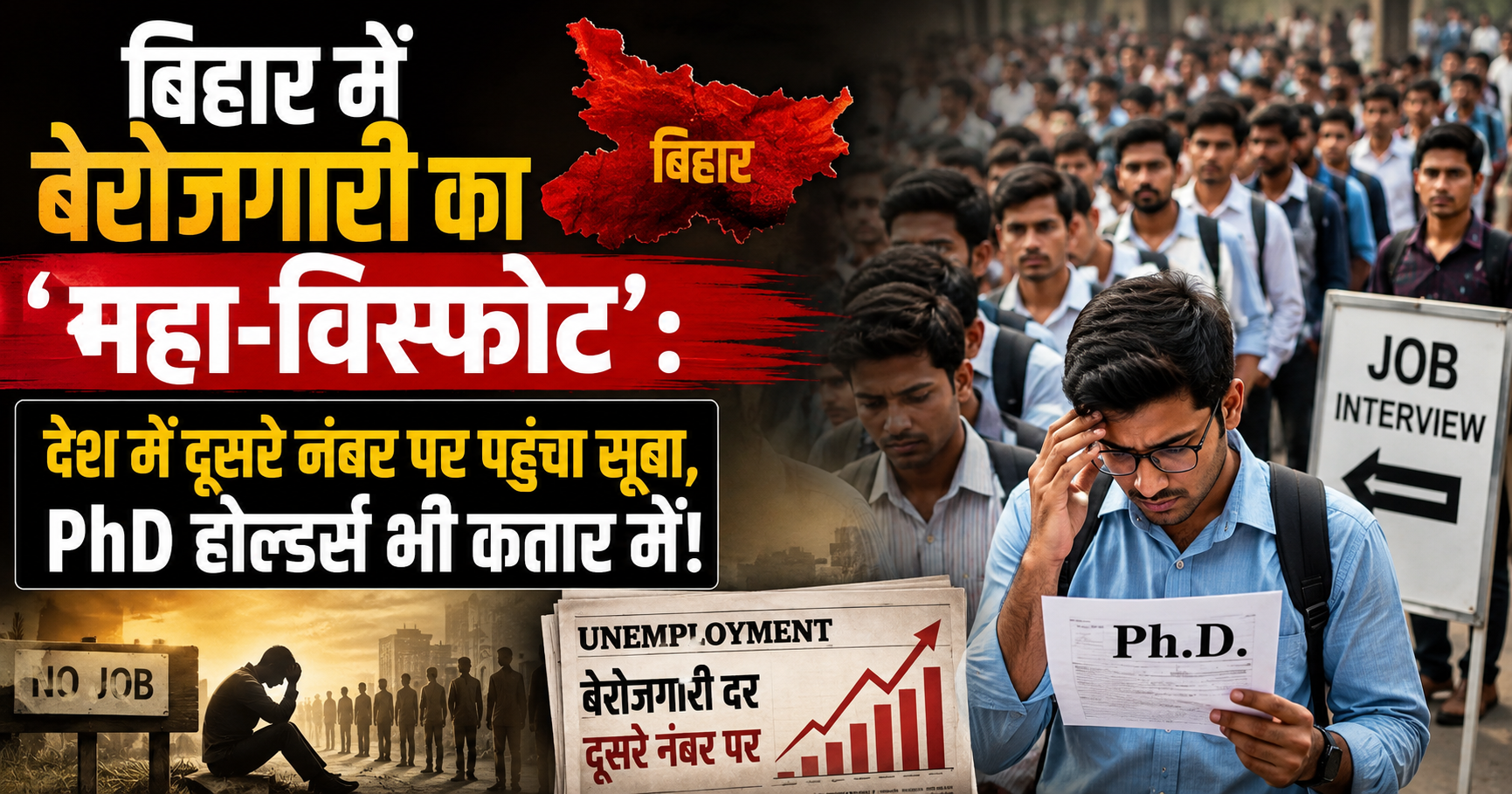
State Ranks 2nd Nationally, PhD Holders Standing in Queue!
Employment in Bihar has always been the epicenter of politics, debates, and electoral promises. However, when the reality of statistics emerges from beneath the layers of claims and promises, the picture looks deeply alarming. The latest data released by the Ministry of Labour and Employment’s National Career Service (NCS) portal paints a grim picture. In the list of 'registered' unemployed youth across the country, Bihar has now climbed to the second spot. Most shockingly, this queue does not just comprise undereducated youth—even specialists holding the highest academic degree (PhDs) are wandering in search of a job.
By the Numbers: The Stark Reality of Unemployment in Bihar
Youth from across the nation have registered on the National Career Service (NCS) portal looking for livelihood opportunities. Bihar's figures in this mega-registration drive have left experts startled:
National Total: Over 62.6 million (6.26 crore) unemployed individuals have registered on the portal nationwide.
Bihar’s Share: Bihar alone accounts for more than 5.41 million (54.14 lakh) youth in this total pool. This means 8.65% of the country's registered unemployed population hails from Bihar.
Active Job Seekers: Out of these 5.4 million registered individuals, 2.66 million (26.67 lakh) youth are entirely active, regularly tracking jobs, vacancies, and job fairs on the portal.
State-wise Comparative Standing
When comparing major Indian states, the top states in terms of registered unemployed individuals are as follows:
| State | Number of Registered Unemployed |
|---|---|
| 1. Maharashtra | 9.97 Million (99.73 Lakh) |
| 2. Bihar | 5.41 Million (54.14 Lakh) |
| 3. Madhya Pradesh | 5.00 Million (50.00 Lakh) |
| 4. Uttar Pradesh | 5.00 Million (50.00 Lakh) |
| 5. Assam | 4.16 Million (41.68 Lakh) |
Note: Although Maharashtra ranks first on this list, Bihar ranking second is a grave concern for its economy and the future of its youth, given its high population density, lower per capita income, and lagging industrial development.
Age and Gender Metrics: Which Segment is Hurting the Most?
The most critical aspect of this report is the demographic breakdown (by age and gender) it offers of the unemployed population.
Equal Demands from Both Men and Women
While it is often assumed that men are more aggressively active in the job market, the data from Bihar shows that women are equally desperate to become self-reliant:
Male Unemployed: 2.72 Million (27.29 Lakh)
Female Unemployed: 2.66 Million (26.60 Lakh)
Third Gender (Transgender): 523
25 to 34 Age Group Hits the Hardest
Employment is most crucial at an age when an individual wants to settle down in life. According to the data, the heaviest blow has fallen on this exact age bracket:
16 to 18 Years: 73,000 (Looking for work during or right after schooling)
18 to 24 Years: 1.81 Million (18.13 Lakh - Fresh college pass-outs)
25 to 34 Years: 2.34 Million (23.44 Lakh - The most affected demographic)
35 to 44 Years: 790,000
45 to 54 Years: 297,000
55 to 64 Years: 92,000
Above 64 Years: 6,742 senior citizens (Still hunting for work at this stage of life to sustain themselves)The 'Discounting' of Degrees: From PhD Holders to Illiterates
The purpose of education is to secure a better future and stable employment. However, a massive mismatch between educational attainment and job opportunities is evident in Bihar.
PhD and Specialists: 650 PhD degree holders in the state have registered on the NCS portal for a job. This number serves as a chilling testament that higher education is no longer a guarantee of employment.
Graduates and Post Graduates: 515,000 Graduates and 64,000 Post Graduates (PG) are struggling to find work. Additionally, 25,000 youth who pursued technical diplomas after the 10th grade are also in line.
School Education (9th to 12th): The largest pool consists of youth looking for work after basic schooling. This includes 1.52 million who studied up to 9th grade, 1.29 million 10th-pass, and 1.27 million 12th-pass individuals.
Illiterate: Around 562,000 individuals who lack formal education have also registered on the portal, desperately searching for manual labor or any form of basic employment.
Record Spike in Election Year: What Drove the Influx?
An analysis of the timeline reveals a fascinating trend. The registration of unemployed individuals witnessed an unprecedented surge during the recent election cycles and election years in Bihar. The youth anticipated that government recruitment drives or large-scale job fairs would launch amidst the political campaigns.
The April to August Phase: Registration hovered at 64,000 in April, 62,000 in May, 55,000 in June, 72,000 in July, and 86,000 in August.
The September-October Explosion: As election activities intensified, registrations skyrocketed to a record 500,000 in September and 371,000 in October within single months.
November to March: Following this, registrations stabilized at 141,000 in November, 106,000 in December, and averaged around 70,000 to 76,000 monthly in the initial months of the new year.
Annual Registration Graph of Bihar over Recent Years:
2022-23: 4,414
2023-24: 133,667
2024-25: 901,188
2025-26: 1,682,043
This annual graph proves that while awareness regarding the portal has grown, the sheer multi-fold leap in registrations reflects a growing desperation due to a lack of immediate jobs.
What is the National Career Service (NCS) Portal?
Operated by the Ministry of Labour and Employment, Government of India, the NCS Portal is a digital platform designed to bridge the gap between job seekers and employers.
Mandatory for Job Fairs: Registering on this portal has become essential for Bihar's youth because an NCS registration is mandatory to participate in any 'Job Fair' (Rozgar Mela) organized by the state government or private firms.
Access to Global Employers: Large national and international corporations directly pull and shortlist candidate data from this database based on merit and skill criteria.
Compelled Self-Employment: Interestingly, around 55,000 youth registered on this portal are currently classified as self-employed (running small local setups), but have still registered themselves in hopes of finding a more secure and permanent job.
The acute shortage of industrial investment, slow-paced government recruitment processes, and the lack of a robust manufacturing sector are viewed as the foundational causes of this widespread unemployment in Bihar. Until the state witnesses massive private investments and creates localized opportunities for its skilled youth, this long queue on the National Career Service portal is unlikely to shrink anytime soon. Bihar's 5.4 million registered unemployed youth are not just a static statistic; they represent an entire generation waiting for the promise of a better tomorrow.