

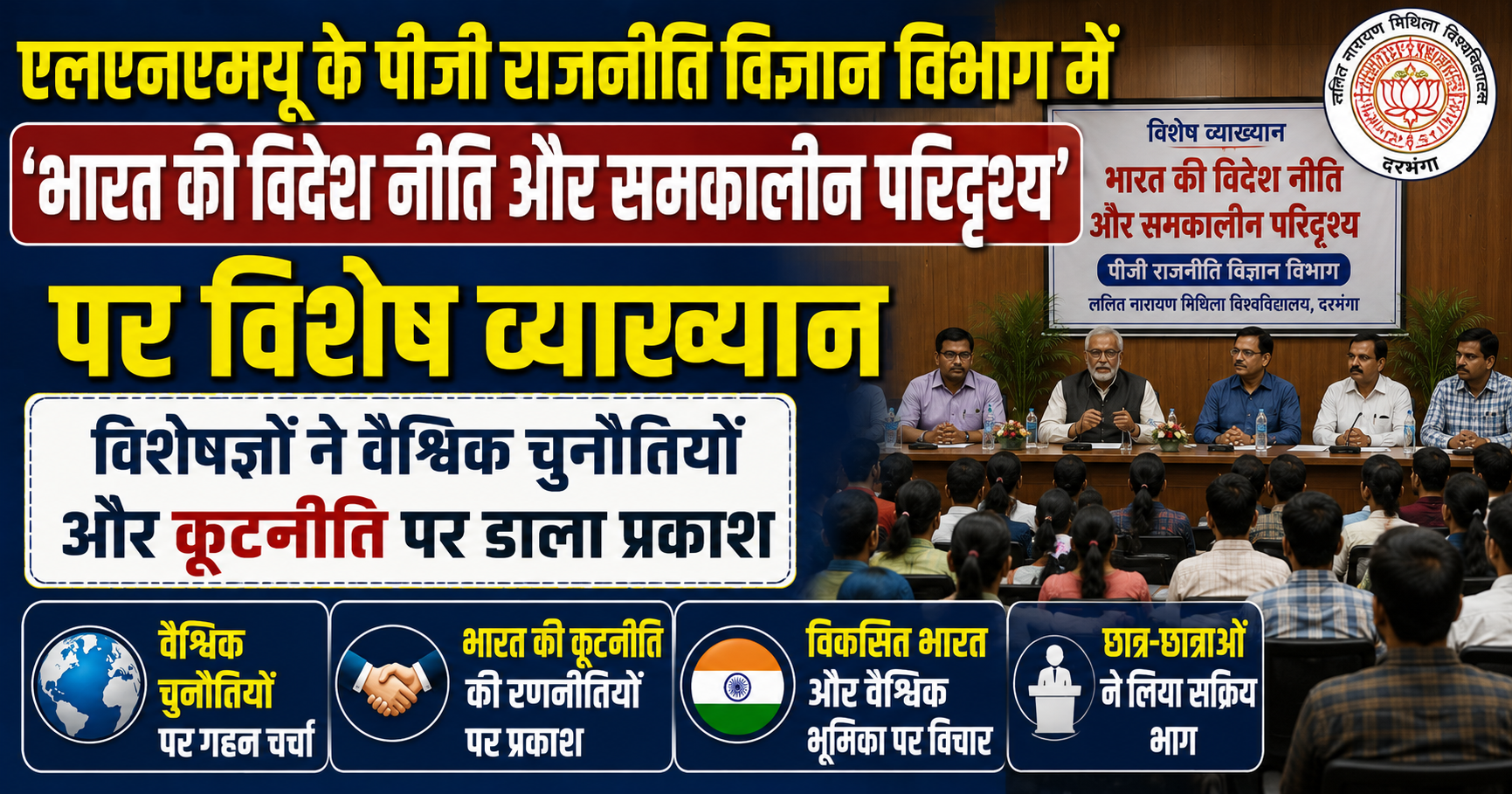
Special Lecture on ‘India’s Foreign Policy and the Contemporary Global Scenario’ Held at LNMU; Experts Discuss Evolution of Indian Diplomacy and Emerging Global Challenges
Darbhanga News:
A special lecture on “India’s Foreign Policy and the Contemporary Global Scenario” was organized on Sunday by the Postgraduate Department of Political Science at Lalit Narayan Mithila University (LNMU). The event witnessed the participation of faculty members, research scholars, students, and academicians from various departments. The lecture focused on the historical evolution of India’s foreign policy, changing global dynamics, emerging international challenges, and the country’s growing role in world affairs.
Delivering the keynote address, Prof. Satyanarayan Prasad said that India’s foreign policy extends beyond diplomatic relations and plays a crucial role in safeguarding national security, promoting economic development, strengthening strategic interests, encouraging international cooperation, and preserving the country's cultural values. He emphasized that despite the enormous challenges faced at the time of Independence, India successfully laid a strong foundation for its foreign policy.
India’s Foreign Policy Took Shape After Independence
Prof. Satyanarayan Prasad explained that after gaining independence in 1947, India had the responsibility of formulating a foreign policy that would protect national interests while promoting global peace and cooperation.
He noted that in its early years, India adopted the principles of non-alignment, peaceful coexistence, and maintaining friendly relations with all nations. At a time when the world was deeply divided by the Cold War rivalry between two major power blocs, India chose an independent and balanced foreign policy instead of aligning itself with either side. This approach earned the country a distinctive position in international diplomacy.
Discussion on the Importance of the Non-Aligned Movement
During the lecture, Prof. Prasad elaborated on the significance of the Non-Aligned Movement (NAM) and India's leading role in representing the interests of developing nations on the global stage.
He said that the policy of non-alignment enabled India to make independent decisions on international issues while maintaining strategic autonomy. Although global circumstances have changed significantly over the decades, India has consistently upheld its core principles of peace, cooperation, mutual respect, sovereignty, and constructive international engagement.
India's Expanding Role in the Changing Global Order
Prof. Prasad observed that international politics has become far more complex in the modern era. Issues such as globalization, technological advancement, climate change, cybersecurity, terrorism, energy security, and economic competition have become increasingly important in shaping foreign policy.
He noted that India has emerged as one of the world's leading economies and now plays a more influential role in international forums. The country's active participation in global organizations reflects its growing diplomatic influence and international standing.
Importance of Relations with Neighboring Countries
The lecture also highlighted the significance of India's relations with its neighboring countries. Prof. Prasad emphasized that stable and positive ties with neighboring nations are an essential component of any country's foreign policy.
He underlined the importance of border security, regional trade, cultural exchanges, and regional cooperation in maintaining peace and stability across South Asia. According to him, India's foreign policy seeks not only to protect national interests but also to promote regional development and peaceful coexistence.
Students Introduced to the Practical Aspects of Foreign Policy
During the interactive session, Prof. Prasad explained that foreign policy affects far more than government-to-government relations. It has a direct impact on trade, education, employment, investment, technological collaboration, and the everyday lives of citizens.
He encouraged students to study international relations, history, political science, and economics together in order to better understand global developments and international diplomacy.
Encouraging Academic Research and Intellectual Debate
Faculty members attending the event remarked that such academic lectures play a significant role in enhancing students' knowledge and encouraging meaningful research. They said these discussions help students and scholars develop a deeper understanding of contemporary international issues.
Research scholars also interacted with the speaker by raising questions about India's diplomatic strategy, international relations, and future foreign policy priorities, all of which were addressed in detail.
Interactive Question-and-Answer Session Draws Attention
The question-and-answer session became one of the highlights of the program. Students asked questions about India's global role, reforms in the United Nations, regional cooperation, economic diplomacy, strategic partnerships, the emerging world order, and changing geopolitical developments.
Responding to the queries, Prof. Prasad explained that while India's foreign policy continues to evolve in response to changing international circumstances, national interest and strategic autonomy remain its fundamental guiding principles.
Head of the Department Expresses Gratitude
At the conclusion of the program, the Head of the Department thanked the keynote speaker, faculty members, research scholars, and students for their active participation.
He stated that the university would continue organizing similar academic events to provide students with opportunities to interact directly with experts on important national and international issues.
He also encouraged students to participate regularly in such programs and pursue serious academic study of contemporary political and global affairs.
Students Gain Fresh Perspectives
Students who attended the lecture said the event helped them gain a better understanding of the historical development of India's foreign policy, its present-day challenges, and its future prospects.
They observed that such academic discussions are valuable not only for examinations but also for developing a broader understanding of international politics and global diplomacy.
The special lecture sparked renewed interest among students in international relations and India's foreign policy, while faculty members expressed hope that similar academic initiatives would continue in the future, further strengthening the university's tradition of intellectual discourse and scholarly engagement.