
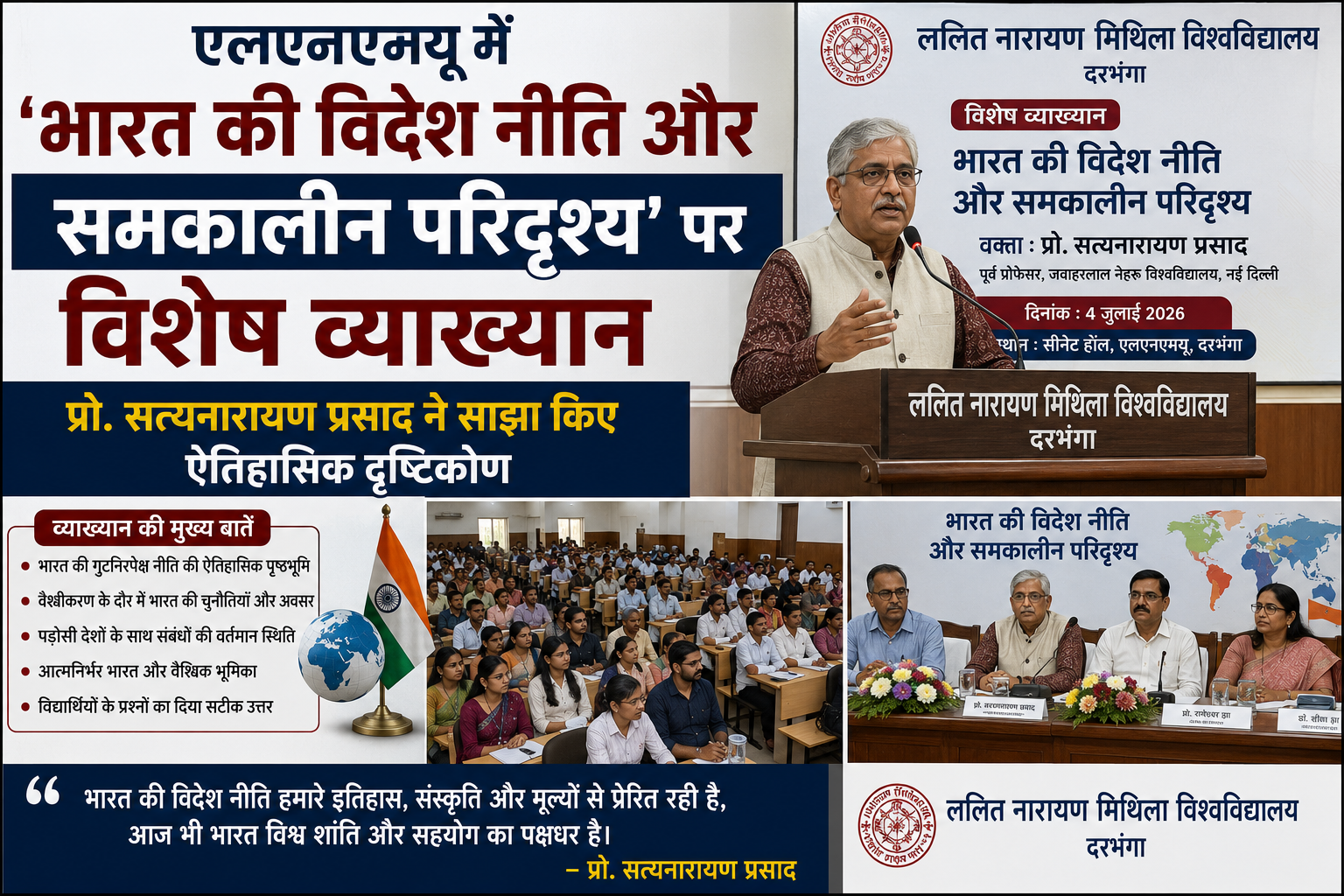
Special Lecture at LNMU on 'India’s Foreign Policy and Contemporary Landscape': Prof. Satyanarayan Prasad Shares Historical Perspectives
Darbhanga: A significant academic event was recently held at the Department of Political Science (Postgraduate), Lalit Narayan Mithila University (LNMU). The department organized a special lecture series on the subject, "India’s Foreign Policy and Contemporary Landscape," featuring renowned academician Prof. Satyanarayan Prasad as the keynote speaker. During the program, he held an insightful discussion on the evolutionary journey of India’s foreign policy and its historical context.
Historical Basis of Foreign Policy: Challenges at the Time of Independence
Prof. Satyanarayan Prasad began his lecture by discussing the global circumstances at the time of India’s independence. He explained that when India gained freedom, the world was divided into two blocs (the United States and the Soviet Union during the Cold War). At that time, India’s foreign policy was crafted around maintaining an independent identity and avoiding alignment with any military bloc.
Prof. Prasad emphasized that:
Policy of Non-Alignment (NAM): Under the visionary leadership of India’s first Prime Minister, Pandit Jawaharlal Nehru, India chose the path of 'Non-Alignment.' This decision was a testament to the diplomatic maturity of that era.
Peace and Coexistence: By adopting the principles of 'Panchsheel,' India paved the way for peaceful coexistence before the world.
Capacity for Independent Decision-Making: He explained that in the initial phase, India's priority was to strengthen its nascent democracy and achieve economic self-reliance, which required a peaceful international environment.
The Evolutionary Nature of Foreign Policy
During the lecture, Prof. Prasad discussed how India’s foreign policy has changed over time. He noted that while policy was more inclined toward 'Idealism' in the early decades, it has rapidly moved toward 'Realism' in modern times. He highlighted several important phases:
The Era of Economic Diplomacy: After the liberalization of 1991, 'Economic Diplomacy' entered India’s foreign policy.
Towards a Multi-polar World: India is now playing its role not just as a regional power, but as a global power.
Strategic Autonomy: Today, India is capable of forging strategic partnerships with any country in pursuit of its national interests, which reflects its growing global stature.
Contemporary Landscape: Balancing Challenges and Opportunities
Highlighting the challenges of current foreign policy, Prof. Satyanarayan Prasad remarked that today’s world is highly complex. India has to proceed with great caution amidst its relationships with neighbors, border disputes, and shifting global equations.
Relations with China and Pakistan: A major part of India’s current foreign policy is maintaining a 'Balance of Power' with neighboring countries.
Leadership on the Global Stage: By chairing the G20 and becoming the voice of the 'Global South,' India has proven that its foreign policy is no longer 'reactive,' but 'proactive.'
Digital and Tech Diplomacy: Cybersecurity and technological cooperation have now become new pillars of India’s diplomacy.
Lessons for Students and the Role of the Department
The Head of the Department, who presided over the event, stated that such lectures provide students with a practical and diplomatic perspective beyond textbook knowledge. For the PG Political Science students, Prof. Satyanarayan Prasad’s lecture was highly inspiring. He encouraged students not only to study history but to learn how to conduct a nuanced analysis of the diplomatic shifts happening in the present.
The special lecture concluded with the observation that India’s foreign policy has always been rooted in the philosophy of 'Vasudhaiva Kutumbakam' (The world is one family). While it has certainly evolved with time and circumstances, the core elements of 'peaceful development' and 'equality' remain intact.


