
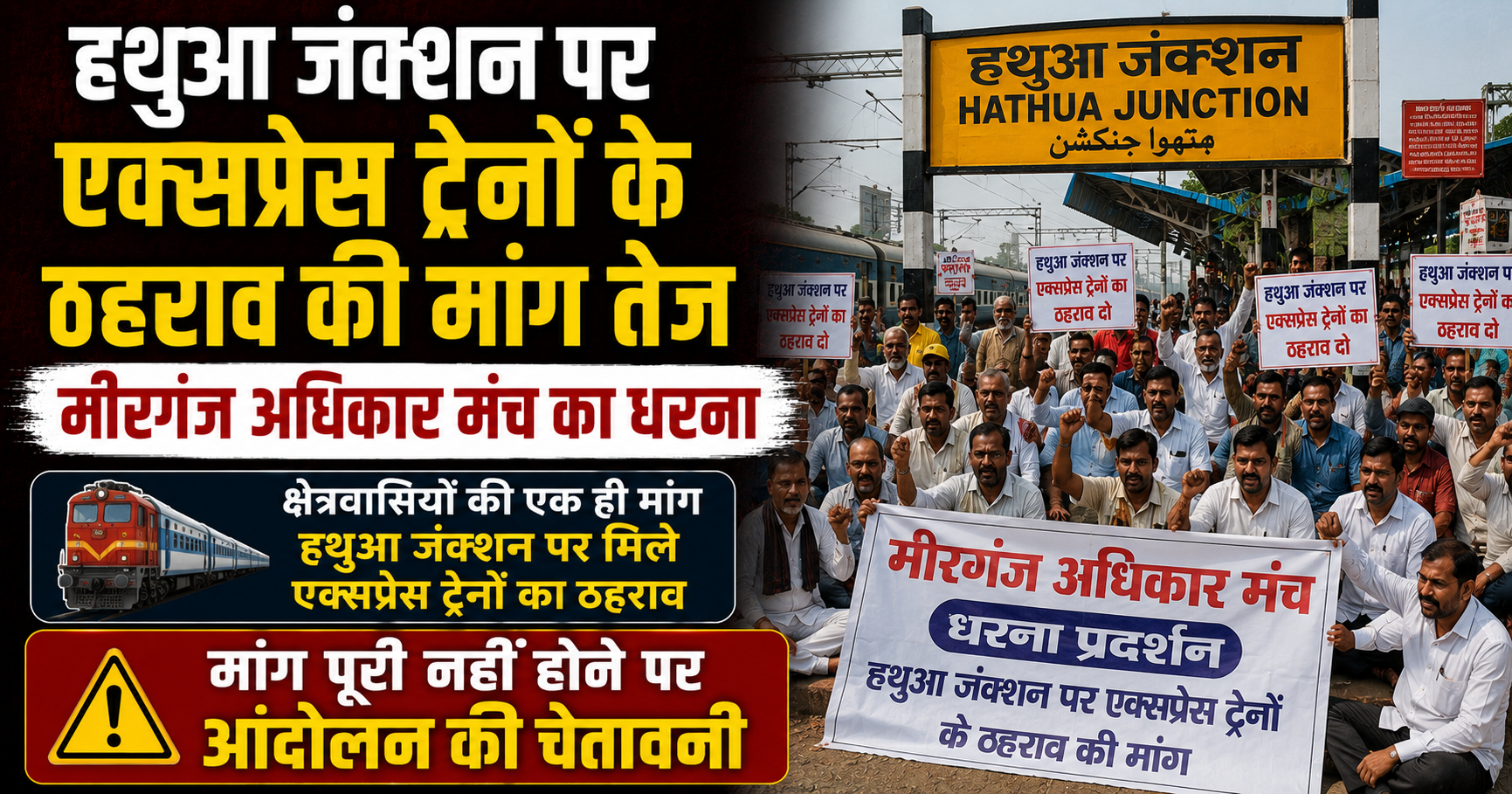
Protest Demands Halt of Major Express Trains at Hathua Junction; Mirganj Adhikar Manch Warns of Intensifying Agitation
Gopalganj News:
On Monday, members of the Mirganj Adhikar Manch and local residents staged a protest at Hathua Junction in Gopalganj district, demanding that major express trains be given regular stops at the station. A large number of people participated in the demonstration, urging the railway authorities to address the long-pending public demand. Protesters warned that if their demands were not met soon, they would intensify their agitation.
Carrying banners and placards, demonstrators raised slogans and appealed to the railway administration to consider the issue in the larger public interest. The protest was attended by social activists, traders, students, youth, local representatives, and residents from nearby areas.
Long-Pending Demand Raised Once Again
According to the protesters, Hathua Junction is one of the important railway stations in Gopalganj district and serves thousands of passengers every day. However, several major express trains pass through the station without stopping, forcing passengers to travel to distant railway stations to board long-distance trains.
Residents said the lack of stoppages results in additional travel time, higher transportation costs, and considerable inconvenience, especially for senior citizens, women, and students.
Public Interest at the Center of the Protest
Leaders of the Mirganj Adhikar Manch said the protest was organized solely in the public interest and had no political agenda. They stated that local residents have been demanding stoppages for major express trains at Hathua Junction for several years, but the railway administration has yet to take concrete action.
They argued that considering the station's strategic location and growing passenger traffic, it fully deserves stoppages for important express services.
Impact on Trade and Education
Local traders and students also joined the demonstration, saying that inadequate rail connectivity affects business activities and creates difficulties for students traveling to other cities for higher education, competitive examinations, and employment opportunities.
Business representatives noted that improved railway services would boost commercial activity and contribute to the region's overall economic development.
Appeal to Railway Authorities
The protesters urged the railway administration to prioritize passenger convenience and approve stoppages for major express trains at Hathua Junction at the earliest. They also requested that railway officials conduct an on-site inspection to assess the station's passenger volume and operational requirements.
They emphasized that consultations with local public representatives and community organizations could help identify a practical solution.
Warning of a Stronger Agitation
During the protest, organizers warned that if their demands continued to be ignored, they would launch a phased and more extensive movement. Future actions could include larger demonstrations, signature campaigns, submission of memorandums, and other peaceful democratic protests.
They asserted that the campaign would continue until regular stoppages of major express trains at Hathua Junction were approved.
Widespread Public Support
The protest received support from various social organizations, youth groups, women, senior citizens, and residents from across the region. Participants said that the railway authorities should recognize the genuine needs of passengers and take a positive decision without further delay.
Several speakers highlighted that improved rail connectivity is essential for regional development and that Hathua Junction should receive facilities in line with its growing importance.
The movement demanding express train stoppages at Hathua Junction has grown into a significant public campaign in Gopalganj. According to the Mirganj Adhikar Manch and local residents, improved railway connectivity would not only benefit passengers but also strengthen the region's economy, education, and overall development. Attention is now focused on the railway administration's response to this long-standing demand.


