
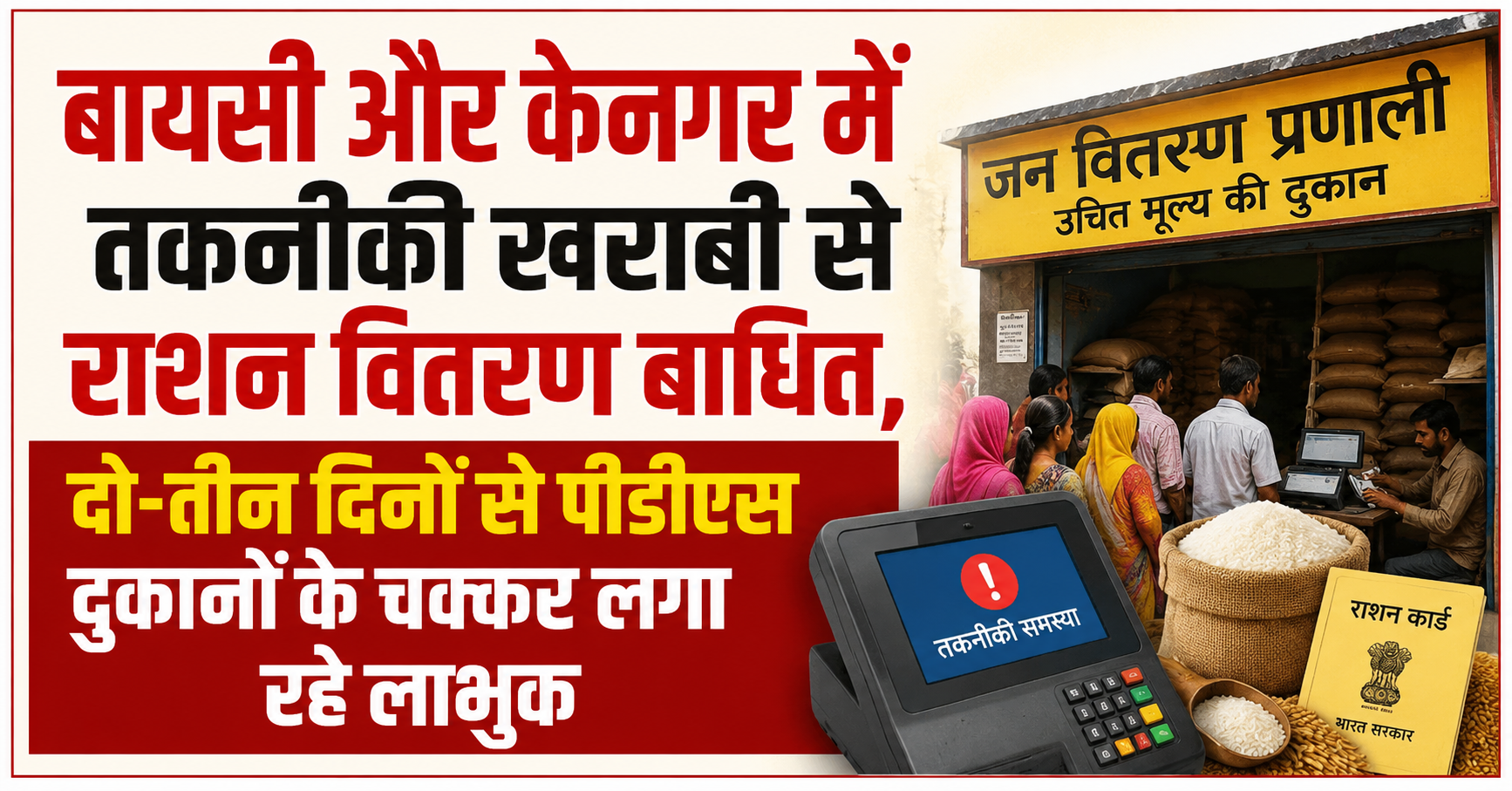
Ration Distribution Disrupted in Baisi and Kenagar Due to Technical Issues, Beneficiaries Forced to Return Empty-Handed
Purnia: Ration distribution through the Public Distribution System (PDS) has been disrupted in Baisi and Kenagar blocks of Purnia district due to technical problems at fair-price shops. For the past two to three days, several beneficiaries have been visiting PDS shops to collect their allotted ration but have been forced to return empty-handed because of technical difficulties. The situation has led to growing dissatisfaction among beneficiaries.
According to local information, ration distribution at several PDS outlets in Baisi and Kenagar has been affected due to technical problems. Beneficiaries are reaching the shops at the scheduled time, with many arriving early and waiting in queues. However, problems with the e-POS machines or the related online system are preventing the distribution process from being completed. Some shopkeepers have reportedly asked beneficiaries to return after the technical problem is resolved.
Beneficiaries Forced to Return Without Ration
The disruption has particularly affected families that depend heavily on the Public Distribution System for their monthly food requirements. For many households in rural areas, ration received through the PDS forms an important part of their food supply. Being unable to collect ration for two to three consecutive days has therefore become a serious concern.
Beneficiaries said they have to travel to the ration shops according to the distribution schedule. When they reach the shop only to find that ration cannot be distributed because of a technical problem, they lose both time and money. Many are now being forced to make repeated trips to the shops.
Several beneficiaries have demanded that the technical problems be resolved immediately and that adequate time be provided for those who could not collect their ration within the scheduled period. They said technical failures should not affect their entitlement to food grains.
Distribution Dependent on e-POS and Online System
The distribution of ration under the PDS now relies significantly on e-POS machines and digital verification systems. Beneficiaries are identified and the distribution process is completed electronically. Problems related to network connectivity, servers or machines can bring the entire process to a halt.
PDS dealers also face difficulties during such situations. Shopkeepers say that they cannot distribute ration manually when the digital system is not functioning. Beneficiary verification and the distribution process have to be completed through the system before the ration can be issued. As a result, when the machine or server fails, dealers have little choice but to ask beneficiaries to wait or return later.
Shopkeepers Also Facing Difficulties
The disruption has not only affected beneficiaries but also created problems for PDS dealers. People arriving at the shops naturally expect to receive their allotted ration. When distribution is not possible because of technical issues, disagreements may arise between beneficiaries and shopkeepers.
Shopkeepers say they also want beneficiaries to receive their ration on time. However, when the problem is related to the machine or online system, they cannot resolve it on their own. Several dealers have reportedly informed the concerned authorities about the issue and requested that the system be restored as soon as possible.
Local residents said that technical problems in ration distribution are not a new issue. Network or server-related failures have, on several occasions, forced beneficiaries to make repeated visits to PDS shops. The problem becomes even more serious in rural areas where internet connectivity can be weak.
Demand for Immediate Administrative Action
Beneficiaries in Baisi and Kenagar have urged the administration to resolve the technical problems immediately. They said poor and needy families should not be made to suffer unnecessarily while trying to collect their monthly ration. If distribution is interrupted due to technical reasons, the department should consider alternative arrangements wherever possible.
Residents have also demanded that additional distribution days be arranged for families who could not collect their ration because of the technical problems. This would allow beneficiaries to receive their entitled food grains without facing further inconvenience.
Villagers said the primary objective of the PDS is to ensure regular food-grain supplies to needy families. Therefore, whenever the system is disrupted because of technical problems, immediate departmental intervention is necessary.
Network Connectivity Remains a Major Challenge
The introduction of digital systems has been aimed at making ration distribution more transparent and efficient. However, network connectivity and technical infrastructure remain major challenges in several rural areas. When the network is weak or the server connection fails, beneficiary verification and ration distribution through the e-POS machine are affected.
Experts say that simply providing digital machines is not enough to make the system effective. Reliable internet connectivity, adequate server capacity and quick technical support are also essential. There should be a strong mechanism through which technical complaints from PDS shops can quickly reach support teams and be resolved.
Beneficiaries Hope for Early Relief
After ration distribution was disrupted in Baisi and Kenagar for the past two to three days, beneficiaries are now hoping for quick intervention from the concerned department. Their biggest concern is that they should not lose their monthly food-grain entitlement because of a technical problem.
Beneficiaries said they have been repeatedly visiting ration shops to collect their allotted food grains. If the technical issue is resolved soon, they will be able to return and collect their ration. At the same time, the administration will need to ensure that beneficiaries whose distribution was delayed receive their ration in an organized manner once the system becomes operational.
The situation in Baisi and Kenagar has highlighted the need to strengthen the technical infrastructure supporting digital ration distribution. A permanent solution is required so that poor families do not have to repeatedly visit PDS shops because of network failures, server problems or e-POS machine issues.


