


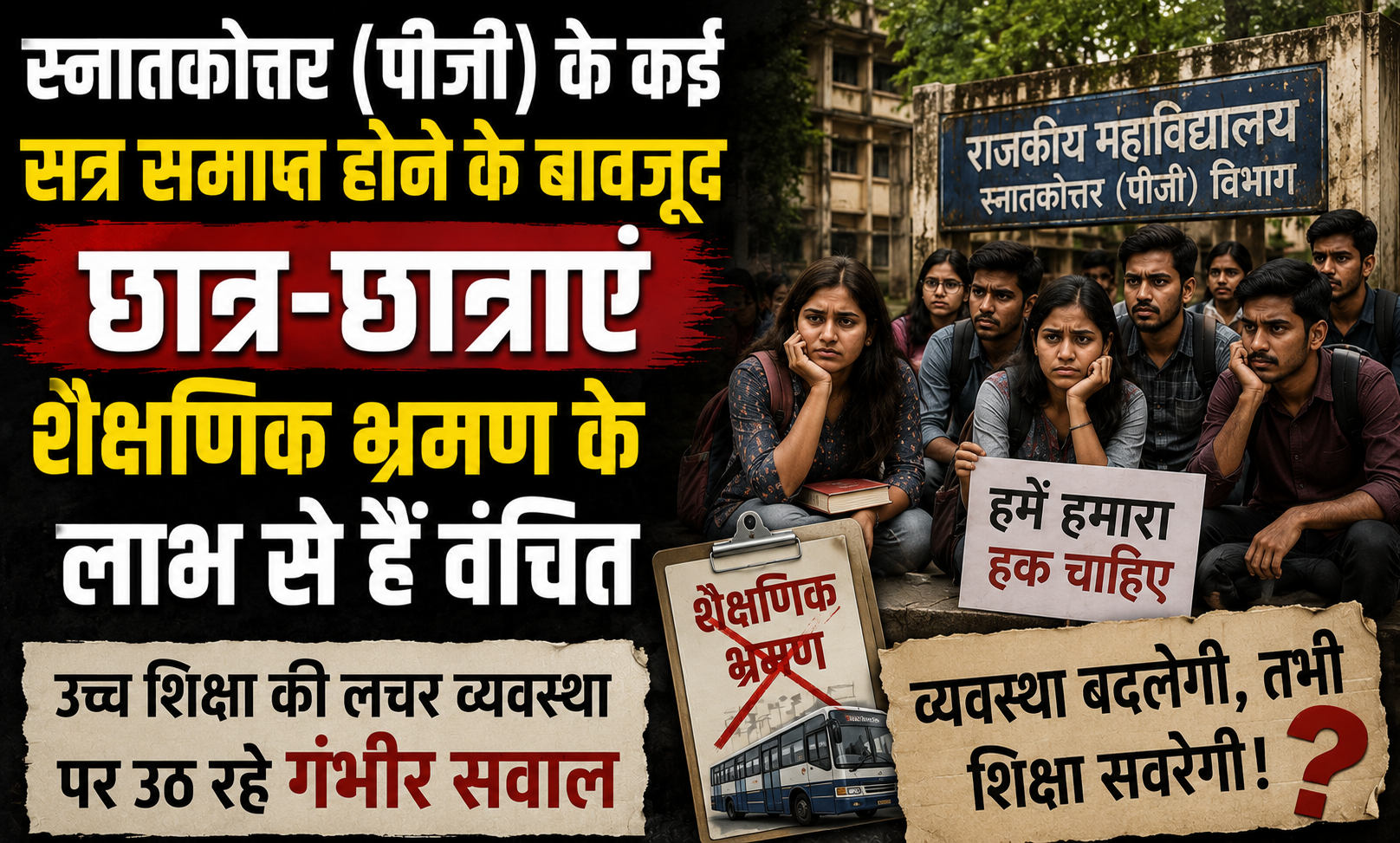
Postgraduate (PG) Students Deprived of Educational Excursions Despite Completion of Multiple Sessions, Raising Serious Questions on Lax Higher Education System
Purnia: The scope of higher education and academic research is not confined merely to theoretical lectures within four walls. Unless textbook knowledge is connected with ground realities, practical applications, and real-world experiences, the intellectual and professional development of students remains incomplete. In this holistic developmental process, the role of an educational excursion (study tour) is considered extremely vital. According to University Grants Commission (UGC) guidelines and prescribed standards of higher education, field visits and practical studies are deemed a mandatory and significant part of the curriculum for postgraduate (PG) students.
However, a deeply disappointing and concerning piece of news is emerging from Purnia University, an institution that kindles the light of higher education in the Seemanchal and Kosi regions of Bihar. Even after the successful completion of multiple sessions and examinations in various postgraduate departments of the university, students remain completely deprived of the benefits of educational excursions to this day. Session after session has concluded, and young individuals are running around offices holding degrees, yet due to the apathy and administrative sluggishness of the university administration, students have not received the practical exposure that forms a valid and necessary part of their curriculum. Widespread anger and disappointment prevail among the student community due to this systemic negligence.
Significance of Educational Excursions: Mandatory Part of Curriculum vs. Administrative Apathy
Unlike general undergraduate studies, postgraduate education serves as a medium to attain specialization in a specific subject. Whether it is students of history and geography who need direct study of historical monuments and geographical formations, or students of science, sociology, and economics for whom regional data collection and out-of-lab experiences are essential, educational excursions form the lifeblood of every discipline.
Bridge Between Theoretical Knowledge and the Practical World: Things taught on a blackboard while sitting in classroom chairs remain restricted to clearing examinations. When students visit factories, research centers, historical heritage sites, or rural-urban areas related to their subjects, their logical capabilities and comprehension of the discipline multiply manifold.
Misappropriation of Budgets and Provisions: Hefty fees are extracted from students every session under the guise of development funds and course fees. By rule, this fee includes a designated budget provision for educational excursions. Despite sessions coming to an end, where that money is spent or in which departmental accounts it is buried remains a major subject of financial corruption.
Intellectual Loss to Students: Students from several sessions have completed their master's degrees and departed from the university without ever being informed that any such tour was part of their syllabus, leaving their academic experience incomplete.
Wretched State and Apathy of Departments at Purnia University
Students of various postgraduate departments operating under the Purnia University campus (such as Hindi, History, Political Science, Sociology, Economics, and Science faculties) express that they repeatedly raised demands for educational excursions before their Heads of Departments (HODs) and faculty coordinators, but received only empty assurances every time.
"We paid the practical and tour fees along with our course fees at the time of admission. Our entire PG session has ended, but to this day, we have not been taken on a single educational excursion. When asked, officials make excuses regarding a lack of budget or failure to secure administrative permission." — A Graduated Postgraduate Student, Purnia University
Plans Imprisoned in Files: Dates and plans for educational excursions are beautifully outlined within the academic calendar on paper, but when it comes to ground-level implementation, those files are consigned to the back burner due to a lack of administrative willpower.
Shrugging Off Responsibility: Responsible university officials often defend themselves by citing difficulties in managing logistics, security arrangements, and student counts. Yet, do students from other universities cross these hurdles and embark on excursions? This argument is merely a shield to hide administrative failure.
Striking a Blow to Academic Standards
When a university fails to provide basic practical facilities and study tours to its postgraduate students, raising questions about its credibility becomes natural.
Students Lagging in Competition: Students from other central and well-managed state universities perform better in national-level competitive examinations and research interviews on the strength of practical exposure. Conversely, students at Purnia University are compelled to remain mere bookworms, lagging behind in the race for practical knowledge.
Growing Mental Distress Among Students: Students feel that if the university administration cannot utilize students' academic rights and the money they have paid, such hollow provisions hold no justification.
Demands and Warnings from Student Associations
Addressing this serious issue, student organizations and aware students have prepared to submit memorandums to the Vice-Chancellor (VC) and Registrar of the university.
Demand for Transparent Budget Audits: Students demand a high-level investigation into where the allocated budget funds went for sessions that have concluded without conducting educational excursions.
Clear Guidelines for Future Sessions: Students have warned that the university must issue a fixed timeline for upcoming sessions, making it mandatory to send every PG student on an educational excursion at least once during their two-year curriculum.
The deprivation of educational excursions for students even after the completion of multiple postgraduate sessions at Purnia University proves that mere formality is prioritized over academic quality at the institution. Higher education is not a factory for distributing degrees, but a temple for the comprehensive personality and intellectual development of students. The time has come for the Purnia University administration to step outside the confines of air-conditioned chambers, break its administrative inertia, and ensure these fundamental academic rights of students, so future researchers and youth emerge fully mature to contribute toward nation-building.