

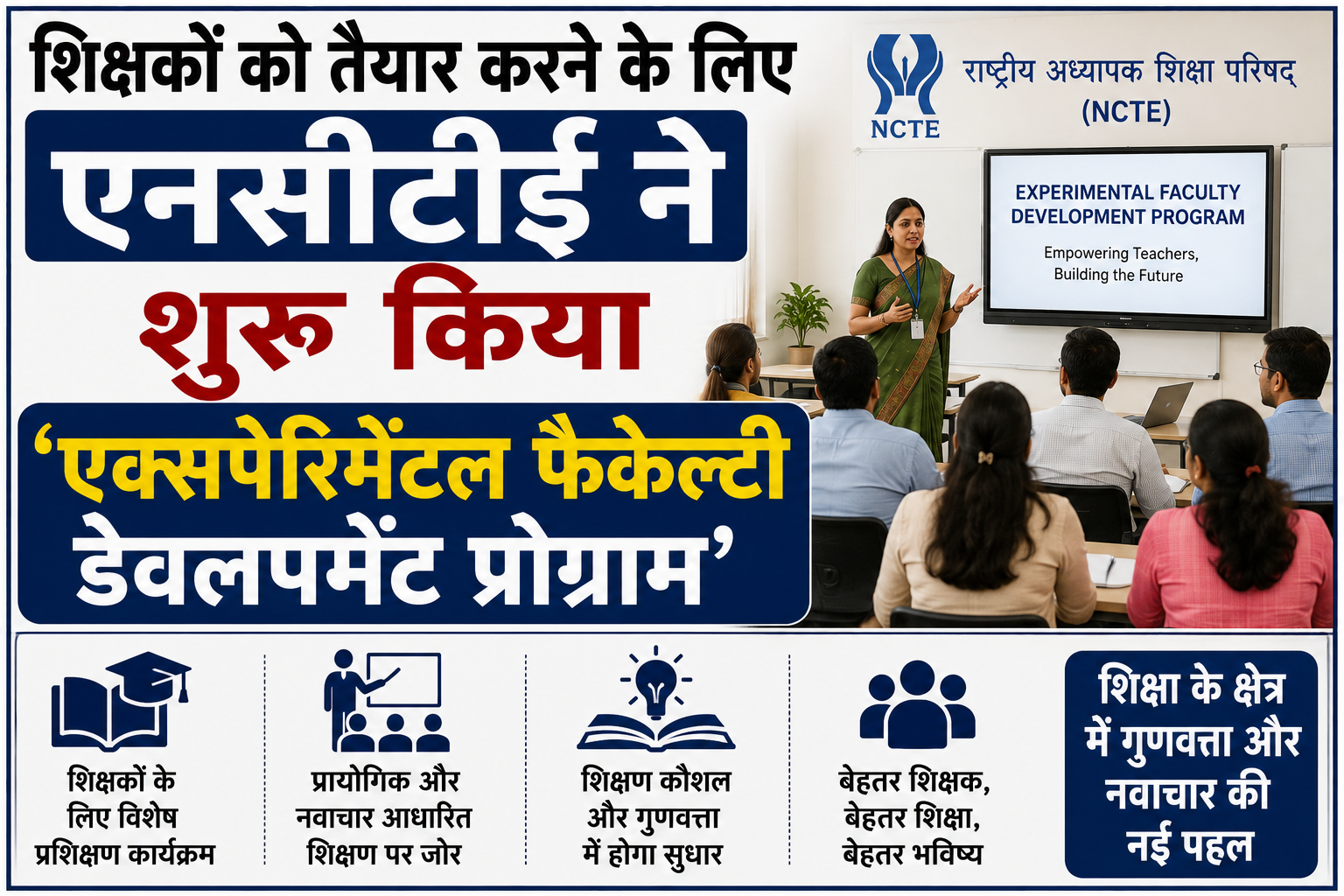
NCTE Launches 'Experimental Faculty Development Program' to Prepare Teachers
New Delhi/Nationwide: A historic shift is set to begin in India’s educational framework. The National Council for Teacher Education (NCTE) has decided to fully integrate the 'Indian Knowledge System' (IKS) into B.Ed. curricula. In line with this, an ambitious 'Experimental Faculty Development Program' has been launched to align teachers with this new pedagogical approach.
The Core Objective: A Multi-Disciplinary Approach
The primary objective of this program is to enable B.Ed. trainee teachers to go beyond textbook knowledge and become proficient in teaching 'multi-disciplinary' subjects. The NCTE believes that holistic development is impossible in modern education without incorporating ancient Indian values and a scientific perspective.
Through this training, teachers will be taught how to teach various subjects—such as science, mathematics, language, ethics, and art—by integrating them with an Indian perspective. This program is designed to elevate teachers from being mere 'instructors' to becoming 'mentors.'
Why is this shift necessary?
In line with the National Education Policy (NEP 2020), this initiative is an effort to reconnect education with its roots. According to NCTE officials, the Indian Knowledge System is not just a subject of history; it is a logical and experimental science. The main focus of this Faculty Development Program is to teach how the methods of ancient scholars like Charaka, Sushruta, Aryabhata, and Chanakya can be implemented in today’s classrooms.
Experimental Learning: As the name suggests, this program will be entirely 'hands-on.' Emphasis will be placed on teaching skills through classroom debates, case studies, and field work.
Integration of Holism: Teachers will be trained on how to present subjects to students by linking environmental science with ancient architecture, and principles of Ayurveda with modern health science.
Value-Based Education: A significant portion of this training focuses on developing empathy, social responsibility, and leadership qualities in teachers so that they can instill better values in future citizens.
What will change in B.Ed. Colleges?
Following the successful implementation of this program, the B.Ed. curriculum will become more dynamic and vibrant. Future teachers will no longer promote rote learning; instead, they will inspire curiosity and critical thinking among students. This initiative will not only revive India's glorious heritage but will also prove helpful in establishing the country as a ‘global knowledge superpower.’
Implementing this major change, however, also presents a challenge. Faculty across B.Ed. colleges nationwide will need to be updated. The NCTE aims to have at least a certain number of teachers in every B.Ed. institution who are fully proficient in imparting multi-disciplinary education through the Indian Knowledge System by the next academic session.
Educationists believe that this transformation will prove to be a milestone for the Indian education sector. It will prepare teachers who are capable of maintaining the right balance between modern technology and traditional values.