

Life Imprisonment for Elder Brother and His Wife in Murder of Younger Brother Over House Partition Dispute
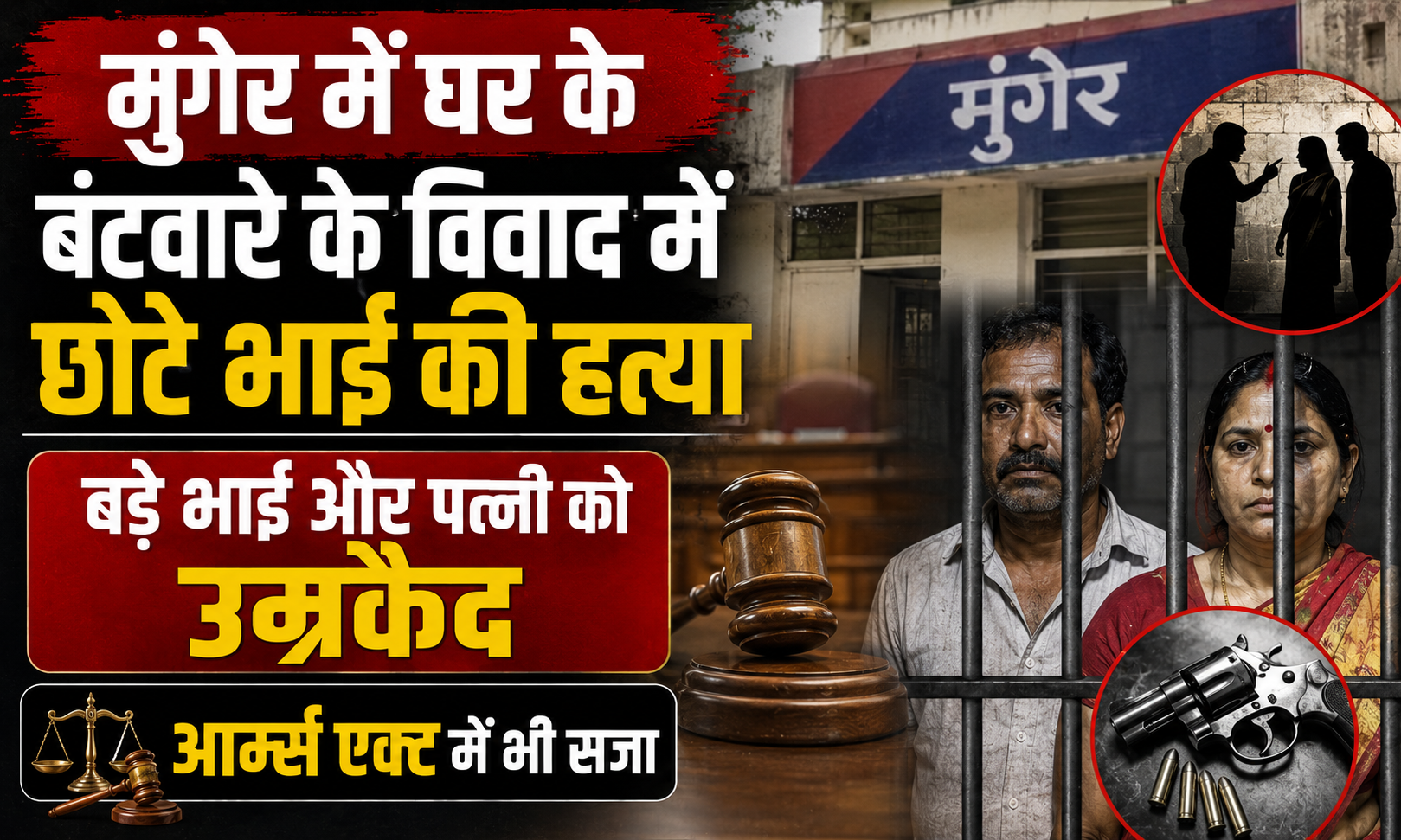
Munger, Correspondent: A court in Munger has sentenced Rahmatullah and his wife to life imprisonment in connection with the murder of his younger brother, Waliullah, following a dispute over the partition of their family house. In addition to the life sentence for the murder, the court has also awarded punishment under the Arms Act. The verdict brings a significant development in the case, which arose from a family dispute that allegedly escalated into a fatal attack.
According to the case details provided, the dispute between the brothers was related to the division of their house and family property. What began as a disagreement over partition eventually turned into a serious criminal matter, resulting in Waliullah’s death. Following the incident, police investigated the case, collected evidence and initiated legal proceedings against the accused.
After the completion of the judicial proceedings, the court found Rahmatullah and his wife guilty and sentenced both to life imprisonment. The court also imposed separate punishment under the Arms Act in connection with the weapon-related aspects of the case.
Dispute Began Over Partition of the House
The case reportedly originated from a dispute within the family over the division of the house. Property and partition disputes can become sensitive issues, particularly when family members disagree over ownership, possession or the division of individual shares.
According to the case, differences developed between elder brother Rahmatullah and younger brother Waliullah over the division of their family house. The dispute subsequently escalated and ultimately resulted in the death of Waliullah.
The incident highlights how unresolved property disputes can sometimes develop into serious conflicts. Instead of being resolved through discussion or legal means, disputes can become increasingly hostile when tensions continue to rise.
Murder Created Shock in the Area
The murder of Waliullah reportedly created shock and concern in the local area. The fact that the alleged dispute involved members of the same family made the incident particularly disturbing for local residents.
After receiving information about the incident, police began an investigation. Officials examined the circumstances surrounding the death and sought information from people connected with the case.
Investigators also worked to establish the circumstances of the alleged crime and determine the role of the accused. Since the case involved a weapon, provisions of the Arms Act were also included in the legal proceedings.
Police Investigation Played a Key Role
As part of the investigation, police examined the circumstances surrounding the incident and collected relevant evidence. In a murder case, investigators generally rely on witness statements, medical evidence, material evidence and other available records to establish the sequence of events.
Following the investigation, the police proceeded with legal action against the accused. The case subsequently reached the court, where the prosecution presented its evidence.
The defence was also given an opportunity to present its arguments. After examining the evidence and hearing both sides, the court reached its conclusion regarding the guilt of the accused.
Court Finds Rahmatullah and His Wife Guilty
After considering the evidence and arguments presented during the trial, the court found Rahmatullah and his wife guilty in the murder case.
The court subsequently sentenced both accused to life imprisonment. In addition to the punishment for murder, they were also sentenced under the Arms Act for the weapon-related offence involved in the case.
The verdict marks an important stage in the legal proceedings and provides a judicial conclusion at the trial-court level.
Additional Punishment Under the Arms Act
The Arms Act aspect is an important part of the case. Indian law provides separate provisions for offences involving illegal possession, use or other unlawful activities involving firearms or weapons.
When a weapon is allegedly involved in a serious criminal offence, the accused may face charges under both the principal criminal offence and relevant provisions of the Arms Act, depending on the evidence available.
In this case, the court imposed punishment under the Arms Act in addition to the life sentence for the murder.
Tragic Consequences of a Family Dispute
The case highlights the potentially devastating consequences of unresolved family disputes. Disagreements over property, houses and inheritance can create serious tensions between relatives.
While disagreements within families are not unusual, allowing such disputes to escalate into violence can have irreversible consequences. In this case, the dispute over the division of a house ultimately resulted in the death of a family member and criminal proceedings against other members of the same family.
The incident serves as a reminder that property-related disagreements should be addressed through dialogue, mediation or appropriate legal channels rather than violence.
Long Judicial Process
Criminal cases involving murder generally involve several stages, including police investigation, collection of evidence, filing of the charge sheet, examination of witnesses and arguments by both the prosecution and defence.
The Waliullah murder case also proceeded through the judicial process. After examining the evidence and hearing arguments from both sides, the court delivered its verdict.
For the victim’s family, the judgment represents an important moment after the prolonged legal process. Families affected by violent crimes often have to wait for years while investigations and court proceedings continue.
Impact on the Victim’s Family
The death of Waliullah had a profound impact on his family. A murder does not affect only the person who loses their life; it can have long-term emotional, social and financial consequences for surviving family members.
The family may have to cope with grief while simultaneously dealing with legal proceedings and other practical challenges.
The court’s decision may provide some measure of legal closure to the victim’s family by establishing responsibility through the judicial process.
Importance of Evidence in Criminal Cases
Evidence plays a crucial role in determining the outcome of criminal proceedings. In murder cases, statements from witnesses, medical reports, forensic evidence, material evidence and other records can be important in establishing the prosecution’s case.
The prosecution has to establish the allegations before the court according to the required legal standard. The defence, meanwhile, has the right to challenge the prosecution’s evidence and present its own arguments.
In this case, after examining the material presented before it, the court concluded that Rahmatullah and his wife were guilty and subsequently imposed the prescribed punishments.
Need to Resolve Property Disputes Peacefully
The case also highlights the need for families to resolve disputes involving houses and property through lawful and peaceful means.
Property disputes can involve questions of ownership, inheritance, possession and division of shares. If disagreements arise, parties can seek legal advice, mediation or judicial intervention rather than allowing tensions to escalate.
Maintaining proper documentation of property ownership and family agreements can also help prevent disputes.
Legal Remedies Are Available
Legal experts generally advise individuals involved in property disputes to rely on documentation and established legal procedures. Where possible, mediation can provide an alternative means of resolving disagreements without prolonged litigation.
If a dispute cannot be resolved through mutual discussion, courts can determine property rights based on applicable laws and evidence.
Violence, on the other hand, can transform a civil or family dispute into a serious criminal case, as illustrated by the Munger incident.
Verdict Sends a Strong Message
The court’s decision in the Waliullah murder case also sends a broader message about accountability for serious crimes. The law provides for strict punishment when guilt is established in cases involving murder and illegal weapons.
At the same time, every criminal case must be decided on the basis of evidence and due judicial process. The court’s verdict in this case followed consideration of the material placed before it during the trial.
The life imprisonment awarded to Rahmatullah and his wife, along with punishment under the Arms Act, marks a significant development in the case.
Appeal May Be Possible Under Law
Following a trial-court conviction, the convicted persons may have legal remedies available under the law, including the possibility of approaching a higher court through an appeal, subject to the applicable legal provisions.
A higher court can examine the trial court’s judgment, evidence and legal findings if an appeal is filed.
For now, the trial court has sentenced Rahmatullah and his wife to life imprisonment in connection with the murder of Waliullah and has also imposed punishment under the Arms Act.
Message for Society
The case provides an important lesson for families facing property or partition disputes. Disagreements should be resolved through dialogue, mediation or legal mechanisms.
A dispute over property or a house should never be allowed to turn into violence. Once violence occurs, the consequences can extend far beyond the original disagreement, affecting entire families and leading to serious criminal proceedings.
Community mediation, legal counselling and timely intervention can sometimes prevent family disputes from escalating.
The case highlights the serious consequences that can arise when family and property disputes escalate into violence. It also underlines the importance of resolving disagreements through lawful and peaceful means.
For the victim’s family, the court’s verdict represents an important step in the judicial process. At the same time, the case serves as a reminder that disputes over property and family assets should be handled through legal channels, mediation and dialogue rather than confrontation or violence.