
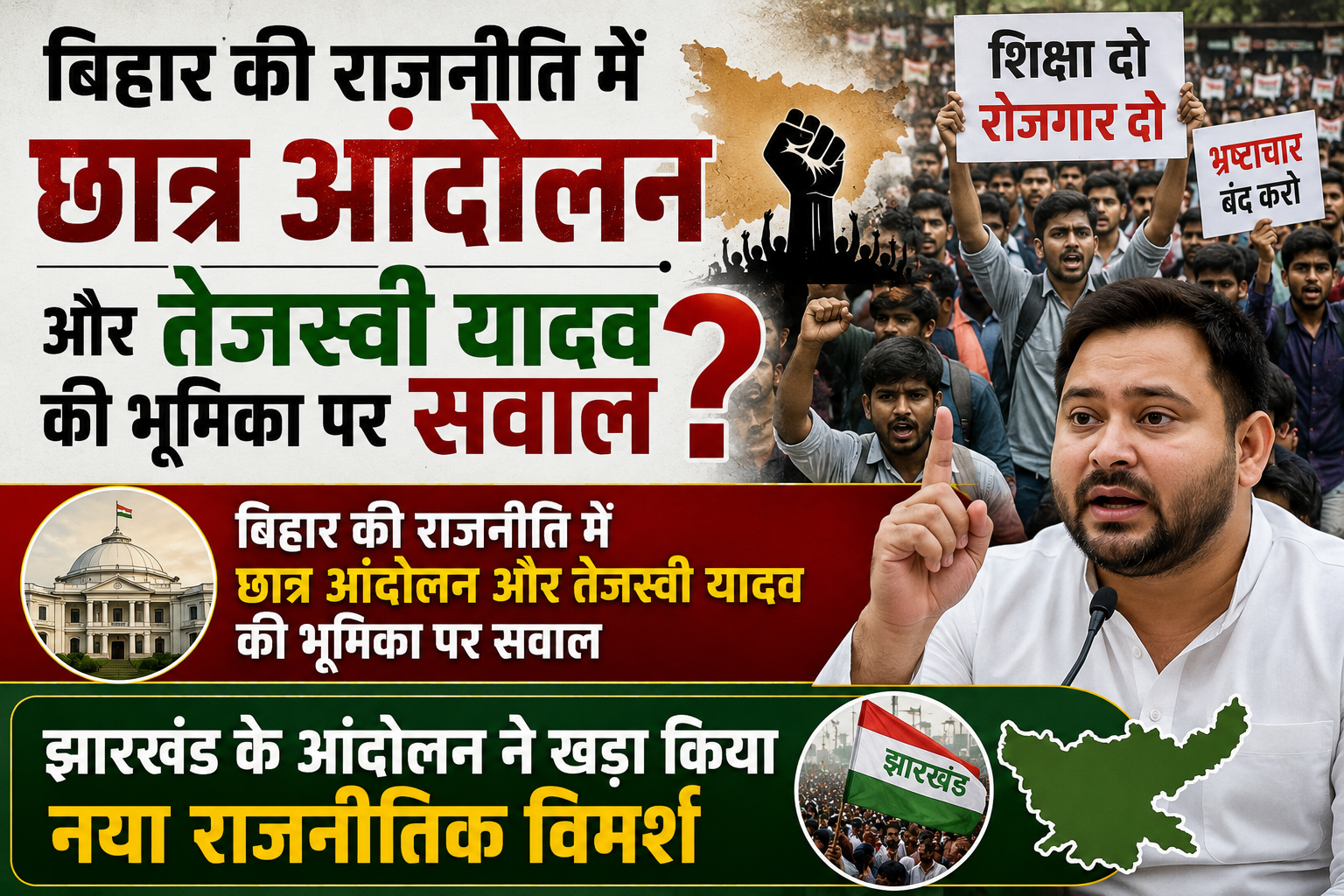
Student Movements and Tejashwi Yadav's Role Under Scrutiny, Jharkhand Agitation Raises New Political Questions
Patna: Student movements have long been an important part of Bihar's political discourse. Issues related to competitive examinations, employment, education and government recruitment have repeatedly emerged as major concerns for students and have often posed challenges for both governments and opposition parties.
Tejashwi Yadav, one of the prominent faces of Bihar's opposition politics, has also repeatedly raised issues concerning students and young people. On matters related to competitive examinations and employment, he has sought to corner the government while claiming to speak on behalf of students.
However, the student movement in Jharkhand has now raised a different political question. The issue is how political parties and leaders view student movements when similar concerns emerge beyond state boundaries. Are student movements merely a means of political opposition, or do they represent broader demands for improvements in education, employment and recruitment systems?
The discussion surrounding the student movement in Jharkhand has once again brought attention to Bihar's political developments and Tejashwi Yadav's role in raising student-related issues.
Student Movements Have Long Been Important in Bihar Politics
Bihar has a long history of student politics. Student activities that began in universities and colleges have often influenced mainstream politics in the state.
A large number of students in Bihar prepare for competitive examinations. Cities across the state have become important centres for government job aspirants. As a result, issues related to examination dates, results, question papers, recruitment procedures and government appointments have acquired considerable political significance.
Whenever dissatisfaction grows among students over an examination or recruitment process, political parties often attempt to raise their concerns. Opposition parties use such issues to question government policies, while ruling parties generally defend the administrative process.
Tejashwi Yadav Raised Issues Such as NEET
In recent years, controversies surrounding NEET and other competitive examinations have brought student politics into the national spotlight. Issues related to examinations have also triggered political debates in Bihar.
Tejashwi Yadav has attempted to highlight concerns affecting students and young people while questioning the government over its handling of such matters.
Employment and youth-related issues have already been important components of his political agenda. He has repeatedly spoken about government jobs, recruitment procedures and the future of young people.
This has contributed to the political association between Tejashwi Yadav and student-related issues.
Jharkhand Student Movement Raises a Different Question
The student movement in Jharkhand has added a new dimension to this political debate. The demands and circumstances surrounding the agitation there are shaped by the state's own political and administrative environment.
Both Bihar and Jharkhand have large numbers of young people preparing for competitive examinations and seeking government employment. Education and employment are therefore major concerns for young people in both states.
In this context, the Jharkhand student movement cannot simply be viewed as an isolated state-level issue. It can also be seen as part of broader expectations among young people in eastern India regarding employment, recruitment and education.
However, the political character and causes of any movement should be assessed on the basis of verified facts and the specific demands raised by the participants.
Student Issues Versus Political Advantage
The role of political parties in student movements has always been a matter of debate. Opposition parties often stand alongside protesting students and use their demands to question the government.
Governments, on the other hand, sometimes accuse opposition parties of giving political colour to student protests.
The most important question in such circumstances is what the core demands of the movement actually are and how those demands can be addressed.
If students are demanding reforms in examination systems, timely results, transparent recruitment and greater employment opportunities, administrative solutions are ultimately more important than political rhetoric.
Employment Remains a Major Concern for Youth
Employment is a major political issue for young people in both Bihar and Jharkhand. A large number of students prepare for government jobs, while the number of applicants is often much higher than the available vacancies.
As a result, even a small problem in an examination or recruitment process can affect the future of thousands of candidates. Delayed examinations, postponed results, controversies over question papers or uncertainty surrounding recruitment can quickly create dissatisfaction among students.
Political parties often incorporate this dissatisfaction into their agendas. However, creating long-term employment opportunities will require expansion of both government and private-sector opportunities.
Political Challenge for Tejashwi Yadav
Tejashwi Yadav also faces a political challenge when it comes to youth and student issues. Raising student concerns while in opposition can be relatively straightforward, but presenting a credible political alternative is more important.
Young voters increasingly expect more than slogans and political support for protests. They want concrete plans for employment, better education, transparent recruitment and economic opportunities.
From this perspective, political credibility can be strengthened when leaders not only support student movements but also present clear policies for addressing their underlying problems.
What Does the Jharkhand Movement Mean for Bihar?
The discussion surrounding the Jharkhand student movement could also serve as a message for political parties in Bihar.
Bihar has a large youth population, and employment-related issues have considerable influence on electoral politics. If student movements are treated merely as instruments of political opposition, their core concerns may be overshadowed.
At the same time, if governments respond to students' grievances promptly and transparently, the need for prolonged protests may be reduced.
Strengthening dialogue between student organisations, political parties and the administration could therefore be important for addressing such issues in Bihar as well.
Social Media Has Changed the Nature of Student Movements
Student movements are no longer confined to streets and university campuses. Social media has given students a powerful platform to present their concerns quickly.
When a problem related to an examination or recruitment process emerges, students can share their grievances online, allowing an issue to gain widespread attention within a short period.
Political parties also use social media to communicate with students and incorporate their concerns into political campaigns.
However, verifying information circulated on social media remains important. The actual situation surrounding a movement should be assessed through official information and credible facts.
Future of Student Movements
The future of student movements will depend largely on how effectively and transparently governments respond to their demands.
If education and recruitment systems improve, examinations are conducted on schedule and employment opportunities increase, dissatisfaction among students may decline.
On the other hand, if such problems persist, student movements could become increasingly influential in politics.
The youth populations of both Bihar and Jharkhand are politically significant. Therefore, issues related to education, employment, competitive examinations and the future of young people are likely to remain important in electoral politics.
Student movements and Tejashwi Yadav's role in Bihar politics have remained subjects of discussion for some time. His efforts to raise issues such as NEET-related concerns and speak about students' problems have connected his political image with youth-related issues.
The student movement in Jharkhand has now added a new question to this debate: Will student movements be viewed merely as a conflict between governments and opposition parties, or will their underlying problems receive lasting solutions?
In the coming years, employment, education, transparency in competitive examinations and opportunities for young people are likely to remain important political issues in both Bihar and Jharkhand.
The challenge for political parties will be to ensure that these concerns do not remain limited to election slogans, but are accompanied by concrete, practical and credible solutions for the future of young people.


