
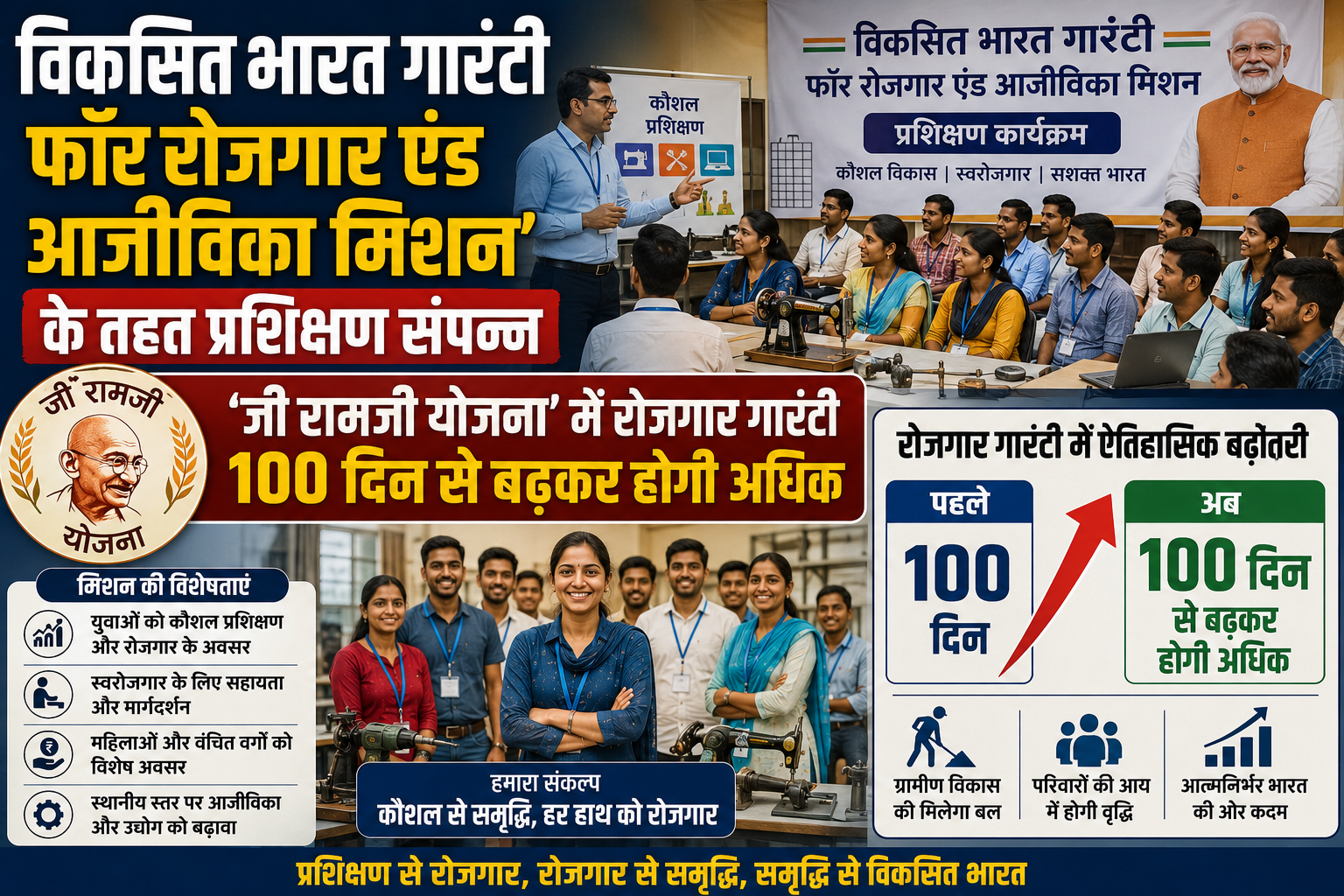
Employment Guarantee Under 'G Ramji Yojana' Extended Beyond 100 Days
A one-day specialized training-cum-awareness program was organized on Monday under the aegis of the 'Viksit Bharat Guarantee for Employment and Livelihood Mission' at the MGNREGA Bhawan located within the Sultanganj Block premises. Several historic declarations and technical insights regarding rural development and livelihood security were shared during this event.
The primary highlight of the training session was the Central Government's ambitious flagship scheme, the 'G Ramji Yojana', under which a comprehensive action plan was drafted to extend the guaranteed employment period beyond the existing 100 days and create fresh livelihood avenues in rural areas. The program witnessed active participation from the Block Development Officer (BDO), MGNREGA Programme Officer (PO), Mukhiyas (village heads) of all panchayats, Panchayat Rozgar Sevaks (PRS), and rural livelihood 'Jeevika Didis'.
A New Blueprint for Developed India and Rural Employment
The program commenced with the traditional lighting of the lamp. Addressing the training session, key speakers emphasized that India's journey toward becoming a developed nation by 2047 remains incomplete without strengthening the rural livelihood framework. Driven by this resolve, the 'Viksit Bharat Guarantee for Employment and Livelihood Mission' is being executed at the grassroots level.
A New Employment Guarantee: Previously, under MGNREGA, guaranteed wage employment was capped at just 100 days per financial year. However, through integration with the new 'G Ramji Yojana', a conscious decision has been made to extend this working period to arrest the migration of rural youth and laborers.
Asset Creation: The primary mandate of the mission has shifted from rudimentary earthwork or digging pits to building permanent community assets—such as community ponds, Amrit Sarovars, check dams, and block-level cold storage units.
Understanding 'G Ramji Yojana' and Its Upgraded Framework
During the session, program officers shed detailed light on the technical and structural components of the 'G Ramji Yojana'. The scheme has been comprehensively upgraded by the Ministry of Rural Development:
Extension of Work Days Beyond 100 Days
A major grievance among rural laborers was that after completing their 100 days of mandated work, they were left unemployed for the rest of the year. Under the revised provisions of the 'G Ramji Yojana', targeted households—particularly marginalized and women-headed households—will now be provided an extended guaranteed employment framework (potentially stretching up to 150 days).
Convergence with Skill Development
The scheme does not limit workers to unskilled manual labor; instead, it incorporates mandatory on-site training to transition laborers into semi-skilled workers. This includes training in masonry, plumbing under the Jal Jeevan Mission, and solar light maintenance. This upskilling will automatically translate into higher daily wage brackets for the rural workforce.
Livelihood Mission: The Core Role of 'Jeevika Didis'
Dozens of women representing various 'Jeevika' self-help groups from the Sultanganj block participated in Monday's event. Under the Viksit Bharat Mission, the economic empowerment of women occupies the topmost echelon.
Lakhpati Didi Initiative: The training outlined that the livelihood mission aims to scale the annual income of every active Jeevika Didi to at least 1 Lakh INR. To achieve this, interest-free or low-interest institutional credits will be channeled to them for setting up micro-enterprises like mushroom cultivation, goat farming, poultry, and boutique tailoring.
Market Linkage: Digital literacy modules were introduced during the session to train rural women to list and sell their indigenous products on mainstream e-commerce platforms alongside local physical markets.
Driving Transparency Through Digital Tech and Geo-Tagging
The second half of the training session focused on implementing strict transparency protocols for Panchayat Rozgar Sevaks and representatives of the Mukhiya Association.
100% Geo-Tagging: Every single project sanctioned under the 'G Ramji Yojana' and MGNREGA will undergo mandatory three-phase geo-tagging: before commencement, mid-way through execution, and upon final completion. This will effectively curb paper scams and ghost master rolls.
Aadhar-Linked Payouts: To eliminate middlemen completely, 100% of wage disbursements will be routed directly into the bank accounts of laborers via the Aadhaar Based Payment System (ABPS).
Reactions from Sultanganj Administrators and Public Representatives
Concluding the event, the Block Development Officer (BDO) of Sultanganj stated:
"This training module will act as a catalyst for transforming the rural landscape of Sultanganj. Expanding the work horizon under the 'G Ramji Yojana' will directly benefit thousands of skilled and unskilled laborers across our block. We urge all Mukhiyas and Rozgar Sevaks to launch an immediate survey in their respective domains to map eligible households so that no needy individual is deprived of this guaranteed livelihood."
The President of the local Mukhiya Association also lauded the move, noting that increasing the number of guaranteed working days will double the pace of development across village tracts.
Core Pillars of the Scheme & Training (At a Glance)
| Parameter / Pillar | Key Details & New Provisions |
|---|---|
| Venue of Event | MGNREGA Bhawan, Sultanganj Block Office |
| Parent Mission | Viksit Bharat Guarantee for Employment and Livelihood Mission |
| Flagship Scheme | 'G Ramji Yojana' |
| Major Shift | Minimum employment guarantee extended beyond the baseline of 100 days |
| Core Focus Segments | Women empowerment (Jeevika), skill upgradation, transparent digital transfers |
| Technical Compliance | NMMS app-based attendance, geo-tagging, and Aadhar-linked payments |
The one-day training seminar concluded on Monday at the Sultanganj MGNREGA Bhawan marks a solid structural roadmap to make the rural economy self-reliant. Pushing the employment mandate past the 100-day mark via the 'G Ramji Yojana' proves that the real cost and existential needs of rural labor are being actively answered. If the technical protocols demonstrated during this training are integrated transparently across all panchayats of Sultanganj, this block is well on its way to emerging as a regional role model for employment generation and sustainable women-led livelihoods.


