
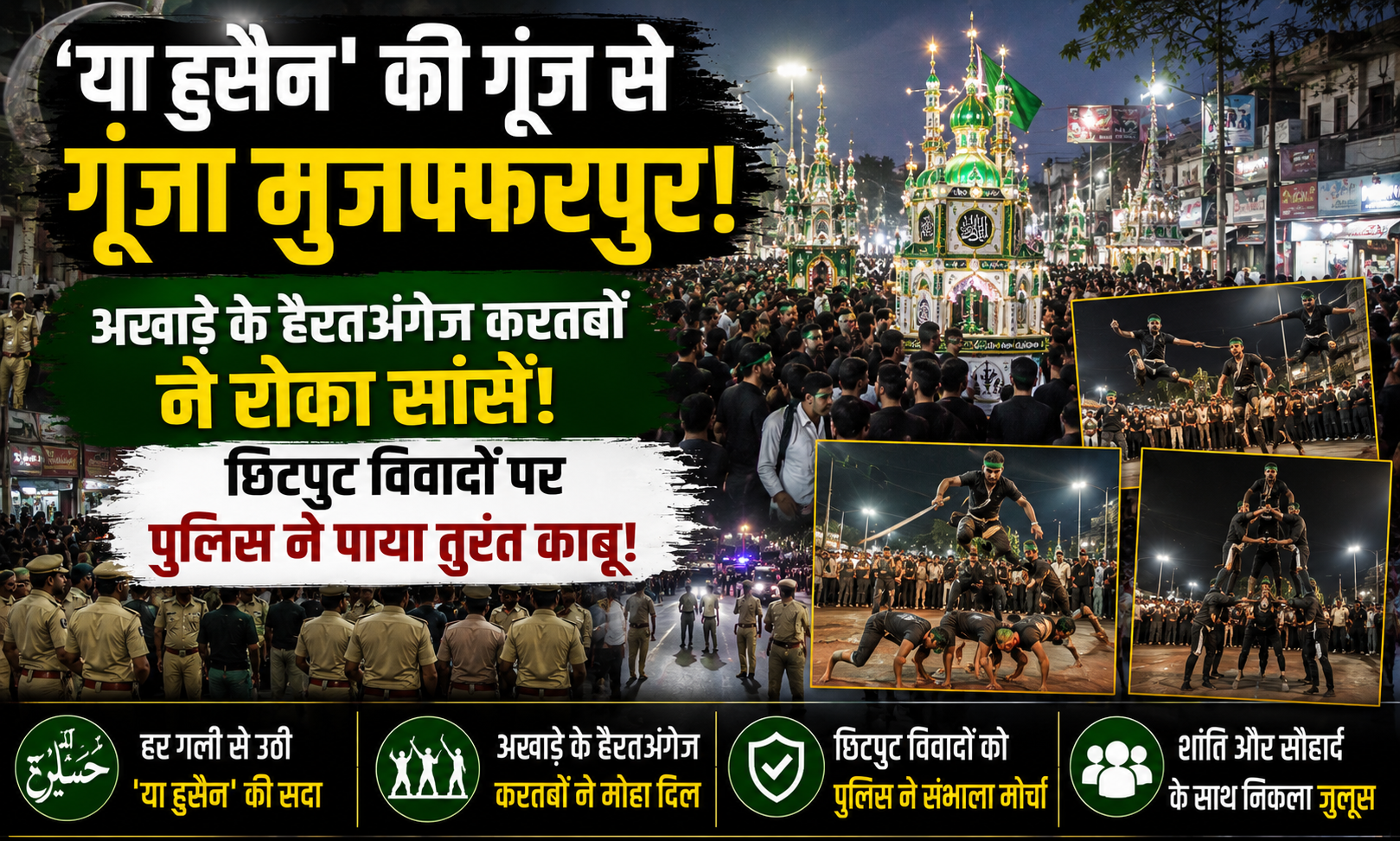
Echoes of 'Ya Hussain' Resound Across Muzaffarpur as Breathtaking Stunts Halt Breaths; Police Swiftly Diffuse Stray Disputes to Maintain Peace!
The 10th day of the holy month of Muharram—Youm-e-Ashura—was observed across the historic city of Muzaffarpur and its peripheral rural sectors with traditional solemnity, deep devotion, and an exemplary display of communal harmony (Ganga-Jamuni Tehzeeb). From Friday morning, the entire district united in mourning the martyrdom of Imam Hussain and his 72 companions at the historic battle of Karbala.
Grand, sky-high Tajia and Akhara processions were carried out from various neighborhoods of the city, weaving through designated arterial routes to converge at the local Karbala grounds. The atmosphere vibrated with the thunderous, high-pitched slogans of 'Ya Hussain, Ya Ali'. Although localized friction and brief arguments broke out at a few sensitive intersections, the pre-alerted district administration and quick-response police units acted swiftly to disperse potential troublemakers and restore complete order.
Displays of Valor: The Daredevil Stunts of the Akharas
The primary attraction of this historic Muharram procession was the extraordinary martial arts skills showcased by the young men and veteran masters (Ustads) of various Akharas. As the massive processions rolled into the city's key intersections—such as Kalyani Chowk, Saraiyaganj, Company Bagh, and Sutapatti—thousands of spectators lined up along the roads to cheer the performers.
Fierce Lathi and Swordplay: Akhara warriors and young children swirled heavy wooden lathis and glittering swords through the air with such rapid precision that it held the onlookers spellbound. The technical prowess of blocking multiple simultaneous strikes using a single shield drew massive rounds of applause.
Dancing with Fireballs: As dusk settled, daring youths spun flaming fireballs (banethi) attached to ropes, creating mesmerizing, circular patterns of fire in the dark air. These high-risk stunts were executed with meticulous safety and practiced focus.
Jaw-Dropping Feats: Several daredevils performed high-risk acts, such as breaking fluorescent tubelights against their bare bodies and slicing coconuts with sharp swords while completely blindfolded, leaving the crowd stunned.
A Beautiful Example of Syncretic Culture: Sharbats Offered by Hindu Brothers
The Muharram processions in Muzaffarpur have historically been a symbol of communal unity. True to this legacy, the city's core values of mutual respect shined through the blistering daytime heat and humidity on Friday:
At numerous major crossroads, members of the Hindu community and local social groups established makeshift canopy stalls to distribute cold water, lemonade, and sweet traditional drinks (sharbat) to the exhausted mourners and Akhara performers.
Furthermore, local puja committees and political leaders stepped forward to honor the leaders (Khalifas) of different Akharas by wrapping ceremonial stoles (angavastram) and tying turbans around them. Village elders remarked that while the day holds a specific religious context, Imam Hussain’s sacrifice was a universal stand against tyranny, allowing individuals across all faiths to express their profound respect.
At a Glance: Muzaffarpur Muharram Routes and Safety Metrics
| Key Metric | Ground Details and Administrative Data |
|---|---|
| Primary Procession Routes | Moving from Sikandarpur, Chandwara, Mithanpura, and Kalyani through Town Thana Road to Karbala |
| Tajia Artistry | Sky-high symbolic replicas meticulously crafted out of thermocol, glass, and glittering tinsel |
| Administrative Deployment | Over 150 strategic junctions manned by magistrates and static police teams |
| Surveillance Operations | High-definition drone cameras, integrated CCTV grids, and plainclothes intelligence units |
Stray Friction Erupts, But the Khaki Force Swings Into Action
While a massive portion of the district observed the occasion in absolute peace and devotion on Friday, a few anti-social elements made failed attempts to give localized disputes a communal color.
Incident 1: Dispute Over Routes in the Rural Suburbs
In a village located within a rural block of Muzaffarpur, a heated argument broke out between the youth of two communities regarding a sudden change in the procession's route. Slogans were traded aggressively, and the situation escalated rapidly toward potential stone-pelting.
The Instant Police Response:
Upon receiving the alert, the local station police along with the Quick Response Team (QRT) rolled onto the site in heavy numbers. Officers executed a minor baton charge to scatter the agitating youth. Members of the local Peace Committee were immediately brought in to mediate, and the procession was peacefully guided forward along its traditionally pre-approved route.
Incident 2: High-Volume DJ Clash
Near a highly sensitive turn in the city, a few miscreants violated administrative orders by playing a banned high-decibel DJ system, which was met with sharp objections from the neighboring residents. As communal friction built up, static magistrates and on-duty police officers intervened on the spot, confiscated the audio equipment, and let the organizers off with a severe legal warning.
An Ironclad Security Net: Drones and Cyber Monitoring Active
The District Magistrate (DM) and Senior Superintendent of Police (SSP) of Muzaffarpur were seen personally patrolling the streets throughout the night and day to supervise operations. A highly structured three-tier security net kept trouble at bay:
Roof Surveillance via Drones: Drones were deployed continuously over narrow alleys and sensitive neighborhoods to monitor rooftops, ensuring no anti-social elements could stockpile stones or objectionable materials.
Cyber Cell Defangs Rumor Mills: The cyber wing of the police kept an active check on digital platforms. A clear directive was issued stating that anyone sharing fabricated videos or inflammatory texts regarding the day's events would face immediate arrest under the IT Act. This effectively kept rumor-mongers at bay.
Final Rites at the Karbala Grounds
As the sun dipped below the horizon, the sea of Akharas and towering Tajias slowly made their way to their final destinations—the local Karbala grounds. Mourners remembered the ultimate sacrifice of Hazrat Imam Hussain with moist eyes and offered silent prayers. Those whose wishes had been fulfilled throughout the year offered floral wreaths, ceremonial sheets (chadar), and cream (malai) to the structures. Late into the evening, following all traditional rituals, the Tajias were respectfully buried (cooled), marking the peaceful conclusion of the ten-day festival of Muharram.
Despite isolated attempts by a few radical elements to disrupt the peace, the Muharram procession in Muzaffarpur concluded as a triumph of administrative capability and public maturity. By crushing stray disputes well in time, the police sent a resounding message that no one is above the law. Ultimately, divisiveness lost, and the traditional brotherhood of Muzaffarpur emerged victorious once again.


