
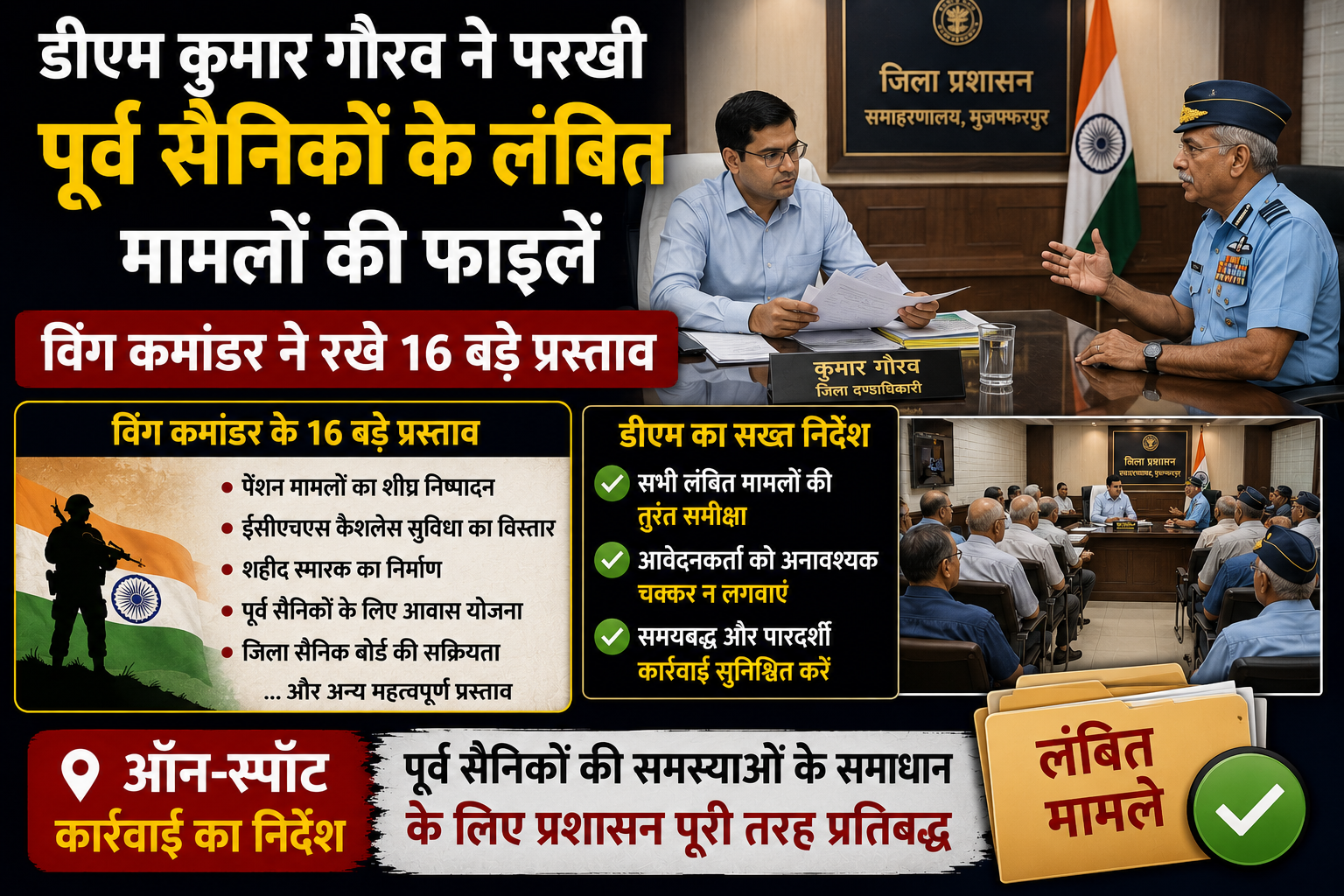
DM Kumar Gaurav Audits Pending Armed Forces Grievance Files; Wing Commander Submits 16 Core Proposals for Fast-Track Action
A major, highly reassuring administrative development has emerged from Muzaffarpur for our nation’s bravehearts, military veterans, and their dependents. Placing the grievances of armed forces personnel on the highest policy pedestal, the district administration has assumed an aggressive, proactive stance. A high-profile review meeting of the District Monitoring Committee was convened at the Collectorate VIP Conference Hall under the chairmanship of District Magistrate (DM) Kumar Gaurav.
The high-level session involved a comprehensive audit of multi-year backlogs concerning land encroachments, pensions, family security, and compassionate appointments. A detailed analytical report covering the matrix of the meeting, the 16 institutional proposals tabled by the Wing Commander, and the strict directives issued by the DM is provided below:
Wing Commander U.K. Tripathi Tables 16 Proposals: Understanding the Core Grievances
At the inception of the session, the District Sainik Welfare Officer-cum-Representative of the Armed Forces, Wing Commander U.K. Tripathi (Indian Air Force), presented a digital and physical dossier containing 16 critical proposals that had been languishing due to bureaucratic red tape.
Structural Categorization of the Tabled Proposals:
Land and Property Encroachments (Land Disputes): Out of the 16 cases, a critical majority of 8 pertained to ancestral land parcels belonging to active-duty jawans being illegally grabbed or contested by local land mafias and regional strongmen while the soldiers were deployed on distant borders.
Pension and Financial Anomalies (Pension Grievances): The Wing Commander flagged protracted delays by state clearing houses in disbursing family pensions, accumulated arrears, and statutory state welfare benefits to military veterans and Veer Naris (war widows).
Personal Security and Police Inaction (Security & Police Support): Several retired veterans had formally registered complaints with the board regarding active physical threats in their respective villages and highlighted a casual attitude from local police stations (Thanas) in registering FIRs.
Compassionate Appointments: The board demanded immediate clearances for pending state government job applications reserved for the direct dependents of martyrs or personnel who passed away during active service.
DM Kumar Gaurav’s Uncompromising Directives: "If Soldiers are Safe on the Borders, We are Safe Here"
After a line-by-line review of the proposals presented by the Wing Commander, District Magistrate Kumar Gaurav adopted an uncompromising stance. He issued an explicit warning to the attending Revenue Officers and Deputy Superintendents of Police, stating that any procedural delay in handling military files would be treated as direct insubordination.
Official Directive from the District Magistrate: "It is deeply troubling and completely unacceptable for this administration if the families of soldiers—who guard our frontiers under sub-zero temperatures and highly hostile conditions—are forced to run from pillar to post in Muzaffarpur's government offices for their fundamental rights, land titles, and pensions. I have personally taken all 16 proposals submitted by Wing Commander Tripathi under my Direct Monitoring Grid. All concerned Circle Officers (COs) and Station House Officers (SHOs) are hereby ordered to investigate these matters and submit an Action Taken Report (ATR) directly to my desk within the next 15 days."
Blueprint of 'Special Saturday Camps' for Accelerated Land Resolution
To deliver concrete results on land disputes, the DM engineered a dedicated operational action plan. He ordered that the civil-revenue Janata Darbars held at the circle block level every Saturday must place veterans' and active servicemen's grievances at the absolute top of the Priority List.
Directives to Circle Officers (COs): In instances where a soldier's land is verified as illegally encroached upon, revenue officials must immediately mobilize local police forces to evict the squatters and restore physical possession to the soldier's family.
Streamlining Arms Licenses: The DM ordered that police background verifications for self-defense arms licenses applied for by retired veterans must be expedited and concluded within a strict 7-day window.
Data Sheet: Institutional Agenda of the District Monitoring Committee
| Quantum of Proposals | Primary Focal Areas | Nodal Enforcement Agencies | Statutory Timeline for Resolution |
|---|---|---|---|
| 16 Institutional Proposals | Land Disputes, Personal Security, Pension Clearances & Compassionate Hiring | District Sainik Welfare Board & Sub-Divisional Magistrates (SDMs) | Maximum 15 Days |
| 08 High-Priority Cases | Illegal Encroachment by Land Mafias | Respective Block Circle Officers (COs) & Local Jurisdictional Police | On-spot Inspection & Forced Evictions |
Establishment of a 'Special Help Desk' for War Widows and Elderly Veterans
The monitoring committee extensively discussed the logistical challenges faced by aging veterans. DM Kumar Gaurav directed the immediate establishment of a Special Help Desk at both the Collectorate and the District Sainik Welfare Office.
This dedicated single-window counter ensures that elderly veterans and war widows do not have to navigate different floors or desks to track their files.
Their official files will now be tagged with a distinct red 'Sainik Flag' marker, serving as a visual cue for desk clerks to process the paperwork with zero turnaround time.
The Muzaffarpur District Monitoring Committee meeting transcended standard bureaucratic formalism, emerging as a definitive model of institutional respect toward the armed forces. The instant intervention by DM Kumar Gaurav on Wing Commander U.K. Tripathi's 16 proposals, backed by a strict 15-day execution window, indicates that the district leadership values on-ground metrics over paperwork. This assertive stance has instilled a renewed sense of security and honor among thousands of military families residing across the district. The focus now shifts to the grassroots implementation of these orders by the field-level Circle Officers and police inspectors.


