


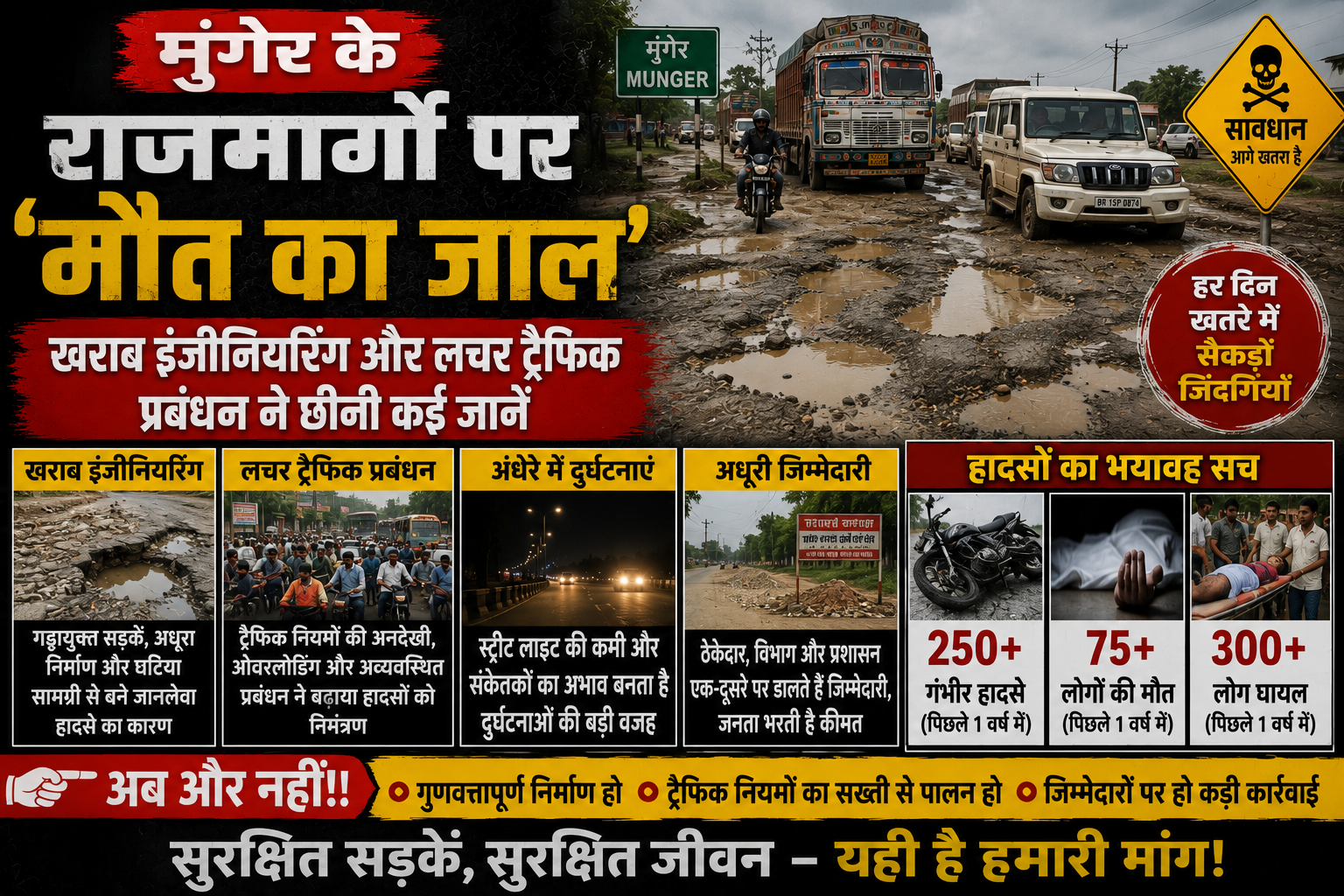
Death Traps' on Munger’s Highways — Poor Engineering and Lax Traffic Management Claim Countless Lives
The network of national highways passing through Munger district was once considered a symbol of progress, but in the last few years, these highways have turned into 'death traps.' Recent horrific road accidents have not only shaken the general public but have also raised serious questions about the administration's functioning and the engineering standards employed during the construction of these highways. A detailed investigation has revealed that most accidents are not merely the result of 'driver negligence,' but a direct consequence of poor road engineering and flawed traffic management.
Focus of Investigation: What is the Engineering Failure?
Our investigation and the complaints of local residents have highlighted the main technical flaws of the highways:
Lack of Acceleration and Deceleration Lanes
The most fundamental rule of highway engineering is that vehicles joining the highway from local roads must have a separate 'acceleration lane' so they can match the speed of the highway's main traffic. These lanes are almost entirely absent on the NH in Munger. The sudden entry of local vehicles onto the highway becomes a death sentence for vehicles approaching from behind at high speeds.
Unauthorized Cuts at Dangerous Locations
The arbitrary cuts made in the highway medians are the biggest hubs for accidents. Built to allow rural populations access to their homes, these cuts—often made by breaking the dividers—are where most head-on collisions occur. There are neither warning boards nor rumble strips at these spots to control speed.
Neglect of 'Black Spots'
There are dozens of 'black spots' (accident-prone areas) in the district where accidents have been occurring continuously, but efforts to fix them have been merely cosmetic. Scientific studies show that these locations suffer from flaws in road gradient, curve design, and visibility.
Lax Traffic Management: Another Major Challenge
Along with engineering flaws, the lack of traffic management has made the situation even more critical:
Negligible Traffic Police Presence: On highway stretches where accidents are most frequent, traffic police patrolling is almost non-existent.
Lack of Signboards and Indicators: The absence of reflective boards or proper lighting on highways during the night leaves drivers unaware of upcoming curves or obstacles.
Encroachment: Small shops and illegal parking along the highways have narrowed the usable road width, causing vehicles to lose control when sudden braking is required.
Local Public Outcry
Local residents and social activists state that they have informed the NHAI (National Highways Authority of India) and the district administration about these issues multiple times, but nothing has happened beyond "moving files."
A local intellectual remarked, "We need acceleration lanes; we want these illegal cuts in the middle of the highway closed. We cannot risk our lives just to go home. Will the authorities only realize these flaws when one of their own family members travels this road?"
Need for Immediate Action and Solutions
To make Munger's highways safe, the administration must take the following steps with immediate effect:
Audit and Reform: An 'Independent Road Safety Audit' of the entire district's national highways should be conducted by a technical team, and identified deficiencies must be rectified within 30 days.
Construction of Acceleration Lanes: Mandatory construction of acceleration lanes at all major entry points joining the highway.
Permanent Solution for Illegal Cuts: All unauthorized cuts on the highway must be closed permanently, and underpasses or service roads should be provided for villagers.
Smart Traffic Management: Installation of high-definition CCTV cameras, speed radar guns, and sensor-based warning lights to alert drivers to upcoming hazards.
Administrative Accountability
Paying compensation or filing an FIR after an accident is not a permanent solution. The government must fix accountability for the contractors and designers of these highways. If the road design itself is unsafe, legal action should be taken against those responsible. The administration must ensure that highways are built for public convenience, not to become a cause of death.
The blood spilled on Munger's roads is a loud cry that there has been a major systemic failure. It is time to replace superficial repairs with 'engineering-based improvements.' If the administration does not take immediate and effective action, the district should prepare for more tragic incidents in the future. To ensure that highways do not become paths to the final journey, the pace of improvement must be accelerated.