

Crimes Against Women Did Not Decline, Illegal Liquor Trade Increased
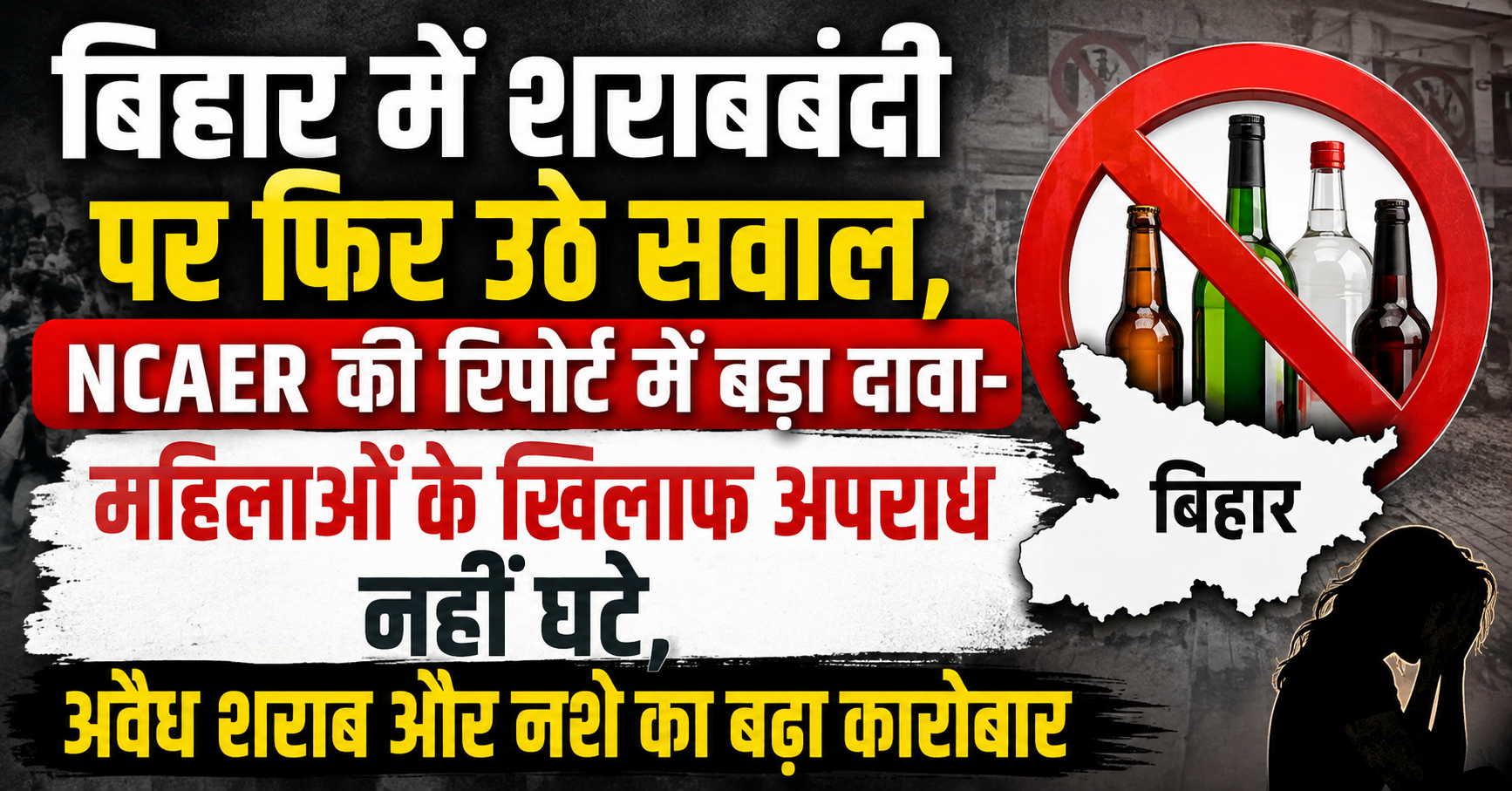
New Delhi/Patna: Bihar’s liquor prohibition policy, implemented in April 2016, has once again come under scrutiny. A recent research paper by the National Council of Applied Economic Research (NCAER) has raised several questions about the state’s prohibition policy. According to the study, there is no clear evidence of a broad decline in crimes against women following the implementation of prohibition. The research also highlights concerns over the growth of the illegal liquor trade, the use of alternative intoxicants, enforcement challenges and corruption.
The NCAER study examines the economic and social consequences of prohibition in Bihar. The research paper, titled “Macro Perspective of Bihar's Development Achievements, Unfinished Agenda, and the Way Forward,” was presented at the India Policy Forum. The study was led by economist Ratna Sahay and examines prohibition in the broader context of Bihar’s development, government revenue, law and order and social conditions.
What Was the Main Objective of Prohibition?
Bihar introduced prohibition with the stated objectives of reducing domestic violence associated with alcohol and improving the economic condition of families. The government and supporters of prohibition argued that money previously spent on alcohol would instead be used for food, education, healthcare and other essential needs.
Women’s groups and social activists also supported the policy, arguing that reducing the availability of alcohol would help decrease domestic disputes and violence against women.
However, the NCAER study has now questioned whether the policy has achieved some of its expected social outcomes. According to the research, there is no clear evidence of a broad decline in crimes against women after prohibition was introduced.
No Broad Decline in Crimes Against Women
According to the NCAER report, there has been no broad-based decline in reported crimes against women following the implementation of prohibition. The study states that total reported crimes against women increased in the years following 2016.
This finding raises questions about one of the key social objectives of prohibition. However, the relationship between prohibition and crime cannot be determined solely through crime statistics. Reporting patterns, police systems, willingness to file complaints and changes in law enforcement can all influence official crime figures.
The NCAER findings should therefore be viewed as part of a broader academic debate over the impact of alcohol prohibition on violence against women.
Several studies have examined alcohol and domestic violence in Bihar, but their conclusions have not always been identical. Some research has found indications of a decline in domestic or intimate-partner violence after prohibition, while other studies have highlighted the continued availability of alcohol through illegal markets and other challenges.
Concerns Over the Illegal Liquor Trade
Another major issue highlighted by the NCAER report is the illegal liquor market. According to the study, the complete prohibition of legal alcohol sales did not necessarily eliminate demand for alcohol. Instead, some of that demand shifted toward illegal channels.
The report points to concerns over the expansion of illegal networks involved in the supply and sale of alcohol. Such markets are difficult for the government to regulate and can create additional risks related to the quality and safety of alcohol.
The study also refers to increased use of alternative intoxicants. According to the report, some consumers may have turned to other substances when access to alcohol became restricted. These include illegal drugs and other intoxicating substances.
This presents a major challenge for prohibition policy. If demand for intoxicants continues while alcohol availability is restricted, simply banning alcohol may not be sufficient to achieve the broader objective of reducing substance abuse.
Impact on Government Revenue
The impact of prohibition is not limited to the social sector. The NCAER report also examines its financial consequences.
According to the report, in the three years before prohibition, excise duty collected from alcohol accounted for around 14 percent of Bihar’s own tax revenue. After prohibition was introduced, the state lost a significant source of revenue.
At the same time, enforcing prohibition requires government resources. Police and administrative agencies have to conduct regular operations against illegal liquor production, transportation and sales.
The NCAER study argues that if alcohol were brought back under a regulated taxation system, the state could potentially increase its own revenue by around 14–15 percent. Additional revenue could then be used for development and capital expenditure.
Does the Report Recommend Ending Prohibition?
One of the most widely discussed aspects of the research is its suggestion that Bihar reconsider its prohibition policy.
According to the study, the available evidence does not show that prohibition has broadly achieved all of its stated objectives. The researchers therefore recommend reconsidering the existing policy framework.
The report argues that ending prohibition could allow the government to generate additional revenue through excise duties. It could also reduce some of the expenditure associated with monitoring and combating illegal liquor networks.
However, ending prohibition would not simply mean allowing unrestricted alcohol sales. Such a move would create its own policy challenges. The government would need to regulate availability, establish strict age restrictions, expand addiction-treatment services and take measures to address alcohol-related social problems.
Focus on Education, Healthcare and Employment
The NCAER report also emphasizes that Bihar’s development priorities should extend beyond alcohol policy. Education, healthcare, governance and law enforcement, flood management, private-sector development and women’s empowerment are identified as important areas.
The study argues that Bihar needs to improve its capital expenditure and strengthen its ability to generate employment. Creating quality jobs for the state’s large young population is also considered essential.
Revenue generation remains another major challenge for Bihar. The state has limited capacity to generate its own tax revenue and depends significantly on transfers from the central government to finance development programmes. The revenue loss associated with prohibition therefore remains an important economic issue.
Political Debate Over Prohibition Could Intensify
The NCAER study comes at a time when prohibition continues to be a major political and social issue in Bihar. Supporters of the policy have described it as an important social reform, while critics have repeatedly raised concerns about enforcement, illegal liquor networks and revenue losses.
The new report has added an economic and research-based dimension to the debate. However, any decision to end prohibition cannot be based solely on revenue considerations. Social consequences, women’s safety, public health, addiction and law and order must also be considered.
It is also important to note that not all research on prohibition has reached the same conclusion. For example, an academic study published in 2024 found indications of a decline in reported violent crime following prohibition in Bihar, while another study published in 2025 reported evidence of a reduction in intimate-partner violence. In contrast, the new NCAER study says it found no broad decline in crimes against women. This suggests that the impact of prohibition remains a complex and contested research question.
A Major Policy Challenge for the Government
The NCAER report has placed a significant policy question before the Bihar government: Should prohibition continue in its current form, or should the policy be changed?
If prohibition continues, the government will need to focus on dismantling illegal liquor networks, improving enforcement, preventing corruption and addressing the growing use of alternative intoxicants.
If the government considers ending prohibition, it would need a carefully regulated alcohol market, appropriate taxation, strong addiction-treatment services and effective measures to protect women and vulnerable groups.
Bihar has now lived under prohibition for nearly a decade. The NCAER study has therefore renewed calls for a comprehensive assessment of the policy based on current economic, social, health and law-and-order data.