Smart Meters Become a “Surveillance Tool” for Power Companies in Bihar, 10 Billion Data Points Collected to Detect Power Theft
Patna: Smart meters in Bihar are no longer limited to generating electricity bills and enabling prepaid recharge facilities. They are increasingly functioning as a kind of “intelligence and surveillance technology” for power distribution companies. By technically analysing data generated by smart meters, power companies can identify electricity consumption patterns, unusual usage and possible cases of power theft.
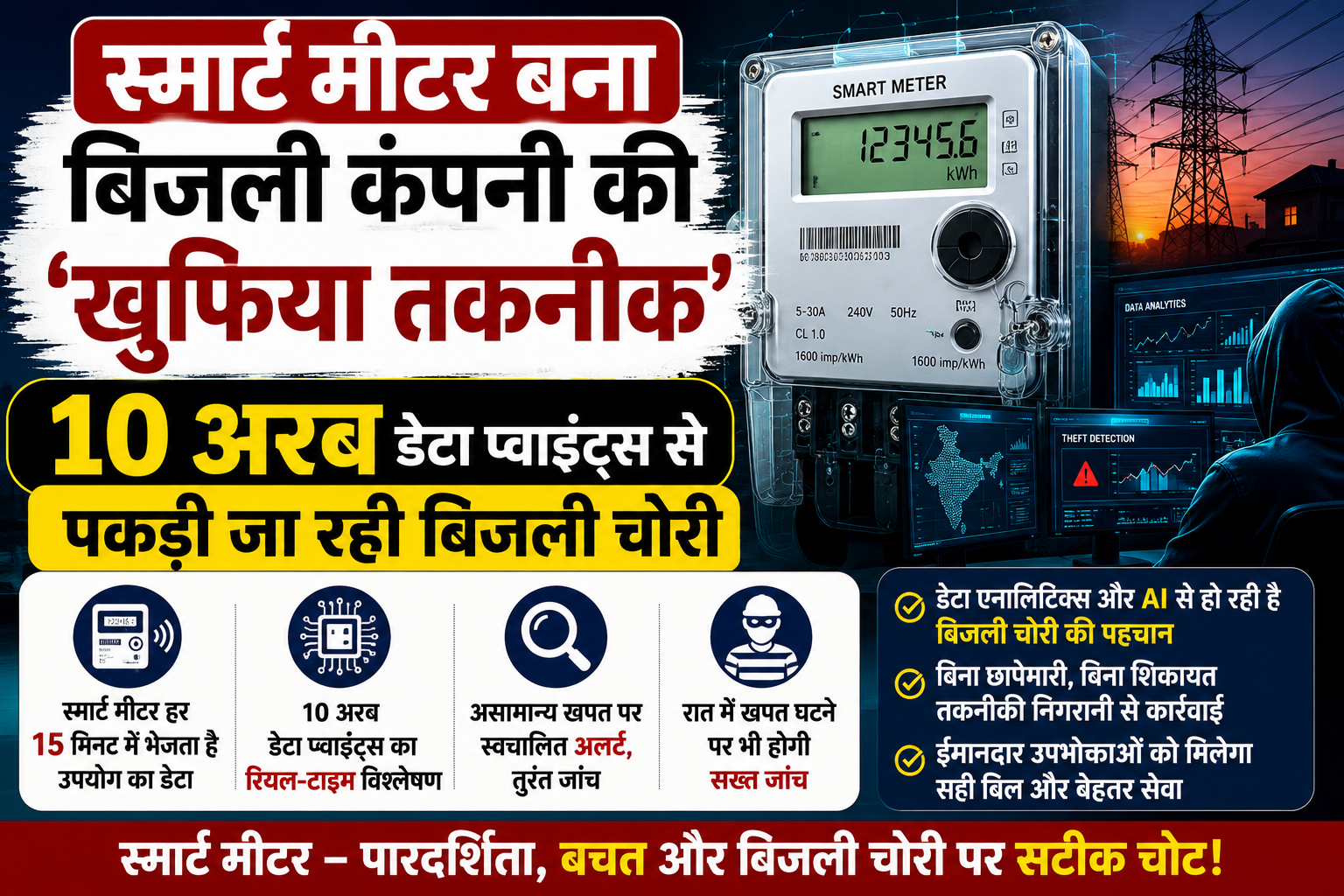
According to the power company, around 10 billion data points have been collected through smart meters so far. This data contains extensive information related to electricity consumption by consumers. Analysis of the data is helping the company not only identify irregularities but also formulate strategies for electricity supply, monitoring and revenue improvement in the future.
Based on smart-meter data, the power company can analyse how electricity consumption changes in different areas and at different times. If a consumer's usage pattern suddenly differs from the normal trend, the connection may be flagged for further investigation.
10 Billion Data Points Form the Basis of Monitoring
Smart meters continuously transmit large volumes of consumption-related data to the power company's system.
Because electricity usage records are available over different periods, a typical consumption pattern can be established for individual connections.
When an unusual change is detected, the data can be analysed at a technical level. This can help identify connections where there appears to be a mismatch between the category of the connection and actual electricity consumption.
According to the company, the collection of around 10 billion data points has created a substantial technological database. This information can also be used to improve electricity management and distribution planning in the future.
A Drop in Consumption After 9 PM Could Trigger an Inspection
Smart meters can provide information about time-based electricity consumption patterns. This allows power companies to identify potentially unusual behaviour.
According to officials, one type of irregularity involves commercial establishments allegedly using electricity connections registered under the domestic category. Such use is against the rules.
In some cases, there may be a difference between the registered category of a connection and the actual nature of electricity consumption.
If a domestic connection shows consumption patterns associated with commercial activity during the day and then records a significant change after a particular time at night, the data could be used to flag the connection for further verification.
However, a reduction in electricity consumption after 9 PM alone would not establish wrongdoing. The data can help identify potentially unusual cases, after which a field team may conduct physical verification.
Identifying Commercial Use of Domestic Connections
One of the challenges faced by power companies has been identifying commercial activities operating through domestic electricity connections.
Domestic and commercial connections are governed by different tariffs and regulations. Therefore, using a domestic connection for commercial purposes can constitute a violation of the applicable rules.
Data generated by smart meters can help identify such cases in a more technical and targeted manner.
For example, if a domestic connection consistently records electricity consumption that is significantly different from normal household usage, the system may flag it for further examination.
Consumer Consumption Patterns Are Being Mapped
Smart meters do more than record the total amount of electricity consumed. They can also help power companies understand consumption patterns.
The data can show when electricity consumption rises, when it falls and during which periods unusual changes occur.
This information can help power companies understand consumer behaviour.
The same data can also be useful for estimating future electricity demand and preparing distribution plans.
Technology's Role in Preventing Power Theft
Electricity theft causes financial losses for power distribution companies.
Under traditional systems, detecting theft or irregularities often required extensive manual inspections.
With smart meters and data analytics, potentially suspicious connections can be identified in advance. This allows inspection teams to focus their resources on locations where irregularities are more likely.
In this way, technology can make the inspection process more targeted and data-driven.
Sudden Changes in Consumption Can Also Be a Signal
If a consumer's electricity consumption follows a relatively stable pattern for a long period and then suddenly changes significantly, it may become a signal for further examination.
However, such changes can also occur for perfectly legitimate reasons.
For example, increased use of electrical appliances, changes in weather, changes in household occupancy or changes in the operating hours of a business can affect consumption.
Therefore, a change in consumption data alone does not establish that a consumer has violated any rule.
The data can be used to identify potentially unusual cases, but the actual situation needs to be verified before any action is taken.
Data Also Helps in Future Planning
The 10 billion data points collected through smart meters are not being used only for monitoring electricity theft.
The power company is also using the information to formulate future strategies.
Data showing when electricity demand rises in different areas, when the load is highest and how consumption patterns are changing can help improve electricity distribution planning.
Forecasting future electricity demand can allow supply arrangements to be prepared accordingly.
Consumers Also Need to Remain Cautious
With the increasing use of smart-meter data, consumers will also need to remain careful about the category of their electricity connections and the manner in which electricity is being used.
If a commercial establishment is operating on a domestic electricity connection, it is important to change the connection to the appropriate category in accordance with the applicable rules.
As data-based monitoring increases, the possibility of identifying such irregularities may also become greater.
Human Verification Remains Important
Although smart meters and data analysis can help identify electricity theft and incorrect connection categories, physical verification remains important before taking final action.
A change in electricity consumption does not necessarily mean that a consumer has violated any rule.
Therefore, data should be treated as a basis for identifying potentially irregular cases, followed by appropriate field verification.
This approach can help ensure fairness while making effective use of technology.
Major Change in Electricity Management
Smart meters are gradually moving Bihar's electricity distribution system towards a more data-driven model.
Under traditional systems, consumption information was available at relatively limited intervals. Smart meters can provide much more detailed consumption information.
This is giving power companies an opportunity to develop a better understanding of consumer behaviour, potential irregularities and electricity demand.
Smart meters in Bihar are increasingly becoming an important data-driven monitoring and planning tool for power distribution companies rather than merely a billing technology.
According to the power company, around 10 billion data points have been collected so far.
Analysis of these figures can help identify electricity consumption patterns, possible power theft and cases where commercial establishments may be using domestic electricity connections.
Officials say that if a connection's consumption pattern differs significantly from its normal trend, it may be flagged for further investigation.
A change in electricity consumption after 9 PM could also become a signal for inspection in certain cases, although physical verification would be necessary before drawing any final conclusion.
In the coming years, smart-meter data is expected to play a role not only in preventing electricity theft but also in forecasting electricity demand, improving supply management and developing future strategies for power distribution companies.
The growing use of smart meters is therefore gradually making Bihar's electricity system more technology-driven, data-based and focused on targeted monitoring.


