
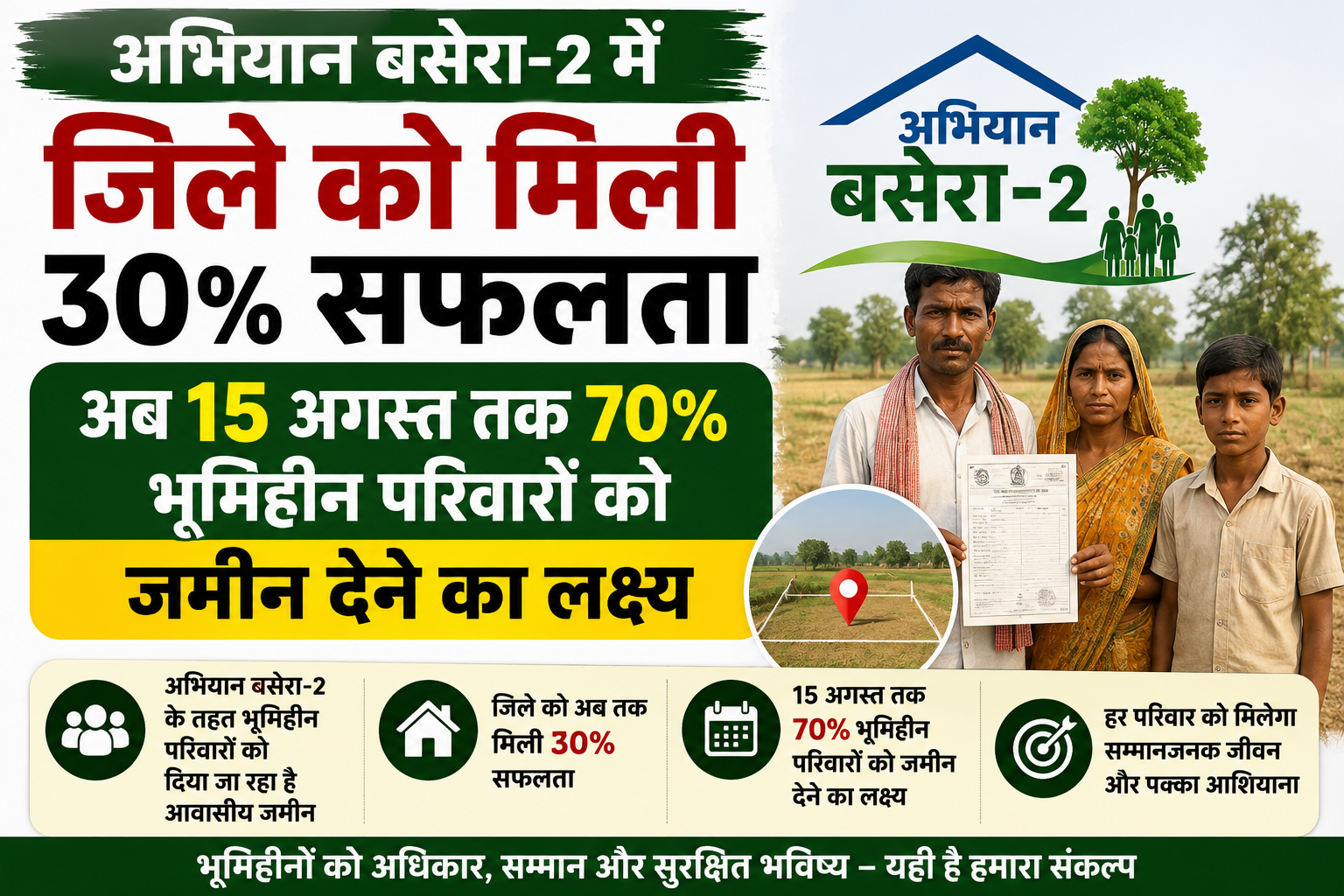
District Achieves 30% Progress, Target Set to Provide Land to 70% of Landless Families by August 15
District Correspondent: The Abhiyan Basera-2 scheme, aimed at providing residential land to landless families, has achieved around 30% progress in the district so far. Under the scheme, the administration is identifying eligible landless families and working to provide them with land for housing. The administration has now decided to accelerate the campaign and has set a target of reaching 70% of landless families by August 15.
The primary objective of the scheme is to provide residential land to poor and landless families who do not own a plot on which they can build a house. At the administrative level, work is underway to identify eligible families, assess land availability and verify the relevant records. Officials have been directed to speed up the campaign and ensure that the maximum number of eligible families receive the benefits of the scheme.
30% Progress Achieved So Far
Around 30% progress has been achieved under Abhiyan Basera-2 in the district. This means that action has been completed towards providing land to a portion of the identified landless families.
The administration now faces the challenge of extending the benefits of the scheme to the remaining eligible beneficiaries. For this, the concerned departments and local administration will need to work in coordination.
After setting August 15 as the deadline, preparations have begun to accelerate the campaign. The objective is to increase the progress of the scheme to 70% by Independence Day.
Major Benefit for Landless Families
There are many families in rural areas who do not own land. For these families, having a plot on which they can build a house is one of their most important needs.
Under Abhiyan Basera-2, providing residential land to eligible landless families will give them an opportunity to establish a permanent home. After receiving land, beneficiaries may also become eligible to receive benefits under government housing schemes and other welfare programmes, subject to the relevant eligibility criteria.
This is expected to contribute to an improvement in the living conditions of economically weaker families.
Availability of Land Is a Key Factor
The availability of government land is one of the most important factors in implementing the scheme.
Where suitable government land is available, the process of allotting land to eligible families can move forward more easily.
However, in some areas, officials have to examine land availability, the nature of the land and the status of land records. These processes can sometimes take time.
The administration is attempting to make use of available government land in accordance with the rules and provide eligible landless families with residential plots at the earliest.
Eligibility Determined After Verification
The scheme is intended only for eligible families. Therefore, beneficiaries' documents and land-related records need to be verified.
After identifying families at the local level, their applications and available documents are checked. Once a family is found eligible, the process of allotting land under the scheme is taken forward.
The objective of this process is to ensure that genuine landless and needy families are not deprived of the benefits.
Target of 70% by August 15
The administration has now set a target of increasing the progress of Abhiyan Basera-2 to 70% by August 15.
After achieving 30% progress so far, the administration will now need to complete an additional 40 percentage points of the target.
For this, officials will need to review pending cases and take action quickly.
Continuous monitoring at the panchayat and block levels will also be necessary to achieve the target within the stipulated period.
Need to Accelerate Administrative Work
The role of the revenue department and local administration will be crucial in completing the campaign within the prescribed deadline.
Officials will need to identify cases where the process has been delayed because of documentation or other administrative issues.
Resolving pending cases on a priority basis could help increase the pace of the programme.
Coordination among the concerned authorities will also be necessary in cases involving the availability and identification of suitable land.
Increased Activity at Panchayat Level
Active participation at the panchayat level will be important for the success of Abhiyan Basera-2.
In rural areas, local authorities and representatives can often obtain better information about landless families and their actual circumstances.
Coordination between panchayat representatives and local administration can help identify eligible beneficiaries more effectively.
At the same time, beneficiaries need to be informed about the scheme's procedures and the documents required to receive its benefits.
Easier Access to Housing for Poor Families
The biggest challenge for many landless families is the lack of land on which they can build a house.
Some families have been living for years on land belonging to others or in temporary settlements.
Providing residential land to such families can enable them to move towards constructing permanent homes.
Abhiyan Basera-2 is an important initiative aimed at addressing this problem.
Potential Benefits of Other Government Schemes
Once land is allotted, eligible families may also have better opportunities to access other government welfare programmes.
If they meet the required criteria, beneficiaries may be able to receive assistance under schemes related to housing construction, drinking water, electricity, sanitation and other basic facilities.
Therefore, the scheme could contribute to the overall development of poor families rather than simply providing them with land.
Monitoring and Transparency Are Essential
Transparency is also important for the successful implementation of the scheme.
The selection of eligible families should be carried out according to established rules, and the process of providing benefits should remain free from irregularities.
Proper verification of land records and beneficiary eligibility is essential for maintaining the credibility of the programme.
The administration must also ensure that genuine landless families are not excluded because of procedural or documentation-related issues.
Growing Expectations Among Rural Residents
Landless families are hopeful about receiving residential land under Abhiyan Basera-2.
For families without their own land, receiving a government-allotted residential plot could provide significant relief.
The administration's plan to achieve 70% progress by August 15 has raised expectations that pending cases will now be processed more quickly.
Challenge Ahead
The biggest challenge before the administration is to achieve the additional 40 percentage points required to move from the current 30% progress to the 70% target.
Work related to land availability, document verification and identification of eligible beneficiaries will need to be completed within the stipulated period.
If administrative coordination remains effective and pending cases are resolved quickly, the target may be achievable.
Under the Abhiyan Basera-2 scheme, the district has achieved around 30% progress so far. The administration has now decided to accelerate the campaign and has set a target of reaching 70% by August 15.
The main objective of the scheme is to provide residential land to eligible landless families who do not have a plot on which to build their own homes.
In the coming days, speeding up work related to land availability, document verification and beneficiary identification will remain a key priority.
If the administration progresses according to the planned timeline, a large number of landless families could receive significant assistance towards securing permanent housing.
August 15 has therefore become an important milestone for the campaign. Moving from the current 30% progress to the 70% target will be a major responsibility for the administration, but efforts are underway to achieve it through effective monitoring and better coordination.


