
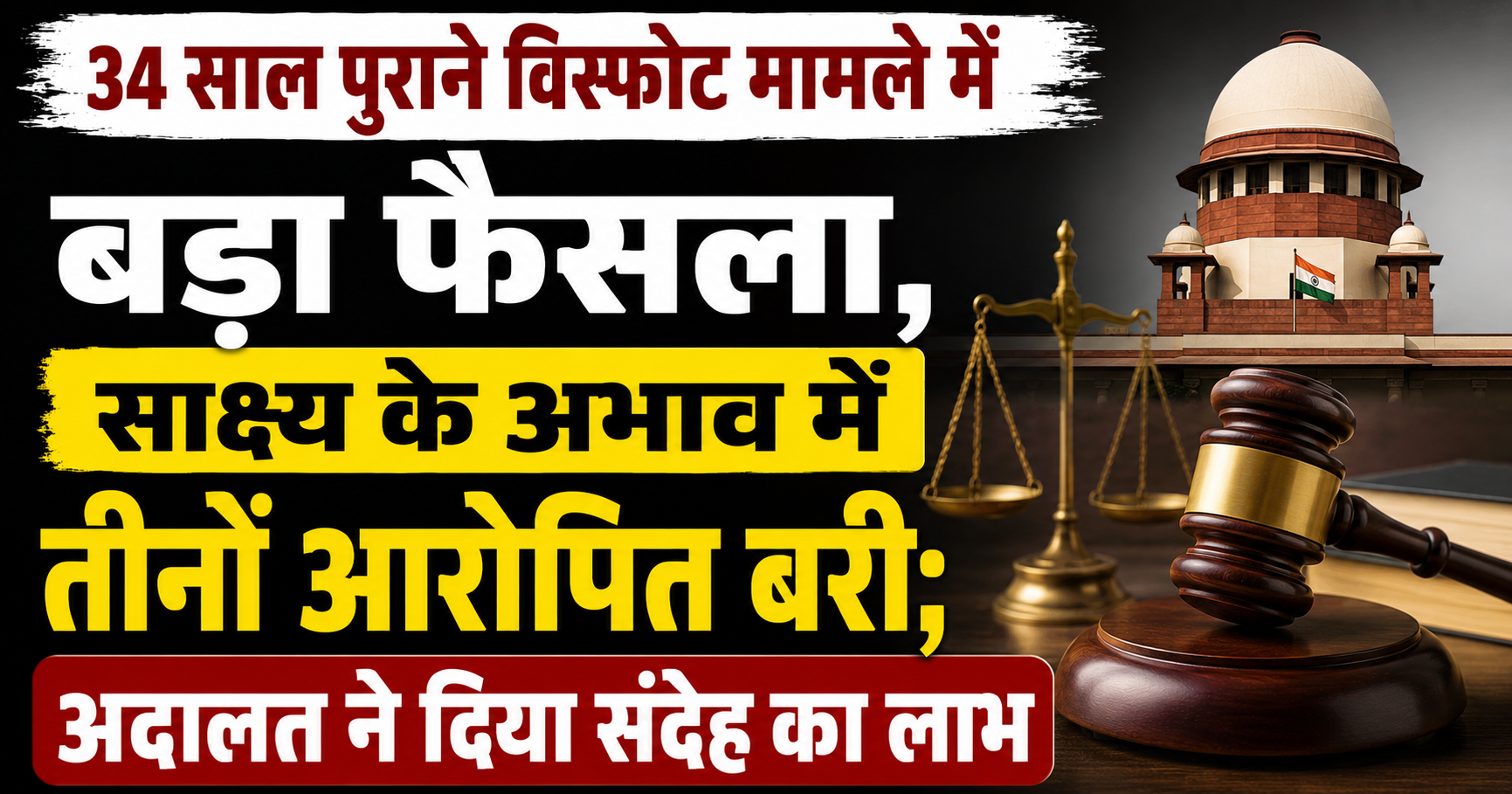
Court Acquits Three Accused in 34-Year-Old Blast Case Due to Lack of Evidence
Patna: In a significant judgment in a 34-year-old blast case, a court has acquitted all three accused, holding that the prosecution failed to prove the charges beyond reasonable doubt. After a prolonged legal battle spanning more than three decades, the court ruled that the available evidence and witness testimonies were insufficient to establish guilt and granted the accused the benefit of the doubt.
The case dates back to 1991 and remained under trial for several years before Additional District and Sessions Judge (ADJ)-2 and MP/MLA Special Judge Brajesh Kumar Singh delivered the verdict.
FIR Was Registered in 1991
The case originated on November 2, 1991, when Ram Lakhan Singh himself lodged the First Information Report (FIR).
According to the FIR, at around 11:00 a.m., a powerful explosion occurred in the cowshed located within the residential premises of the complainant. The blast was so intense that it blew off the tiled roof of the structure and injured one person.
The incident created panic in the area, following which the police initiated an investigation.
Investigation Took an Unexpected Turn
After registering the FIR, police conducted a detailed investigation, examining the blast site, recording witness statements, and collecting available evidence.
However, during the course of the investigation, the police did not accept the complainant's version of events. Instead, after completing the probe, investigators named Ram Lakhan Singh, Surajbhan Singh, and Lalan Singh as the accused in the case and proceeded with legal action against them.
Charges Framed After Years of Legal Proceedings
Following the completion of the investigation, the police filed a charge sheet in court. The case then went through a lengthy judicial process over several years.
Eventually, on April 21, 2018, the court framed charges against the three accused under Sections 307 (attempt to murder), 324 (voluntarily causing hurt by dangerous weapons), 427 (mischief causing damage), and 120B (criminal conspiracy) of the Indian Penal Code (IPC), along with the relevant provisions of the Explosive Substances Act.
After the charges were framed, the trial proceeded with the examination of witnesses and evidence.
Prosecution Failed to Prove the Charges
During the trial, the prosecution presented police witnesses and relied on documentary and other available evidence in an attempt to establish the charges against the accused.
However, after evaluating the evidence, the court found that the prosecution had failed to prove the allegations beyond reasonable doubt. Several crucial aspects of the case lacked sufficient supporting evidence, making it impossible to establish the guilt of the accused with the certainty required under criminal law.
Court Granted Benefit of Doubt
After hearing arguments from both sides and carefully examining the evidence on record, ADJ-2 and MP/MLA Special Judge Brajesh Kumar Singh delivered the judgment.
The court observed that in criminal cases, the burden of proving guilt rests entirely on the prosecution. If the evidence does not conclusively establish the charges, the accused is entitled to the benefit of the doubt.
Applying this well-established legal principle, the court acquitted all three accused of all charges.
An Important Example of Criminal Justice Principles
Legal experts noted that the judgment reaffirms a fundamental principle of criminal jurisprudence—that no person can be convicted unless the prosecution proves guilt beyond reasonable doubt.
The court based its decision solely on the evidence presented during the trial and the applicable legal principles, rather than on allegations alone.
Questions Raised Over Prolonged Litigation
The fact that the case remained pending for nearly 34 years has also drawn attention to the lengthy duration of judicial proceedings in some criminal cases.
Legal experts observe that such prolonged trials can affect the availability and reliability of witnesses, documents, and physical evidence, making it more difficult to establish facts after several decades.
They believe that the timely disposal of serious criminal cases would improve the overall efficiency of the justice system.
Legal Position After the Verdict
With the court's decision, all three accused have been acquitted in the blast case. However, if the prosecution disagrees with the judgment, it has the legal option of filing an appeal before the appropriate higher court. The final legal outcome will depend on any further judicial proceedings.
Conclusion
The judgment brings an end to a legal battle that lasted for more than three decades. Since the prosecution failed to produce sufficient and convincing evidence to prove the allegations beyond reasonable doubt, the court acquitted all three accused.
The verdict once again reinforces a core principle of criminal law: allegations alone are not enough for conviction; guilt must be established through credible and legally admissible evidence. Finding that the prosecution had failed to meet this standard, the court granted the accused the benefit of the doubt and ordered their acquittal.


