
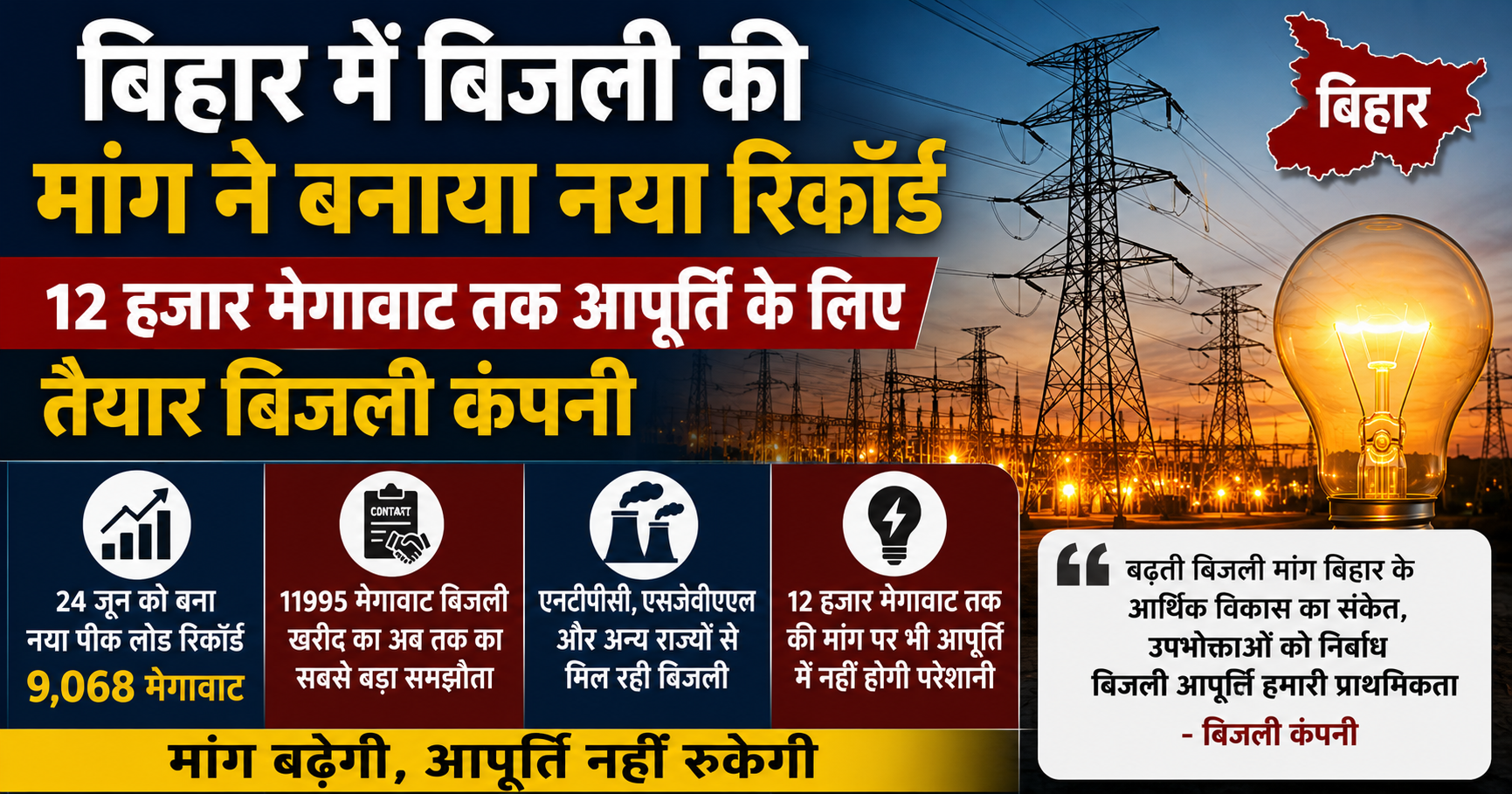
Bihar Sets New Power Demand Record, Electricity Utility Ready to Supply Up to 12,000 MW
Patna: Bihar has achieved a new milestone in its power sector as electricity demand continues to rise across the state. In preparation for the peak summer season, the state's power utility has signed agreements to procure 11,995 megawatts (MW) of electricity from multiple generating companies—its largest-ever power purchase arrangement. Officials say the state is fully prepared to meet demand even if it reaches 12,000 MW, ensuring an uninterrupted power supply for consumers.
According to the Energy Department, electricity consumption has increased steadily this year due to rising temperatures, rapid urbanization, industrial growth, and greater use of electrical appliances in homes and businesses. Anticipating higher demand, the government has secured sufficient power in advance.
New Peak Load Record on June 24
Bihar recorded a new electricity demand milestone on June 24, when the state's peak load reached 9,068 MW, the highest ever recorded.
Power company officials believe demand is likely to increase further in the coming weeks as temperatures remain high and economic activity continues to expand.
Despite the record demand, officials said the state was able to maintain a stable power supply without any major disruptions, demonstrating the effectiveness of its advance planning.
Largest-Ever Power Purchase Agreement
To meet the growing demand, the electricity utility has entered into Power Purchase Agreements (PPAs) totaling 11,995 MW with various power generation companies. This is the largest power procurement arrangement in Bihar's history.
Energy experts believe this large-scale procurement has been planned not only for current summer requirements but also to ensure long-term energy security. The agreements are expected to significantly reduce the possibility of power shortages and guarantee reliable electricity for consumers.
NTPC Plants Contribute the Largest Share
A major portion of Bihar's electricity supply comes from power plants operated by NTPC. Key generating stations supplying electricity to the state include Barh, Nabinagar, Kanti, Kahalgaon, and Barauni.
These power stations play a crucial role in meeting electricity demand across Bihar. According to the Energy Department, their consistent performance has strengthened the state's power supply system.
Additional Supply from SJVNL and Other States
Bihar is not dependent solely on generating stations within the state. It also receives electricity from SJVNL's Buxar power project and has power purchase agreements with generating companies located in other states.
These long-term and short-term agreements provide multiple supply sources, ensuring that electricity demand can be met even if one source experiences disruptions.
Ready to Meet Demand of Up to 12,000 MW
The electricity utility has stated that its current procurement and supply arrangements are sufficient to meet demand of up to 12,000 MW without any major difficulty.
Officials said that, at the state level, there is no shortage of electricity. Any temporary interruptions experienced by consumers are generally caused by localized issues such as sudden increases in demand, technical faults, or distribution network problems rather than an overall shortage of power.
Distribution Network Also Strengthened
To support rising electricity consumption, the power utility has upgraded its distribution infrastructure across the state.
Transformer capacities have been increased in many areas, new transformers have been installed where needed, and aging power lines have been replaced. Several feeders have also been modernized to handle higher loads and reduce the risk of outages.
Officials added that dedicated technical teams have been deployed to quickly resolve local power supply issues whenever they arise.
Rising Demand Reflects Economic Growth
Energy experts believe the increase in electricity consumption is not only the result of summer temperatures but also a positive indicator of Bihar's economic development.
Expansion of industries, growth in commercial establishments, improved rural electrification, and increased use of household electrical appliances have all contributed to the surge in power demand.
According to experts, rising electricity consumption is widely regarded as a sign of economic progress, industrial expansion, and improved living standards.
Focus on Better Consumer Services
The electricity utility emphasized that its goal extends beyond ensuring adequate power availability. It is also working to improve the quality and reliability of services provided to consumers.
Complaint redressal systems have been strengthened, and monitoring at district and regional levels has been enhanced to ensure faster resolution of power-related issues.
Consumers are also benefiting from services such as smart meters, online bill payment, digital complaint registration, and real-time monitoring systems.
Preparing for Future Demand
The Energy Department expects electricity demand in Bihar to continue growing in the coming years.
To address future requirements, work is underway to expand generation capacity, sign additional power purchase agreements, strengthen transmission infrastructure, and modernize the distribution network.
The government's long-term objective is to provide reliable, high-quality electricity to every urban and rural household across the state through continued investment in energy infrastructure.
With a record peak demand of 9,068 MW and 11,995 MW secured through power purchase agreements, Bihar has demonstrated its preparedness to meet growing electricity needs. The power utility says it is capable of supplying electricity even if demand rises to 12,000 MW, while ongoing infrastructure upgrades are expected to further improve reliability.
Energy experts believe the steady rise in electricity consumption reflects Bihar's expanding economy, increasing industrial activity, and improving quality of life. If investment in power generation, transmission, and distribution continues at the current pace, the state is expected to become even better equipped to meet its future energy requirements.


