
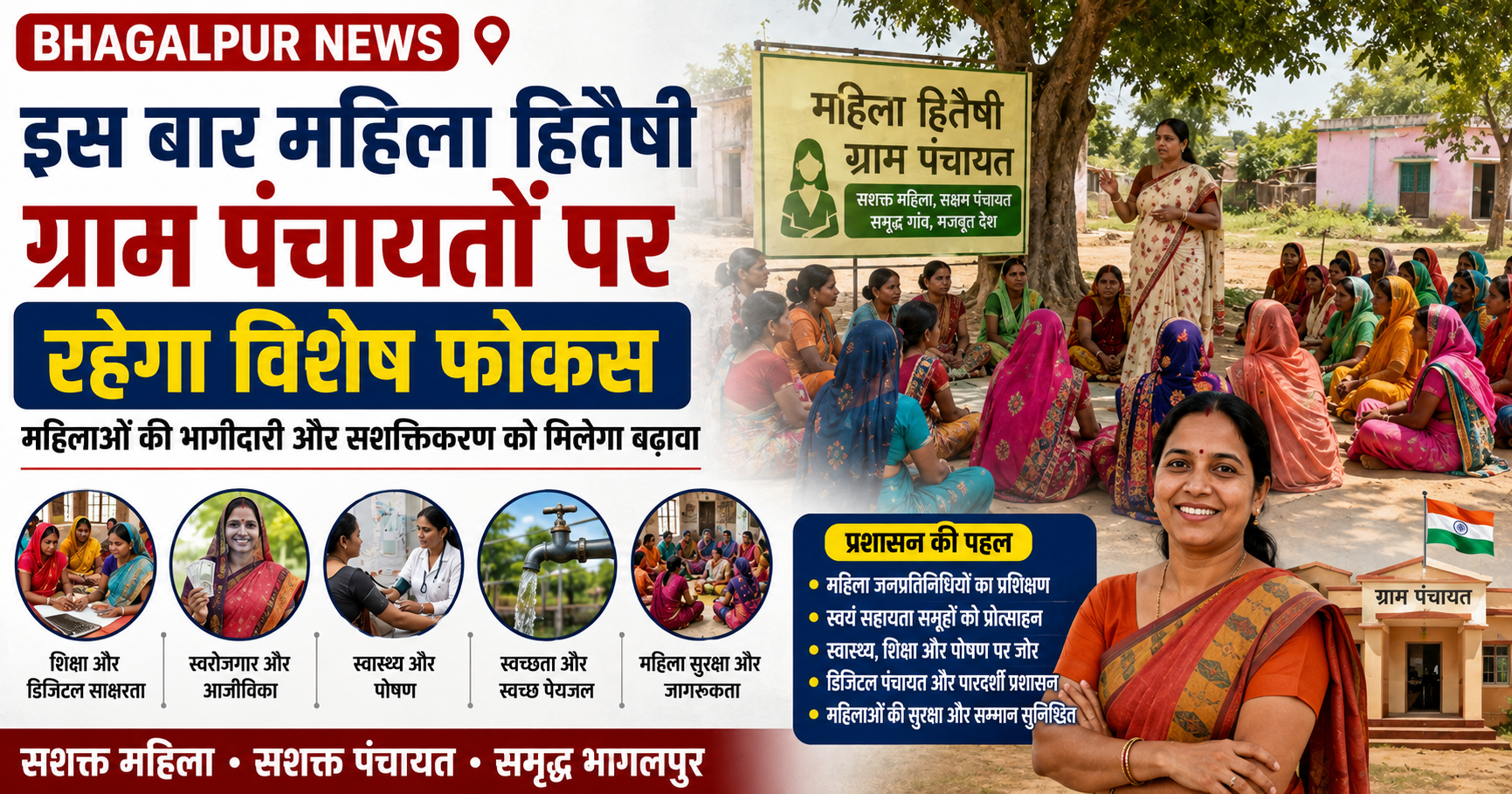
Special Focus on Women-Friendly Gram Panchayats This Year, Greater Emphasis on Women's Empowerment and Participation
Report by Sanjay Kumar, Bhagalpur: In a major step toward strengthening rural development, the Bhagalpur district administration has decided to place special emphasis on developing women-friendly Gram Panchayats this year. Rather than limiting village governance to basic infrastructure alone, the initiative aims to transform Panchayats into safer, more inclusive, and opportunity-driven spaces for women. Several new programs have been planned to promote women's social, economic, and political participation, ensuring they play a more active role in the development of rural communities.
Under this initiative, priority will be given to women's safety, healthcare, education, sanitation, employment, digital literacy, and the strengthening of self-help groups (SHGs). Officials believe that empowering rural women and involving them in decision-making will significantly accelerate overall rural development.
Greater Emphasis on Women's Participation
With women already holding 50 percent reservation in Panchayati Raj institutions, a large number have been elected as Panchayat representatives. However, their active involvement in governance and decision-making remains limited in many areas.
To address this, the district administration plans to organize special capacity-building and leadership training programs for elected women representatives. The training will cover government scheme implementation, financial management, digital governance, Panchayat administration, and leadership development.
Officials believe that strengthening the capabilities of women representatives will improve the implementation of welfare schemes and ensure that issues affecting women receive greater attention at the grassroots level.
Self-Help Groups to Receive Major Support
Women-led Self-Help Groups (SHGs) are expected to play a central role in the women-friendly Panchayat initiative. The administration plans to provide financial assistance, skill development, and entrepreneurship training to active SHGs across the district.
Women will receive support in areas such as tailoring, embroidery, mushroom cultivation, dairy farming, beekeeping, food processing, and handicrafts. These initiatives are expected to create sustainable livelihood opportunities and increase household incomes.
The administration is also exploring ways to connect SHG products with digital marketplaces and e-commerce platforms, enabling rural women to access wider markets and become economically self-reliant.
Education and Healthcare Among Top Priorities
Women's and adolescent girls' health will receive special attention under the campaign. Panchayats will organize regular health camps, anemia screening programs, maternal and child healthcare services, nutrition awareness drives, and immunization campaigns.
Efforts will also focus on improving access to clean drinking water, sanitation facilities, and menstrual hygiene management.
To promote girls' education, authorities plan to strengthen school infrastructure, identify school dropouts, and encourage them to return to education. Digital learning facilities and village libraries are also expected to be expanded.
Women's Safety to Remain a Key Focus
Ensuring women's safety in rural areas is another major objective of the initiative. Awareness campaigns, legal aid camps, grievance redressal mechanisms, and women help desks will be established at the Panchayat level.
Special drives will also be conducted against domestic violence, child marriage, dowry practices, and gender discrimination. Officials believe that creating a safe and supportive environment will encourage women to participate more actively in social and economic activities.
Moving Towards Digital Panchayats
The administration also plans to improve digital literacy among women representatives through dedicated training programs. Participants will learn how to use online government services, digital payment systems, e-governance platforms, and Panchayat management portals.
This initiative is expected to enhance transparency in governance while making public services more accessible and efficient for rural residents.
Cleanliness and Environmental Conservation
The women-friendly Panchayat initiative also places strong emphasis on sanitation and environmental sustainability. Women will be encouraged to participate in solid and liquid waste management, plastic-free village campaigns, rainwater harvesting, tree plantation drives, and water conservation projects.
Officials believe that women's active participation in environmental initiatives can help create cleaner, healthier, and more sustainable rural communities.
Administration's Implementation Strategy
The district administration will regularly assess the performance of Panchayats based on several indicators, including women's participation, implementation of government schemes, healthcare, education, sanitation, and livelihood generation.
Top-performing women-friendly Panchayats will be recognized and rewarded to encourage healthy competition and inspire other villages to adopt similar practices.
According to officials, the objective of the initiative extends beyond implementing government schemes. It aims to ensure equal opportunities, dignity, and meaningful participation for women in every aspect of village governance and development.
A New Direction for Rural Development
Development experts believe that the concept of women-friendly Gram Panchayats has the potential to reshape rural governance. When women actively participate in decision-making, achieve financial independence, and gain better access to education and healthcare, the overall development of villages becomes more balanced and sustainable.
The initiative launched in Bhagalpur could serve as a model for other districts in Bihar. If implemented effectively, it is expected to significantly improve the social and economic status of rural women in the coming years. The administration hopes that this women-centric approach will not only strengthen Panchayati Raj institutions but also bring lasting transformation to rural development across the region.


