
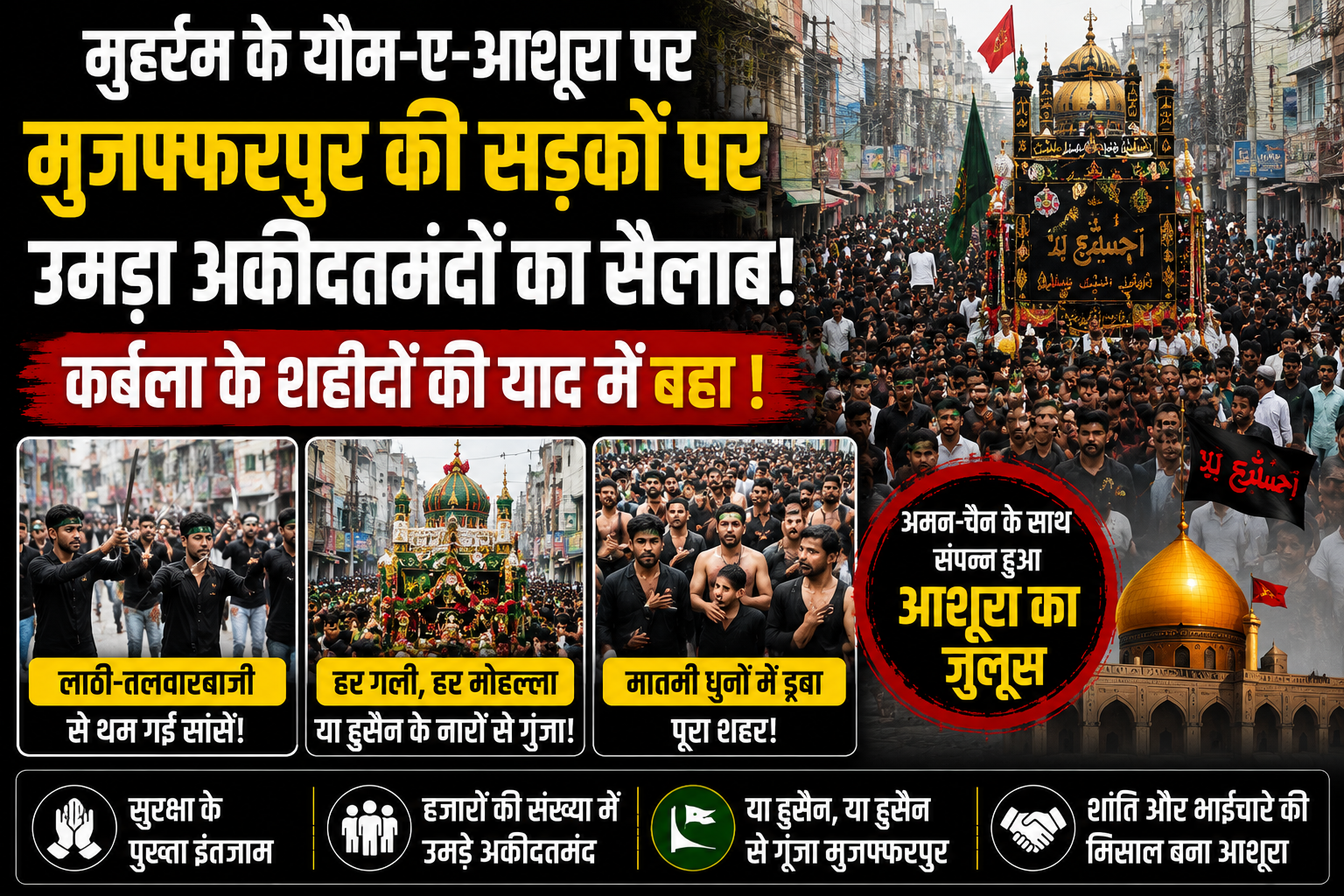
A Sea of Devotees Swarms the Streets of Muzaffarpur on Youm-e-Ashura; Blood Shed in Memory of the Martyrs of Karbala, While Mind-Boggling Swordplay and Lathi Feats Leave Onlookers Spellbound!
The 10th day of Muharram, known as Youm-e-Ashura, was observed with historic solemnity and traditional fervor across the Muzaffarpur district and its expansive rural fringes. The entire city was deeply immersed in grief, commemorating the supreme sacrifice of Hazrat Imam Hussain and his 72 devoted companions who laid down their lives defending truth and justice on the desert sands of Karbala.
As the central procession traversed the city's key intersections—Company Bagh, Sutapatti, Saraiyaganj, Sikandarpur, Kalyani, and Akhadaghat—it was met by a massive sea of devotees. The most staggering and emotionally gripping sight was the bloody mourning ('Khooni Maatam') by the faithful. Devotees lacerated their chests and backs using sharp iron chains, small knives, and razor blades. Concurrently, courageous martial artists from various traditional akhadas showcased breathtaking stunts with traditional weapons, making the air thrum with passionate cries of 'Ya Hussain.'
Bloody Mourning with Chains and Blades: Eyes Well Up Amid Cries of Grief
The most poignant and hair-raising phase of the Ashura procession commenced in the afternoon, universally referred to as the 'Shahidi Juluus' (The Martyrdom Procession).
Pierced Chests: Various operational units ('Anjumans') of the Shia community and other devotees marched out of several local Imambargahs in deep mourning. Amidst mournful elegies and rhythmic dirges ('Nauhas'), young men swung heavy iron chains embedded with blades over their shoulders, casting a somber shadow over the surroundings. Chanting "Ya Hussain, we were not there at Karbala...", the youth struck their backs and chests, spilling blood onto the streets in an intense display of devotion.
The Zeal of the Young and Old: This extreme manifestation of grief was not restricted to the youth alone; elderly men and even young boys chipped their foreheads with small blades out of sheer love for Imam Hussain. Remarkably, despite the streaming wounds, there wasn't a single flinch of pain on their faces—only a profound spiritual absorption in the tragedy of Karbala.
Valour on Display in Akhadas: Breathtaking Feats with Staffs, Swords, and Fire
Parallel to the mourning, traditional martial arts academies (Akhadas) of Muzaffarpur put on a spectacular display of physical prowess. Under the watchful eyes of their master trainers ('Khalifas'), teams of youth and children performed highly technical stunts.
The Clash of Swords and Staffs: As the procession paused near Kalyani Chowk and the Saraiyaganj Tower, martial artists engaged in twin-blade swordplay, defensive staff shielding ('Pattabaazi'), and rapid lathi maneuvers. The sheer agility of the performers, swinging up to four wooden staffs simultaneously while deflecting mock attacks, left the gathering crowds awestruck.
Dancing with Orbs of Fire: As dusk settled over the city, performers spun burning wooden logs and chain-linked fireballs ('Banaiti') through the air, creating dazzling geometric rings of fire. The audience erupted in roaring applause and religious slogans to boost the morale of the artists.
A Beacon of Syncretic Culture: The most beautiful aspect of Muzaffarpur's Akhada culture was its communal harmony. In several troupes, Hindu and Muslim youth stood shoulder-to-shoulder, spinning staffs and proudly waving the Indian national flag together, sending a powerful message of national unity and composite heritage.
At a Glance: Muzaffarpur Muharram Processions
| Key Feature | Live Ground Observations and Logistical Metrics |
|---|---|
| Primary Route | Commenced at local Imambargahs via Company Bagh, Saraiyaganj, Kalyani to Karbala grounds |
| Mourning Profile | Extreme self-flagellation using custom chains, knives, and sharp razor blades |
| Akhada Activities | Traditional lathi combat, specialized swordplay, and fire-spinning maneuvers |
| Security Framework | Heavy police deployment, real-time drone tracking, and centralized CCTV network |
| Communal Backdrop | Active joint participation by Hindu and Muslim communities, showcasing syncretic harmony |
Towering and Illuminated Tajiyas: Resplendent Models Displayed All Night
Grand, brilliantly illuminated 'Tajiyas' (miniature replicas of the mausoleum of Imam Hussain) were paraded through the night from neighborhoods like Sikandarpur, Brahmpura, Chandwara, and Kazi Mohammadpur. Crafted meticulously from thermocol, vibrant tinted papers, glittering mirrors, and intricate LED frameworks, these models mirrored the sacred shrine at Karbala.
Navigating Structural Hurdles: Many of these floating structures were so massive that dedicated akhada volunteers moved alongside them with long insulated bamboo poles, lifting overhead electrical cables to ensure safe passage. Moving ahead of these structures, youth danced to the thunderous beats of traditional drums, Tasha, and Nagadas, guiding the replicas toward the burial grounds.
Uncompromising Security: Drones and Quick Response Teams Maintain Strict Vigil
To ensure that the massive public gathering and the highly charged Akhada processions concluded peacefully, the Muzaffarpur District Administration and the Senior Superintendent of Police (SSP) deployed an unprecedented security blanket.
Boots on the Ground: Heavy contingents of the Bihar Police, units of the Bihar Military Police (BMP), and specialized Quick Response Teams (QRT) were positioned at sensitive street corners and narrow turnings. The District Magistrate (DM) and the SSP personally supervised operations from the central control rooms at Kalyani and Saraiyaganj.
Digital Surveillance: Drones hovered continuously along the entire procession route, mapping rooftops and alleyways to deter any mischief. Furthermore, the cyber cell operated on a 24/7 high-alert status to counter any inflammatory rumors or provocative posts on social media platforms.
The historic Muharram processions that concluded in Muzaffarpur were not merely a display of grief and martial art; they represented a living testament to communal unity and the triumph of righteousness over tyranny. While the blood-stained chests recalled the historic tragedy of Karbala, the spinning staffs of the Akhadas symbolized the collective strength of an undivided society. Late into the evening, amid a deeply emotional atmosphere, the Tajiyas were respectfully buried at various local Karbala grounds, bringing the 10-day period of solemn remembrance to a peaceful and harmonious close.


