
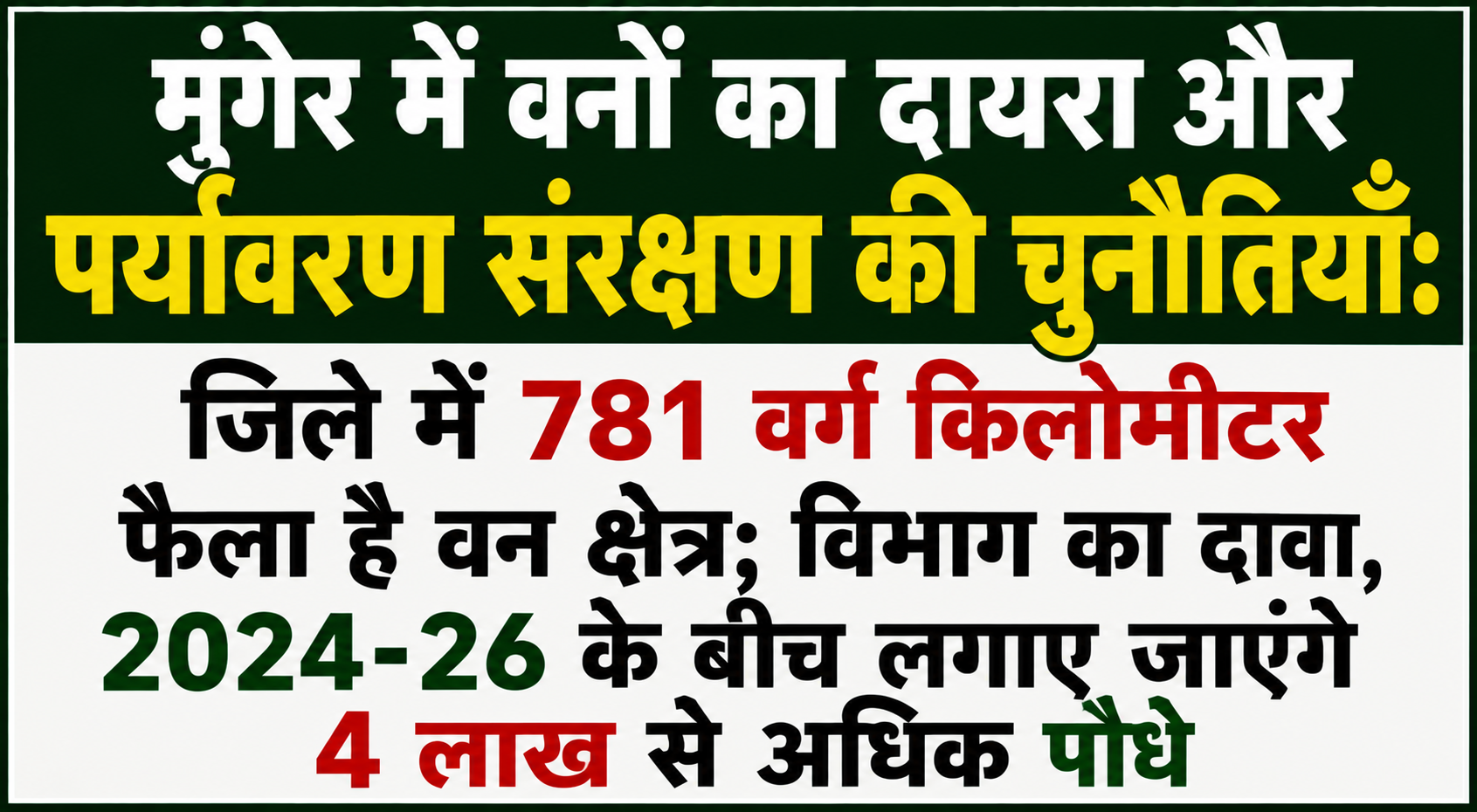
A detailed and significant report regarding environmental conservation, greenery, and the functioning of the forest department has emerged from Bihar's Munger district.
Munger (Bihar): A detailed and significant report regarding environmental conservation, greenery, and the functioning of the forest department has emerged from Bihar's Munger district. Munger is renowned throughout the state for its natural beauty, hills, and forests. According to official data, the total forest area in Munger district is spread across a massive expanse of 781 square kilometers, constituting a major share of the district's total geographical area.
However, despite this rich natural heritage, several questions are being raised regarding the pace and maintenance of tree plantation at the grassroots level. Experts and local environmentalists believe that the rate of felling or natural loss of forests has not been matched by an expected level of new sapling plantation and subsequent care.
Based on a detailed report received from the 'Hindustan' correspondent, the forest department has set a major target for upcoming years, under which it has been claimed that more than 400,000 (4 lakh) new saplings will be planted across the district between the years 2024 and 2026. Additionally, data regarding roadside campaigns conducted in previous years (such as the initiative to plant 2,000 saplings along various roads during 2023–24) has also surfaced. Below is a detailed analysis of the current status of Munger's forest cover, the department's upcoming action plan, plantation data, and vital information concerning environmental conservation.
Geographical and Forest Profile of Munger: A Green Canopy Spanning 781 Square Kilometers
Geographically, Munger district is exceptionally diverse. Alongside plains, it features the tail-end hills of the Vindhya mountain range and dense forests, which balance the local climate.
Vast Forest Cover: The forests spanning 781 square kilometers in the district harbor diverse flora, medicinal plants, and wildlife. This forest tract is considered the backbone of Munger's ecosystem.
Contribution to Environmental Balance: This 781 sq km span not only aids in absorbing carbon dioxide but also plays a pivotal role in sustaining the district's groundwater table and regulating the monsoon.
Sluggish Pace of Plantation: Paper Claims Versus Ground Reality
Despite such a vast expanse of forest area, criticism has frequently been directed at the pace at which new trees are planted annually across the district.
Lack of Expected Momentum: Environmentalists and local conscious citizens assert that the rigorous pace required for forest conservation and the development of new green zones is missing on the ground. Owing to illegal logging and administrative laxity in forest protection, several mature trees are being destroyed, a deficit that sluggish plantation rates fail to make up for.
Data on Roadside Plantation: Reviewing the department's data from the previous session, approximately 2,000 saplings were planted along various major roads across the district during 2023–24 with the objective of beautification and enhancing green cover. However, experts argue that merely planting saplings is insufficient; many wither away due to a lack of protective tree guards and regular watering.
Upcoming Plans of the Forest Department: Target to Plant Over 4 Lakh Saplings During 2024–26
To combat escalating pollution and the threats of climate change, the forest department has formulated an ambitious target for large-scale tree plantation in the coming years.
Vast Target (2024–26): According to official information provided by the forest department, a plan is in place to plant a total of over 400,000 saplings across various divisions and rural areas of Munger district within this two-to-three-year window of 2024 to 2026.
Types of Saplings to Be Planted: Under this campaign, shady trees alongside fruit-bearing and medicinal plants (such as neem, mango, shisham, mahogany, arjun, and teak) are being incorporated to directly benefit both the local rural economy and the environment.
Emphasis on Social Forestry: Special emphasis is being laid on distributing and planting saplings under agroforestry not only inside forests but also on wasteland, government office campuses, educational institutions, and private lands belonging to farmers.
Major Challenges of Plant Protection and Accountability
Planting a sapling is one thing, but nurturing it into a large, healthy tree is the true challenge. Past campaigns in Munger have shown that once budgets are spent and plantation targets are met on paper, the saplings are subsequently neglected.
Lack of Maintenance and Monitoring: Departmental records show that saplings are planted in the hundreds of thousands, but a significant portion of them either dry up or are consumed by cattle due to a lack of upkeep.
Need for Public Participation: Unless local Panchayats, Jeevika groups, and ordinary citizens are directly integrated into this plantation drive, the objective of augmenting greenery cannot achieve cent percent success. Enforcing strict geo-tagging and regular monitoring systems for the saplings is imperative.
The forest cover spanning 781 square kilometers in Munger district is an invaluable gift of nature, and conserving and expanding it remains our collective responsibility. Initiatives like the forest department's claim to plant over 4 lakh saplings during 2024–26 and planting 2,000 roadside saplings in 2023–24 are commendable. However, these schemes must transcend paper blueprints to manifest on the ground. The protection, irrigation, and proper care of every planted sapling must be ensured, for only then can Munger's environment and green canopy be preserved, guaranteeing clean air for future generations.


