
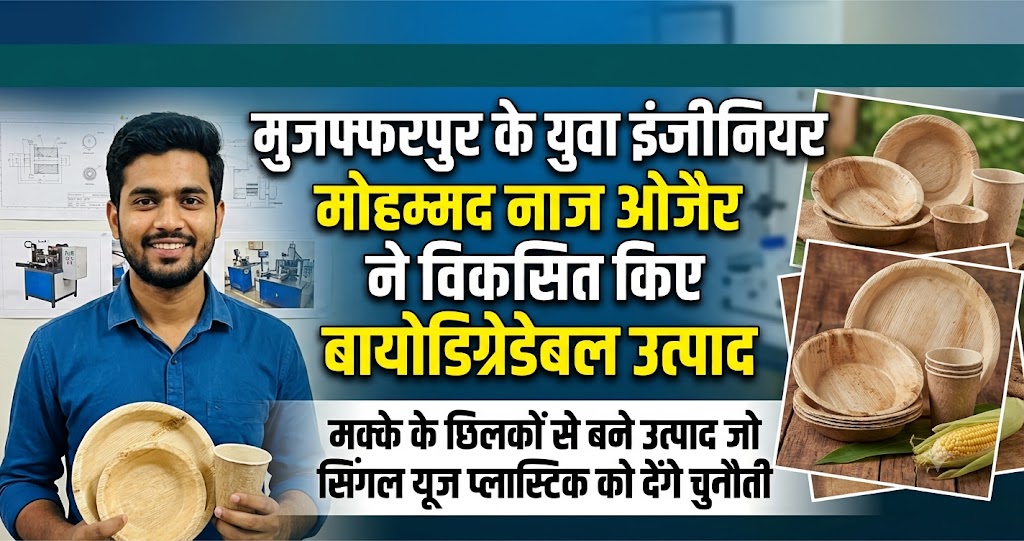
Young Engineer from Muzaffarpur Develops Biodegradable Products from Corn Husks, Offering a Sustainable Alternative to Single-Use Plastic
Muzaffarpur: A young engineer from Bihar's Muzaffarpur district has set an inspiring example in the field of environmental conservation and indigenous innovation. Mohammad Naaz Ozair, a resident of Muradpur village in the Maniyari area, has developed biodegradable products using corn husks, providing a sustainable alternative to single-use plastic. His innovation is not only helping address the growing problem of plastic pollution but also has the potential to create new income opportunities for farmers and strengthen the rural economy.
A Vision for Environmental Protection
Plastic pollution has become one of the world's most pressing environmental challenges. Rivers, agricultural land, forests, and marine ecosystems are increasingly affected by plastic waste. Governments across India have been promoting the reduction and elimination of single-use plastics, and in this context, Mohammad Naaz Ozair's innovation offers a practical and eco-friendly solution.
He explained that after harvesting maize, farmers often consider corn husks to be agricultural waste. These husks are either burned or discarded in the fields, contributing to environmental pollution. Inspired by the idea of converting agricultural waste into useful products, he began working on a sustainable solution.
Applying Engineering Knowledge for Social Good
During his engineering studies, Mohammad Naaz Ozair developed a keen interest in environmental conservation, waste management, and sustainable development. This inspired him to explore ways to transform agricultural residues into eco-friendly materials that could replace plastic products.
After months of research, experimentation, and testing, he successfully developed a process to manufacture durable, lightweight, and completely biodegradable products from corn husks.
Products Developed from Corn Husks
Using his innovative technique, Mohammad Naaz Ozair has produced a variety of environmentally friendly products, including:
Disposable plates
Bowls
Food trays
Packaging sheets
Carry packaging materials
Decorative items
Organic fiber-based utility products
These products naturally decompose within a short period after disposal, making them a far more sustainable choice than conventional plastic items.
A New Source of Income for Farmers
Experts believe that if this technology is adopted on a larger scale, maize farmers could earn additional income by selling corn husks, which are currently treated as waste. Instead of burning or discarding these agricultural residues, farmers could supply them as raw materials for biodegradable product manufacturing.
This would not only increase farmers' earnings but also encourage efficient utilization of agricultural waste while supporting rural industries.
Employment Opportunities in Rural Areas
According to Mohammad Naaz Ozair, large-scale commercialization of this technology could generate employment for thousands of young people.
Processing corn husks, manufacturing biodegradable products, packaging, and marketing could all be carried out in rural areas, creating local employment opportunities and reducing migration to cities.
Why This Innovation Matters
One of the biggest drawbacks of single-use plastic is that it takes hundreds of years to decompose. In contrast, products made from corn husks are completely biodegradable and naturally return to the soil after use without causing environmental harm.
The widespread adoption of these products could:
Reduce plastic pollution
Protect soil and water resources
Lower carbon emissions
Promote efficient use of agricultural waste
Support India's environmental sustainability goals
A Model of Indigenous Innovation
Mohammad Naaz Ozair's work represents a successful example of indigenous innovation built on locally available agricultural resources. Instead of relying on expensive imported materials, he utilized an abundant agricultural by-product found in villages across India.
He believes that India has enormous potential for agriculture-based innovation and that scientific utilization of local resources can contribute significantly to the vision of an Atmanirbhar Bharat (Self-Reliant India).
Appreciation from the Community
His initiative has received appreciation from local residents, educators, environmentalists, and social organizations. Many believe that his work demonstrates how modern education and technology can be used to address real-world environmental challenges.
Experts also suggest that if such innovations receive support through government schemes, startup initiatives, and industrial partnerships, Bihar could emerge as a major hub for green innovation.
Expectations from Government and Industry
Environmental experts recommend providing innovators like Mohammad Naaz Ozair with financial assistance, technical support, patent facilitation, and market access. Programs such as Startup India, Make in India, and agriculture-based industrial development schemes could help scale up this technology.
Research institutions and universities are also encouraged to support similar innovations that promote sustainable manufacturing and environmental conservation.
An Inspiration for Young Innovators
Mohammad Naaz Ozair's success proves that meaningful innovation is not confined to large cities or advanced laboratories. With determination, creativity, and a commitment to solving real-world problems, even a young engineer from a rural village can make a significant impact.
His journey serves as an inspiration for aspiring innovators who wish to combine science, technology, and sustainability for the benefit of society.
By transforming corn husks into biodegradable products, Mohammad Naaz Ozair has demonstrated that environmental protection and economic development can go hand in hand. His innovation has the potential to become a practical alternative to single-use plastics while creating new opportunities for farmers, generating rural employment, and promoting sustainable industrial growth.
If supported and adopted on a larger scale, this homegrown technology could contribute significantly to India's efforts toward a cleaner environment, a stronger rural economy, and a more sustainable future.


