
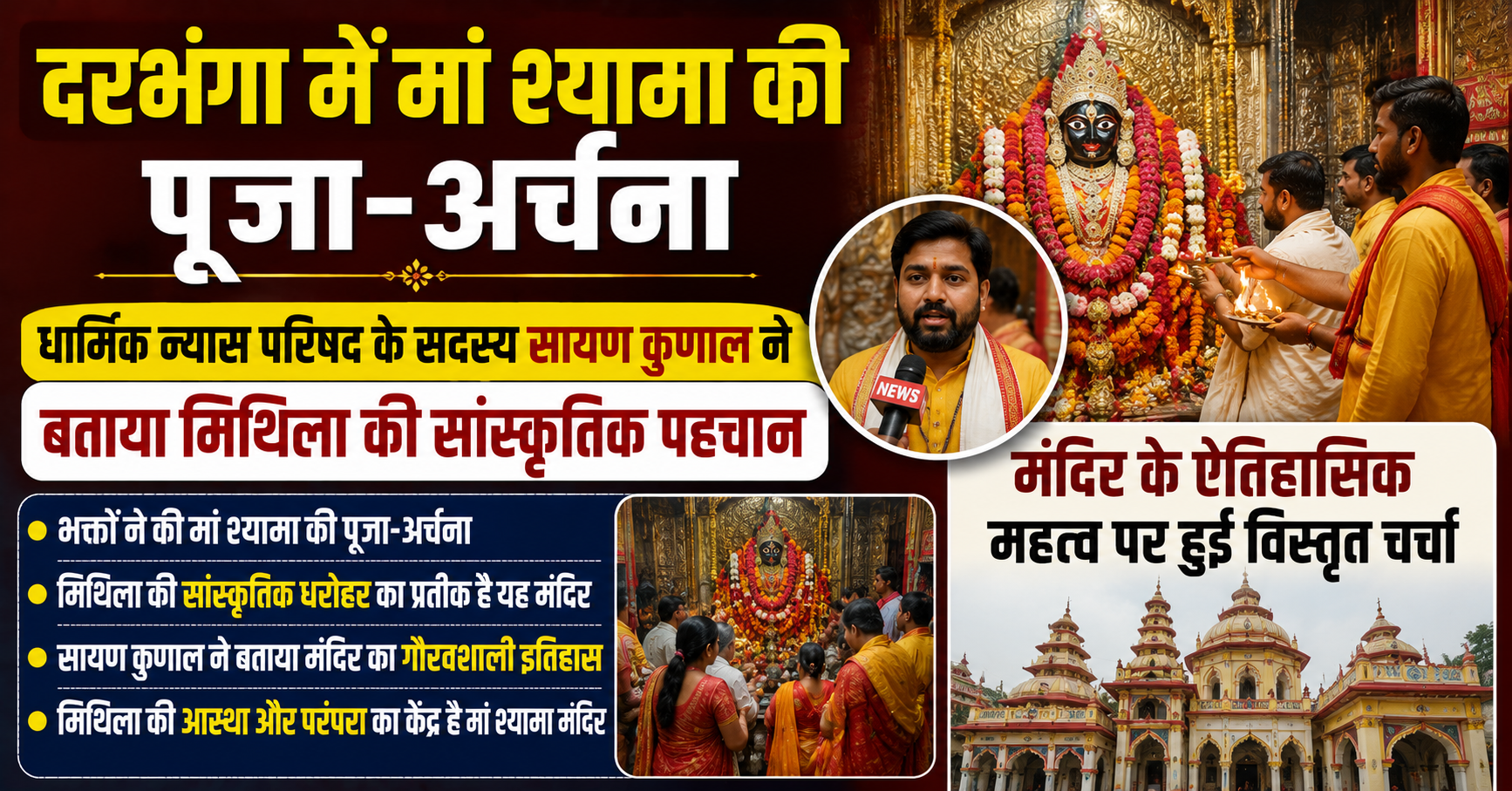
Worship of Maa Shyama in Darbhanga, Religious Trust Board Member Sayan Kunal Calls It a Symbol of Mithila’s Cultural Identity; Detailed Discussion on Temple’s Historical Significance
Darbhanga News:
On Saturday in Darbhanga, a devotional and cultural atmosphere was witnessed as Sayan Kunal, a member of the Bihar State Religious Trust Board, offered prayers at the renowned Maa Shyama Temple. On this occasion, he described Maa Shyama not merely as a deity but as a symbol of Mithila’s cultural identity and spiritual heritage. The event was attended by local scholars, priests, and devotees, where detailed discussions were held on the temple’s religious, cultural, and historical importance.
During the worship ceremony, the environment became deeply spiritual with Vedic chanting. Devotees offered prayers to Maa Shyama and sought blessings for peace and prosperity in the region. Scholars present at the event highlighted the temple’s traditions, historical evolution, and its role in preserving Mithila’s rich religious heritage.
Maa Shyama as a Center of Faith and Culture in Mithila
Sayan Kunal said that the Maa Shyama Temple is a major center of faith in the Mithila region and has been a symbol of devotion for centuries. He emphasized that understanding Mithila’s culture, traditions, and religious identity is incomplete without acknowledging the significance of this temple.
He added that the temple is not just a place of worship but also represents social unity, cultural heritage, and spiritual consciousness. Devotees visiting the temple experience not only religious faith but also a strong sense of cultural belonging.
Discussion on Religious and Historical Importance
Scholars present at the event elaborated on the historical significance of the Maa Shyama Temple. They explained that it is an integral part of Darbhanga’s religious tradition and is associated with several legends and historical beliefs.
They noted that although the structure of the temple may have changed over time, its spiritual significance and devotion among people have remained unchanged. Even today, it continues to serve as a major center of faith and spiritual strength for the local community.
Active Participation of Priests and Scholars
The worship ceremony was conducted with the participation of Pandit Chandrakant Jha, Professor Jaishankar Jha, and several other scholars and priests. Together, they performed the rituals and led the devotional proceedings.
The priests conducted the rituals with Vedic chants and educated devotees about the importance of religious traditions. They stated that such events strengthen spiritual awareness and help people stay connected with their cultural roots.
Emphasis on Mithila’s Cultural Identity
Sayan Kunal highlighted that Mithila’s identity is deeply rooted in its rich cultural and religious traditions. He said that the Maa Shyama Temple stands as a powerful symbol of this identity, binding generations together through faith and unity.
He also remarked that such religious sites are important not only for tourism and cultural studies but also for promoting moral values and social harmony in society.
Atmosphere of Devotion and Enthusiasm Among Devotees
A large number of devotees attended the worship ceremony. People participated in the rituals and offered prayers to Maa Shyama. The entire temple premises were filled with an atmosphere of devotion and spiritual energy.
Devotees expressed that such religious events bring them mental peace and spiritual strength. Many also appreciated the arrangements and the smooth conduct of the ceremony.
Discussion on Religious Tourism Potential
During the event, it was also discussed that the Maa Shyama Temple holds significant potential as a religious tourism destination. Experts suggested that with proper development and promotion, it could attract devotees from across India and abroad.
They noted that the development of religious sites can also boost the local economy and generate employment opportunities in the region.
Message of Social and Cultural Unity
The event conveyed a strong message that religious places are not only centers of worship but also play a vital role in strengthening social unity and cultural harmony. The Maa Shyama Temple ceremony reflected this tradition.
At the conclusion of the program, all attendees prayed for peace, prosperity, and happiness in the region. The organizers stated that similar religious and cultural events would continue in the future to further strengthen Mithila’s cultural heritage.


