
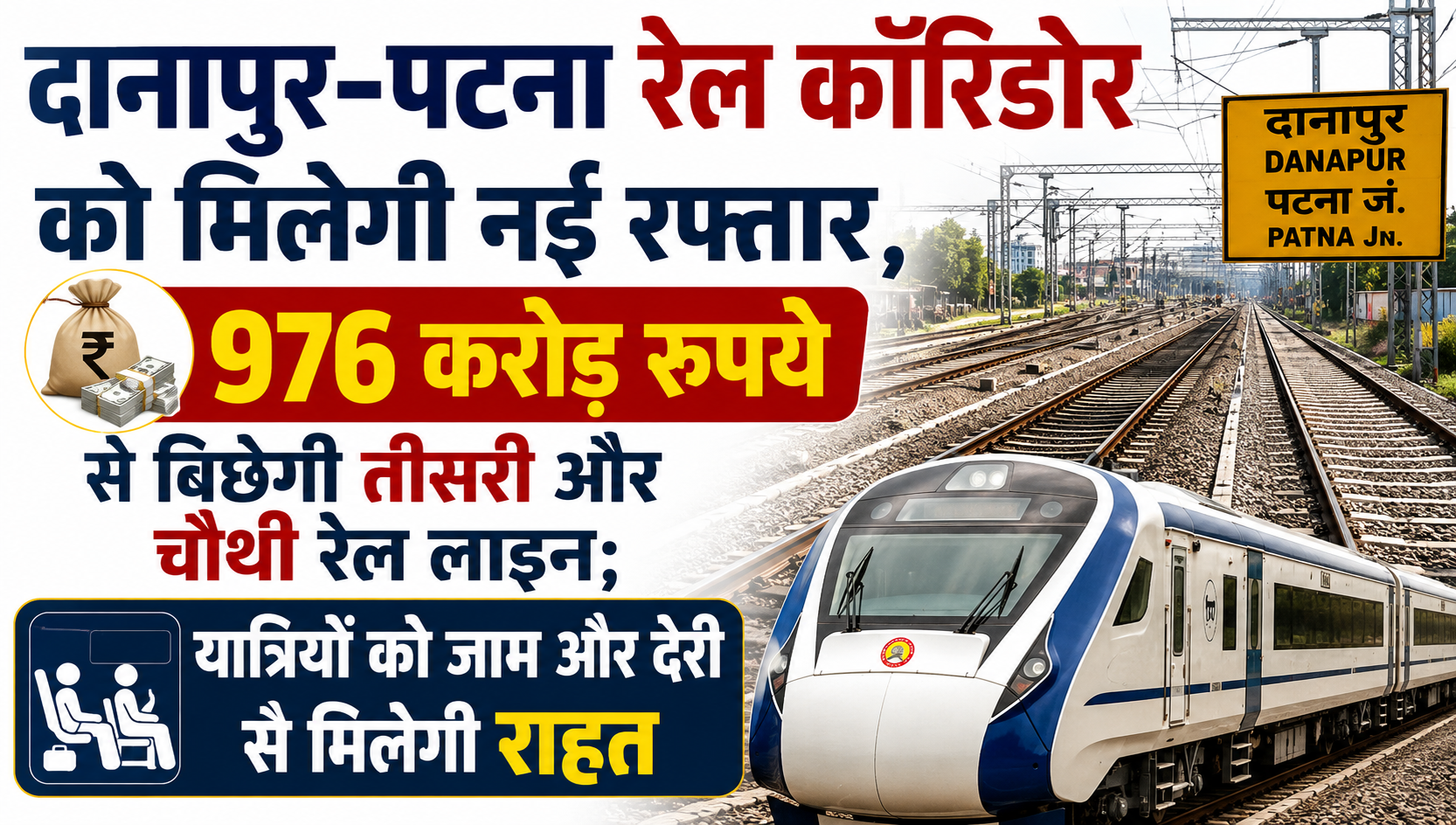
Third and Fourth Railway Lines to Be Laid at a Cost of ₹976 Crore; Passengers to Get Relief from Congestion and Delays
Patna: In a major step toward strengthening the railway network of Bihar’s capital and surrounding areas, the project to lay third and fourth railway lines between Danapur and Patna has been approved. The ambitious project, estimated to cost ₹976 crore, aims to reduce traffic pressure on one of the busiest sections of the Patna rail corridor, improve train punctuality, and provide a better travel experience for passengers.
According to railway officials, the existing double line between Danapur and Patna carries a large number of express, superfast, passenger, MEMU, and freight trains every day. Due to continuously increasing traffic, trains often have to wait for signals, leading to delays. The construction of the new third and fourth lines is expected to significantly reduce this problem.
One of the Busiest Rail Sections
The Danapur–Patna section is considered one of the most important and busiest stretches under the East Central Railway zone. It serves as a key route for trains connecting Delhi, Mumbai, Kolkata, Prayagraj, Varanasi, Lucknow, Ranchi, Gaya, Dhanbad, and the northeastern states.
Hundreds of trains pass through this section daily. With the steady rise in passenger numbers and freight operations, the existing two tracks have come under heavy capacity pressure. This is why the Railways has long been planning to expand the capacity of this route.
₹976 Crore Project
The project, worth approximately ₹976 crore, includes the laying of the third and fourth railway lines, installation of modern signaling systems, track upgrades, construction of necessary bridges, expansion of electrical infrastructure, and various safety-related works.
The Railways’ objective is not only to add extra tracks but also to prepare the entire rail corridor for future growth in traffic demand. Once completed, the operational capacity of this section is expected to increase substantially.
Improvement in Train Punctuality
At present, heavy traffic often forces trains to halt between Danapur and Patna. One train must wait until another clears the section, resulting in delays.
With the new lines in place, different categories of trains can be operated in a more organized manner. It will become easier to manage separate movement patterns for express, passenger, and freight trains, increasing the likelihood of trains running on time.
Direct Benefit for Passengers
The biggest beneficiaries of this project will be millions of rail passengers. Travelers commuting between Patna, Danapur, Ara, Buxar, Pandit Deen Dayal Upadhyay Junction (Mughalsarai), Gaya, and other cities are expected to experience fewer delays.
In addition, the Railways will be able to introduce new train services on this section more easily in the future, increasing the availability of transport options for passengers.
Faster Freight Movement
The Danapur–Patna section is not only important for passenger trains but also for freight transportation. Freight trains serving several industrial areas of Bihar, Jharkhand, and eastern India operate through this route.
The additional railway lines will ensure smoother freight movement, helping industries receive goods on time and improving transportation efficiency. This is also expected to reduce logistics costs and support commercial activities.
Expansion of Patna Rail Corridor Capacity
Railway experts believe that train traffic and passenger demand on the Patna rail corridor will continue to grow in the coming years. The additional tracks will therefore play a crucial role in meeting future requirements.
The new lines will provide greater operational flexibility, and in case of technical or operational disruptions, alternative tracks will be available. This will enhance the reliability of the railway network.
Use of Modern Technology
The project will employ advanced railway engineering technologies. High-quality rails, concrete sleepers, modern signaling systems, and automated safety equipment will be used in track construction.
Where necessary, railway bridges and overbridges will also be constructed or expanded to ensure safe and uninterrupted train operations.
Boost to the Local Economy
Such a large infrastructure project is expected to generate thousands of direct and indirect employment opportunities during the construction phase. Engineers, technicians, construction workers, machine operators, and many others are likely to benefit.
After completion, improved rail connectivity will support trade, tourism, education, and healthcare services. Easier travel to and from Patna is also expected to benefit local markets and businesses.
New Momentum for Regional Development
Better rail connectivity is a key driver of economic development. The expansion of the Danapur–Patna rail line will strengthen connections between various districts of Bihar and improve the investment climate.
Enhanced railway infrastructure is expected to positively impact industrial growth, transportation of agricultural produce, and the service sector, giving a new boost to the state’s overall economic development.
Part of Railways’ Long-Term Strategy
The Ministry of Railways is working on several projects across the country to increase the capacity of busy rail routes. The Danapur–Patna third and fourth line project is part of this broader strategy to make the railway network more capable, safer, and future-ready.
Experts believe that this project will become a significant achievement for the East Central Railway and will play an important role in handling increasing rail traffic in the coming years.
The construction of the third and fourth railway lines between Danapur and Patna at a cost of ₹976 crore is a major step forward for Bihar’s railway infrastructure. The project is expected to improve train punctuality, reduce congestion, provide better passenger facilities, and make freight transportation faster and more efficient. It is also likely to generate employment, encourage business activities, and accelerate regional economic growth. Once completed, the Patna rail corridor will move closer to becoming one of the country’s more modern and higher-capacity railway networks.


