
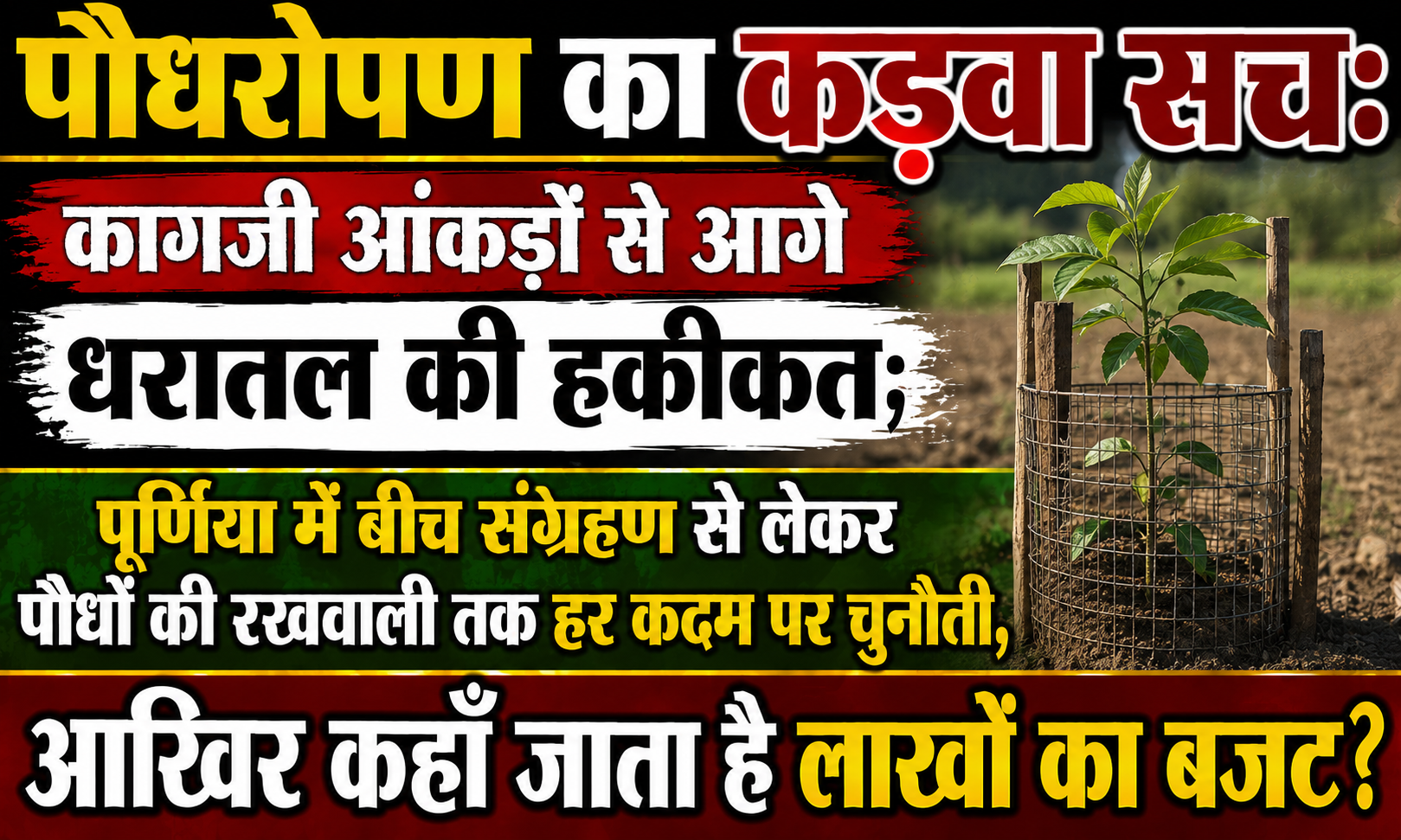
The Bitter Truth of Tree Plantation: Ground Realities Beyond Paper Statistics; Purnia Campaign Highlights Challenges at Every Step from Seed Collection to Plant Protection—Where Does the Lakhs-Rupee Budget Actually Go?
Purnia (Bihar): To safeguard the environment, combat global warming, and make the earth lush and green, large-scale tree plantation campaigns are conducted nationwide every year. Governments and various departments claim to plant lakhs and crores of saplings annually, but have we ever tried to find out how many of those saplings actually manage to grow into trees? Under 'Hindustan's' special investigation and campaign 'The Truth About Tree Plantation', the ground reality emerging from Purnia is enough to expose these claims.
According to the report by Purnia's correspondent, from seed collection in nurseries to the final stage of planting and their subsequent proper care, every single step involves nothing but expenditure. However, an even greater and tougher challenge is their maintenance and protection. Typically, with whatever fanfare saplings are planted in the initial days of a campaign, within a few months they fall victim to administrative and departmental apathy. Let us explore the journey of saplings from birth to becoming trees, the realities of financial management, and the obstacles in their conservation through Purnia's special campaign 'The Truth About Tree Plantation'.
The Beginning of the Campaign: The Costly Journey from Seed Collection to Nursery
The entire process of tree plantation is not as simple as it appears on paper. A thriving sapling must pass through several rigorous stages before it is ready.
The Challenge of Quality Seed Collection: The first and most critical stage is the collection of high-grade seeds from forests or protected trees. This requires skilled workers who can select the right seeds at the right time.
Maintenance and Manure-Watering in Nurseries: Once seeds are acquired, they are sown in nurseries using scientific methods. Preparing the soil, applying manure, regular irrigation, and spraying pesticides to protect them from pests—all these processes consume a heavy budget. After months of hard work, when saplings are ready for planting, they finally become eligible to be transferred to the ground.
The Main Phase of Plantation: Transportation and Labor Costs
Extracting saplings from the nursery and transporting them to targeted sites (roadside boundaries, government premises, forests, or panchayat areas) is a massive logistical task in itself.
Transportation and Cartage Expenses: Transporting saplings safely without damage is expensive. Coupled with digging pits, labor wages, and expenditures incurred during the actual planting, these factors significantly inflate the financial figures of the campaign.
Pressure to Meet Targets: Forest departments and other related departments face targets to plant lakhs of trees every year. Due to this pressure, saplings are often planted in a rush, without paying adequate attention to their geographical suitability.
The Biggest Challenge: Maintenance and Protection of Saplings
According to experts and ground reports, planting saplings accounts for only 30 percent of the work; the real challenge lies in the remaining 70 percent, which is their maintenance and protection.
Lack of Tree Guards and Water: In regions like Purnia, regular watering of saplings during summers and other months is essential. Due to budget constraints or lack of monitoring, many saplings dry up for want of water. Furthermore, stray cattle (cows, goats, etc.) grazing on the saplings pose the greatest threat. Without robust tree guards or fencing, saplings are destroyed within days.
Lack of Accountability: Departments consider their job done once saplings are planted, but no ground-level accountability is fixed for their upkeep. This is why out of every 100 saplings planted, hardly 20 to 30 survive, while the rest perish merely on paper.
Paper Statistics vs. Ground Reality
Under this campaign running in Purnia, it has come to light that large-scale plantations are carried out at the end of financial years merely to exhaust budgets, while the monitoring of their survival rate is exceptionally weak.
Proper Utilization of Funds or a Mere Formality: Crores of rupees are spent annually in the name of the environment; if this is utilized properly and geo-tagging along with regular care of the saplings is ensured, the atmosphere of Purnia and surrounding districts could improve significantly.
Lack of Public Participation: Unless local citizens, schools, and panchayats are directly integrated into this campaign, achieving 100 percent success solely through government efforts remains impossible.
'Hindustan's' special campaign 'The Truth About Tree Plantation' has made it clear that planting trees in Purnia is as easy as it looks, but keeping them alive is an equally massive struggle. While heavy expenses are involved from seed collection to nursery care, transportation, and planting, without proper maintenance, all this investment proves futile. What is required is that departments should not merely focus on paper statistics of planting trees, but instead formulate a robust action plan for their conservation—only then can the real objective of this campaign be fulfilled and our earth made lush and green.


