
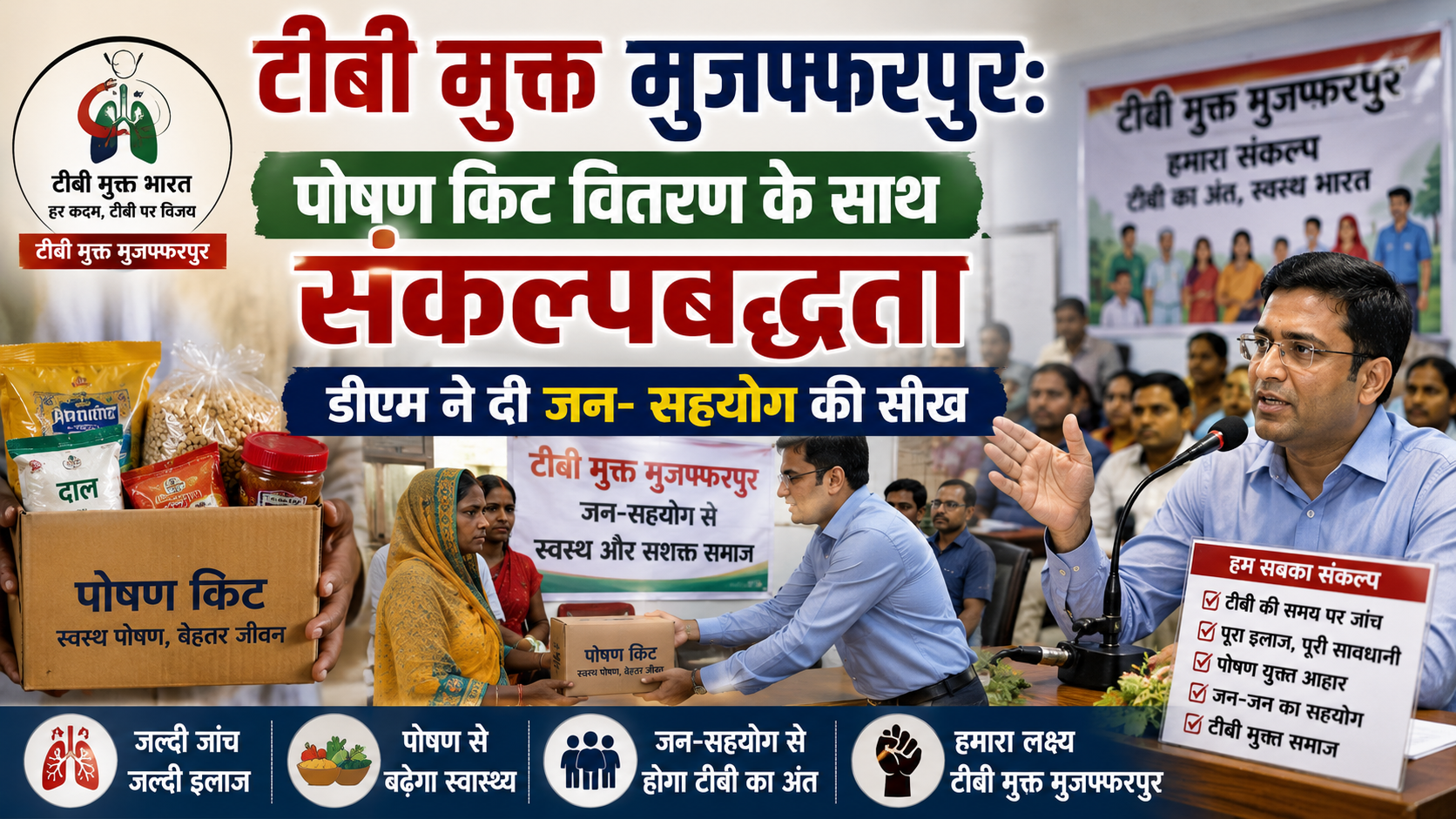
TB-Free Muzaffarpur: Commitment Alongside Nutrition Kit Distribution; DM Emphasizes Community Cooperation
A new wave of energy regarding the 'TB-Free India' (Nikshay Mitra Abhiyan) campaign has emerged in Muzaffarpur, Bihar. Recently, as a result of the solidarity of social organizations and active efforts by the administration, nutrition kits were distributed among 150 TB patients. This initiative not only provides support to the patients but is also a major step toward changing society's perception of a disease often considered incurable.
The Main Objective: Nutrition Along with Medication
District Magistrate (DM) Kumar Gaurav actively participated in the nutrition kit distribution program. In his address, he emphasized a crucial point: "Treatment for TB does not depend solely on medicine; balanced nutrition is essential."
It is often observed that TB patients take their medication but suffer from weakness due to a lack of essential nutrients in their bodies. This joint effort by the administration and social organizations is acting as a shield for those patients who were unable to afford a nutritious diet due to financial constraints.
New Hope for 150 Patients
During the program, nutrition kits were handed over to 150 selected patients. These kits contain all the essential items that can accelerate the recovery rate of a TB patient, such as:
Protein-rich pulses and soybeans.
Peanuts and jaggery (sources of iron and energy).
Grains (Sattu, chickpeas, etc.).
Vitamins and other micronutrients.
These kits will not only provide better nutrition to the patients but also give them the physical strength to combat the side effects of the medication.
Role of Social Organizations: An Example of Solidarity
In TB eradication, the contribution of social organizations (NGOs) along with government efforts is indispensable. Various organizations in Muzaffarpur have become 'Nikshay Mitras' and adopted patients. Their solidarity demonstrates that TB is not just the responsibility of the government, but a collective accountability of the entire society. The work of these organizations is not limited to kit distribution; they are also monitoring the regular counseling of patients and their compliance with medication.
TB-Free India: Challenges and Solutions
The Government of India aims to make India TB-free by 2025. The Muzaffarpur administration is constantly striving to translate this goal into reality on the ground. From the points emphasized by DM Kumar Gaurav, it is clear that three key pillars are essential for TB control:
Awareness: Educating people about TB symptoms (such as cough lasting more than two weeks, weight loss, night sweats).
Continuity: Explaining to patients that interrupting the course of medication—which lasts six to nine months—can be dangerous (due to the risk of Drug-Resistant TB).
Nutrition: Ensuring the availability of nutritious food to economically disadvantaged patients.
Need to Eradicate Social Stigma
The 'stigma' prevalent in society regarding TB patients remains a major obstacle. Many patients hide their illness for fear of social repercussions, which not only puts their own lives at risk but also spreads the infection to others. In his address, the DM appealed to the public to treat TB patients with empathy. When society embraces these patients, they will come forward for treatment without hesitation.
Future Roadmap
The next goal of the Muzaffarpur administration is to reach the last TB patient in the district. To achieve this, the administration has:
Planned to organize TB screening camps at every block level.
Encouraged local representatives to become 'Nikshay Mitras.'
Monitored the progress of patients' treatment through digital tracking.
This nutrition kit distribution program in Muzaffarpur has emerged as a successful 'model.' It proves that when administrative willpower and the spirit of social service combine, even the greatest challenges can be overcome. The dream of a TB-free Muzaffarpur will not be fulfilled until we all become 'Nikshay Mitras' and support one another. This initiative has brought happiness to these 150 families and serves as a message to the entire district that every individual's participation is crucial in building a healthy society.


