
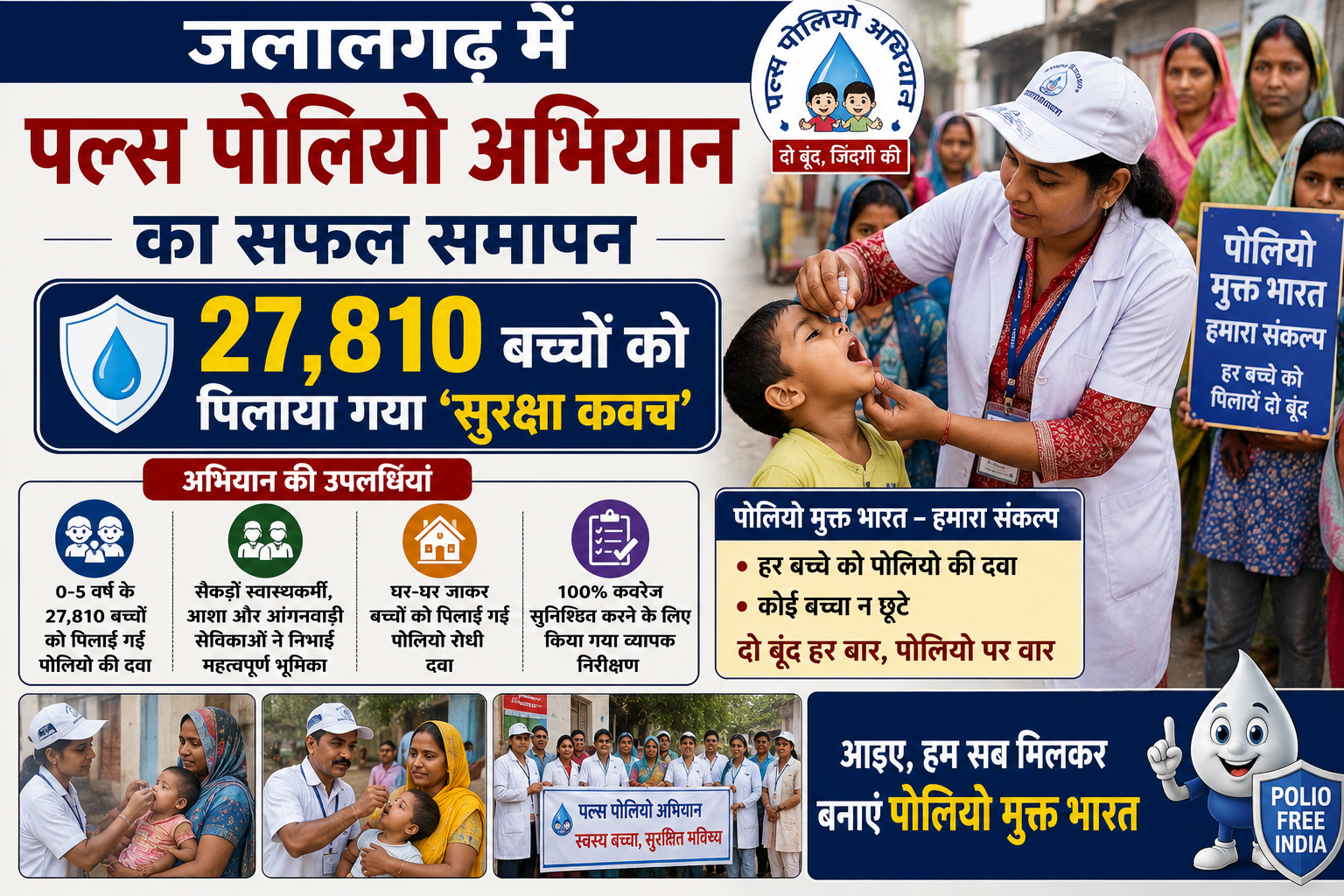
Successful Conclusion of Pulse Polio Campaign in Jalalgarh: 27,810 Children Administered 'Shield of Protection'
Jalalgarh (Purnia). Committed to completely eradicating the incurable disease of polio, the Pulse Polio vaccination campaign has concluded successfully in the Jalalgarh block. According to data released by the Health Department, a total of 27,810 children were administered polio drops during this five-day intensive drive, providing them with a vital shield of protection for life. The campaign, which commenced on June 28, 2026, ran on a war footing across the entire block until July 2, 2026.
Door-to-Door Knocking: The Resolve of Healthcare Workers
Healthcare teams remained fully active on the ground to realize the dream of a polio-free India. Defying scorching heat and challenging conditions, healthcare workers went door-to-door to administer polio drops to children aged zero to five, not just in central residential areas but also in the remote and hard-to-reach pockets of the block.
Team members made dedicated efforts to reach every child requiring the vaccine. In instances where children were unavailable at home during the initial visit, workers returned to those households to ensure no child was left unvaccinated.
'No Child Left Behind, No Break in the Safety Chain'
The success of the campaign can be attributed to the comprehensive action plan laid out by the Health Department. The Medical Officer-in-Charge of the block's Primary Health Center stated that a detailed 'micro-plan' was devised to achieve the set target. Under this strategy:
Monitoring Teams: Special monitoring units were set up in every panchayat to constantly oversee the vaccination progress.
Missed Cases: During the final two days of the campaign, special emphasis was placed on children who were not found at home initially or whose houses were locked.
Focus on Migrant Populations: Tracking and vaccinating children living in temporary settlements, brick kilns, and construction sites was a major challenge that the department successfully met.
Special Strategy for Locked Houses and Out-of-Home Families
One of the biggest hurdles during the campaign was dealing with 'locked houses' where families had gone out for work. Adapting dynamically to the situation, the Health Department modified its strategy to conduct late-evening follow-up drives. Healthcare workers compiled a list of locked households across various neighborhoods and rural areas. On the final day of the drive, a special sweep was conducted to bring the children of these households into the safety net.
Impact of Public Participation and Awareness
A high level of awareness was witnessed among the residents of Jalalgarh this time. Parents stepped forward proactively to get their children vaccinated. At several places, social workers and ASHAs (Accredited Social Health Activists) went from house to house to sensitize parents about the importance of polio eradication, which ultimately made it possible to reach close to a 100 percent target.
The Way Forward: Continuous Vigilance
Although the official five-day campaign wrapped up on July 2, the Health Department remains highly vigilant. The Medical Officer-in-Charge mentioned that close monitoring will continue over the next few days in areas with even a minor risk of vulnerability. Furthermore, groundwork for the next phase of the vaccination drive has already begun.
The vaccination of 27,810 children is not merely a statistic; it represents a triumph of coordination between the Health Department and civil society. Polio eradication stands as one of the greatest achievements in India's public health history. The promptness and dedication demonstrated by the Jalalgarh block administration and its healthcare workers set an exemplary standard for other regions.